Zajecka John M, Stanford Arielle D, Memisoglu Asli, Martin William F, Pathak Sanjeev
Department of Psychiatry, Rush University Medical Center, Chicago, IL, USA,
Psychiatric Medicine Associates, LLC, Skokie, IL, USA,
Neuropsychiatr Dis Treat. 2019 Apr 4;15:795-808. doi: 10.2147/NDT.S199245. eCollection 2019.
The endogenous opioid system is a fundamental regulator of mood in humans. Previously reported clinical trials have demonstrated the efficacy of the investigational agent buprenorphine/samidorphan (BUP/SAM) combination, an opioid-system modulator, for the adjunctive treatment of major depressive disorder. We present here a third phase III study of different design.
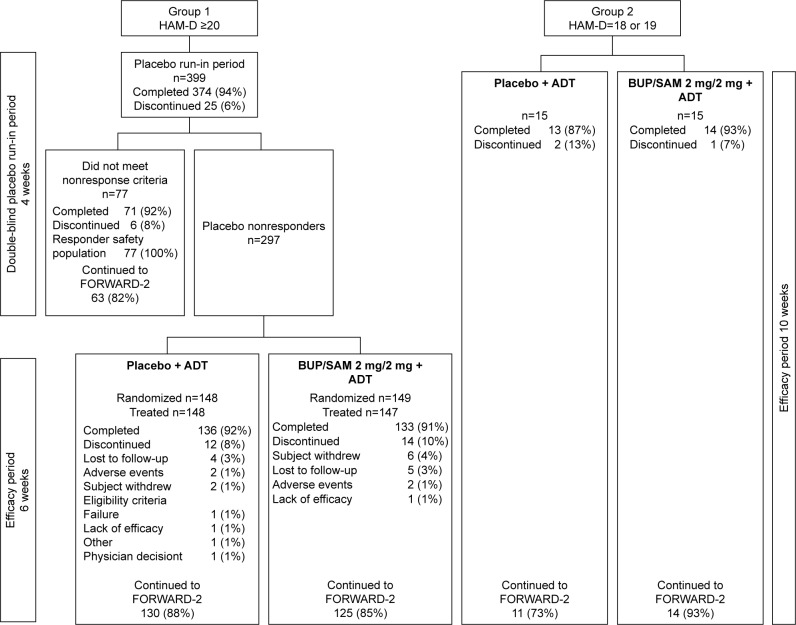
Adult patients with major depressive disorder and inadequate response to antidepressant therapy were enrolled in this double-blind, placebo-controlled, placebo run-in study to evaluate the efficacy, safety, and tolerability of adjunctive BUP/SAM 2 mg/2 mg. Patients with baseline Hamilton Depression Rating Scale score $20 received double-blind placebo in addition to background antidepressant therapy for 4 weeks. Nonresponders were randomized to receive adjunctive BUP/SAM 2 mg/2 mg or placebo for 6 weeks. The primary end point was change in Montgomery-Åsberg Depression Rating Scale (MADRS)-10 total score from randomization at baseline to the end of the 6-week treatment period.
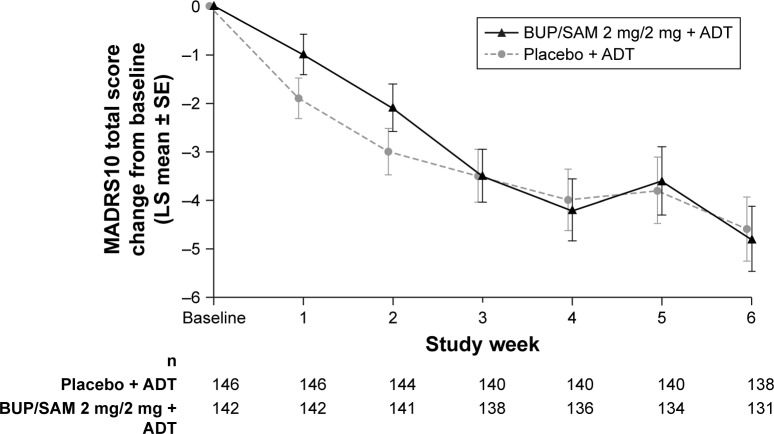
Least-squares mean change in MADRS-10 score at end of treatment was -4.8 (SE 0.67) in the BUP/SAM 2 mg/2 mg group and -4.6 (SE 0.66) in the placebo group (mean difference -0.3 [SE 0.95], =0.782). There were no differences in MADRS-based response or remission rates. Overall, 42.9% of the BUP/SAM 2 mg/2 mg group and 34.5% of the placebo group experienced at least one treatment-emergent adverse event during the 6-week treatment period, most of which were mild or moderate in severity. There were no clinically important changes in laboratory parameters, weight, or vital signs and no evidence of abuse potential during treatment or opiate-withdrawal symptoms post treatment.
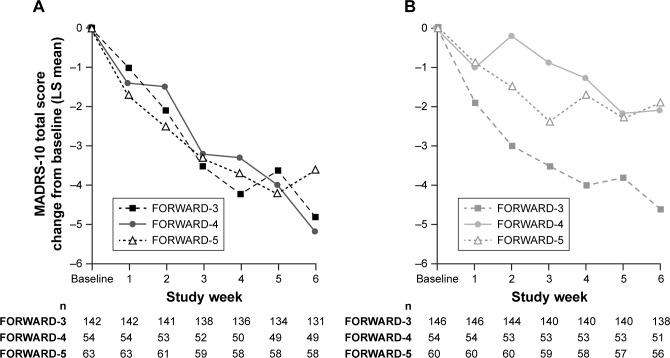
Efficacy results in FORWARD-3 measured by change in MADRS-10 score did not meet the primary end point, but postbaseline improvement in MADRS-10 in the BUP/SAM 2 mg/2 mg group was consistent with that seen in previously reported trials. BUP/SAM 2 mg/2 mg was well tolerated.
内源性阿片系统是人类情绪的基本调节因子。先前报道的临床试验已证明研究药物丁丙诺啡/沙美阿片(BUP/SAM)组合(一种阿片系统调节剂)辅助治疗重度抑郁症的疗效。我们在此展示一项不同设计的III期研究。
将对抗抑郁治疗反应不足的重度抑郁症成年患者纳入这项双盲、安慰剂对照、安慰剂导入期研究,以评估辅助使用2毫克/2毫克BUP/SAM的疗效、安全性和耐受性。基线汉密尔顿抑郁量表评分≥20分的患者在接受背景抗抑郁治疗的同时,接受为期4周的双盲安慰剂治疗。无反应者被随机分配接受辅助使用2毫克/2毫克BUP/SAM或安慰剂治疗6周。主要终点是从基线随机分组到6周治疗期结束时蒙哥马利-Åsberg抑郁量表(MADRS)-10总分的变化。
治疗结束时,2毫克/2毫克BUP/SAM组MADRS-10评分的最小二乘均值变化为-4.8(标准误0.67),安慰剂组为-4.6(标准误0.66)(均值差异-0.3 [标准误0.95],P = 0.782)。基于MADRS的反应率或缓解率无差异。总体而言,在6周治疗期内,2毫克/2毫克BUP/SAM组42.9%的患者和安慰剂组34.5%的患者经历了至少一次治疗中出现的不良事件,其中大多数为轻度或中度严重程度。治疗期间实验室参数、体重或生命体征无具有临床意义的变化,且治疗期间无滥用可能性证据,治疗后也无阿片戒断症状。
FORWARD-3研究中以MADRS-10评分变化衡量的疗效结果未达到主要终点,但2毫克/2毫克BUP/SAM组MADRS-10评分在基线后有所改善,这与先前报道的试验结果一致。2毫克/2毫克BUP/SAM耐受性良好。