Department of Chemistry, University of South Florida, Tampa, FL, 33620, USA.
Single Molecule Study Laboratory, College of Engineering and Nanoscale Science and Engineering Center, University of Georgia, Athens, GA, 30602, USA.
Nat Commun. 2018 Nov 1;9(1):4575. doi: 10.1038/s41467-018-07045-9.
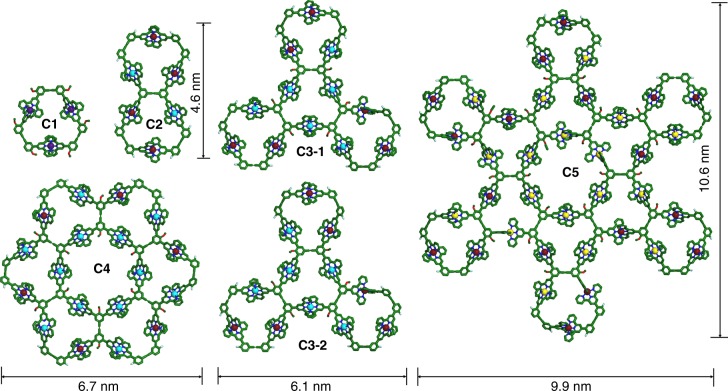
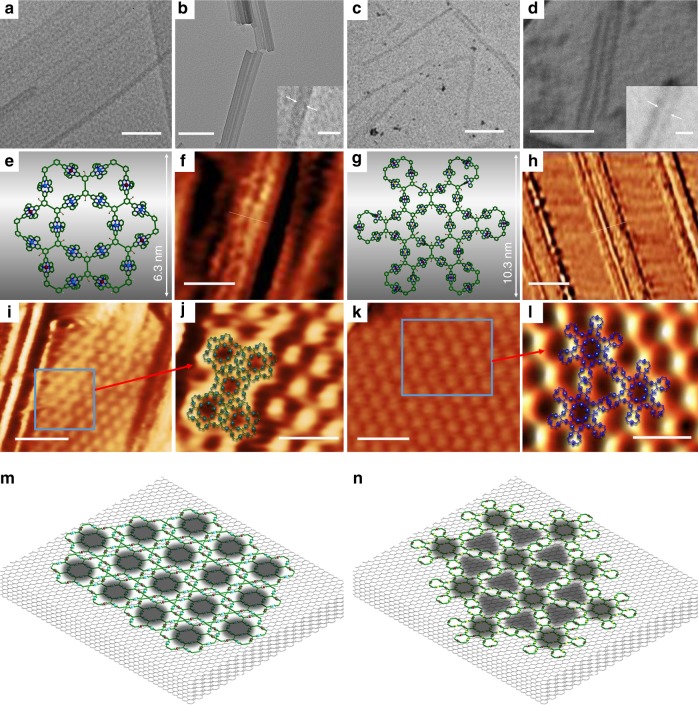
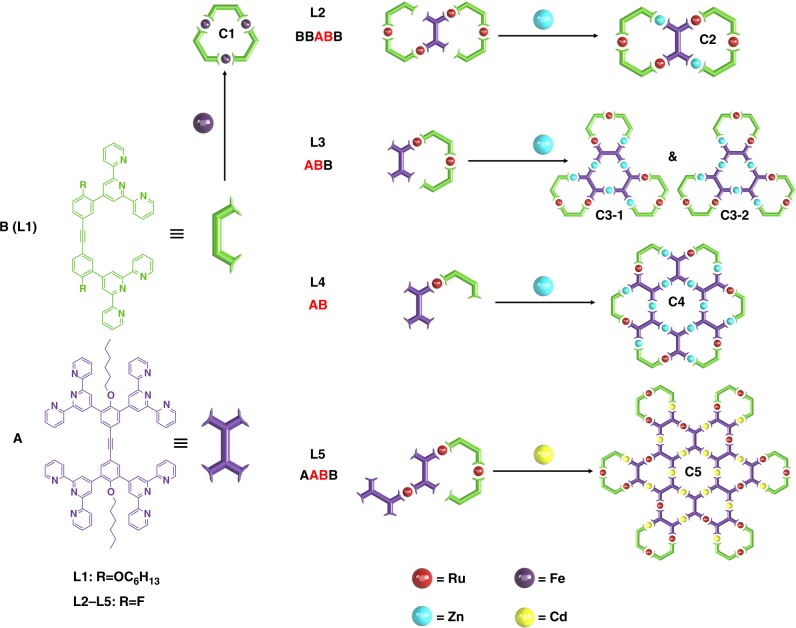
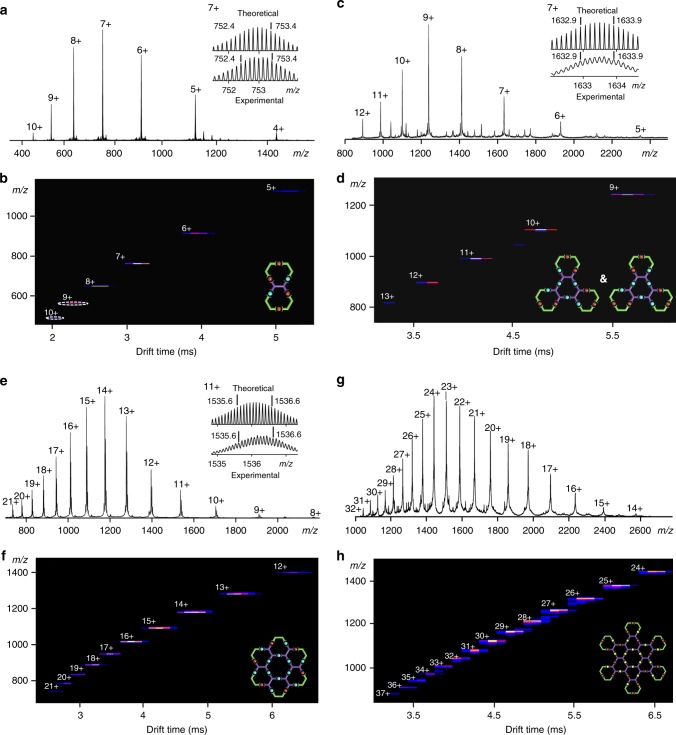
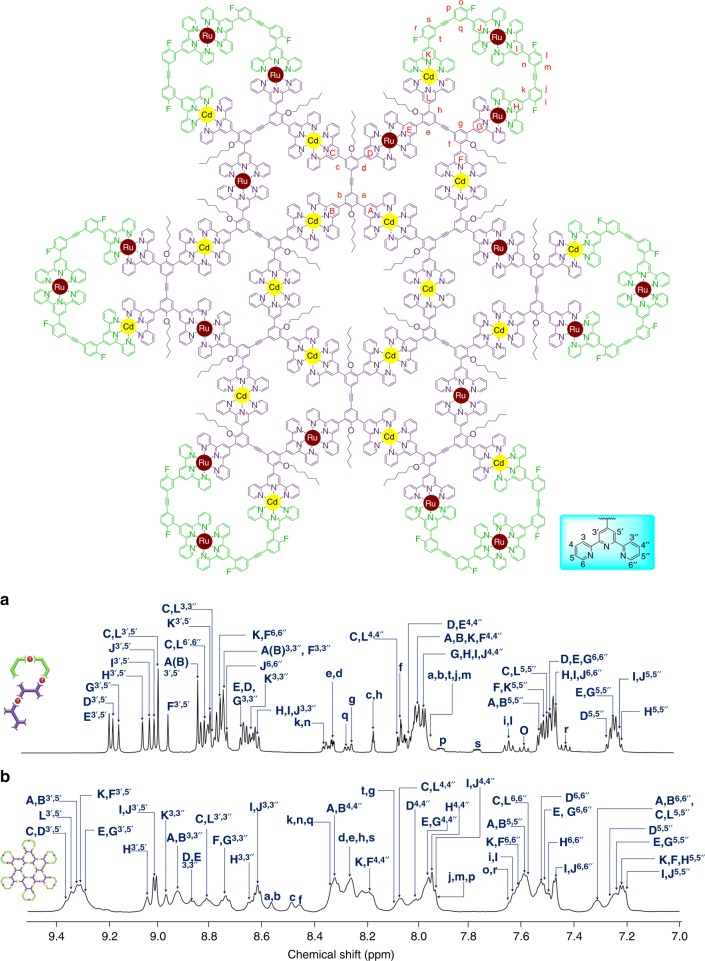
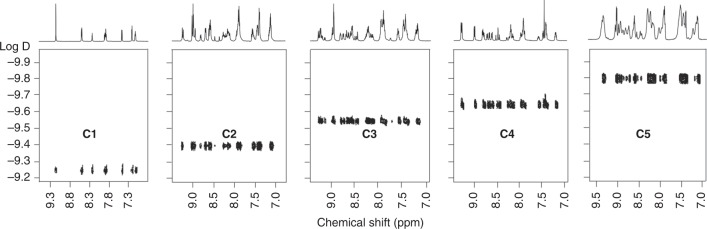
Coordination-driven self-assembly as a bottom-up approach has witnessed a rapid growth in building giant structures in the past few decades. Challenges still remain, however, within the construction of giant architectures in terms of high efficiency and complexity from simple building blocks. Inspired by the features of DNA and protein, which both have specific sequences, we herein design a series of linear building blocks with specific sequences through the coordination between terpyridine ligands and Ru(II). Different generations of polycyclic supramolecules (C1 to C5) with increasing complexity are obtained through the self-assembly with Cd(II), Fe(II) or Zn(II). The assembled structures are characterized via multi-dimensional mass spectrometry analysis as well as multi-dimensional and multinuclear NMR (H, COSY, NOESY) analysis. Moreover, the largest two cycles C4 and C5 hierarchically assemble into ordered nanoscale structures on a graphite based on their precisely-controlled shapes and sizes with high shape-persistence.
协调驱动的自组装作为一种自下而上的方法,在过去几十年中见证了构建巨型结构的快速发展。然而,在从简单的构建块构建巨型结构方面,仍然存在效率和复杂性方面的挑战。受 DNA 和蛋白质的特性启发,它们都具有特定的序列,我们通过三吡啶配体和 Ru(II)之间的配位设计了一系列具有特定序列的线性构建块。通过与 Cd(II)、Fe(II)或 Zn(II)的自组装,得到了具有不同复杂程度的多环超分子(C1 到 C5)。通过多维质谱分析以及多维和多核 NMR(H、COSY、NOESY)分析对组装结构进行了表征。此外,最大的两个环 C4 和 C5 基于其精确控制的形状和尺寸,在石墨上自组装成有序的纳米结构,具有高形状保持性。