Department of Chemistry, University of South Florida, Tampa, Florida 33620, United States.
Department of Materials Science and Engineering, University of North Texas, Denton, Texas 76203, United States.
J Am Chem Soc. 2020 May 27;142(21):9809-9817. doi: 10.1021/jacs.0c03459. Epub 2020 Apr 29.
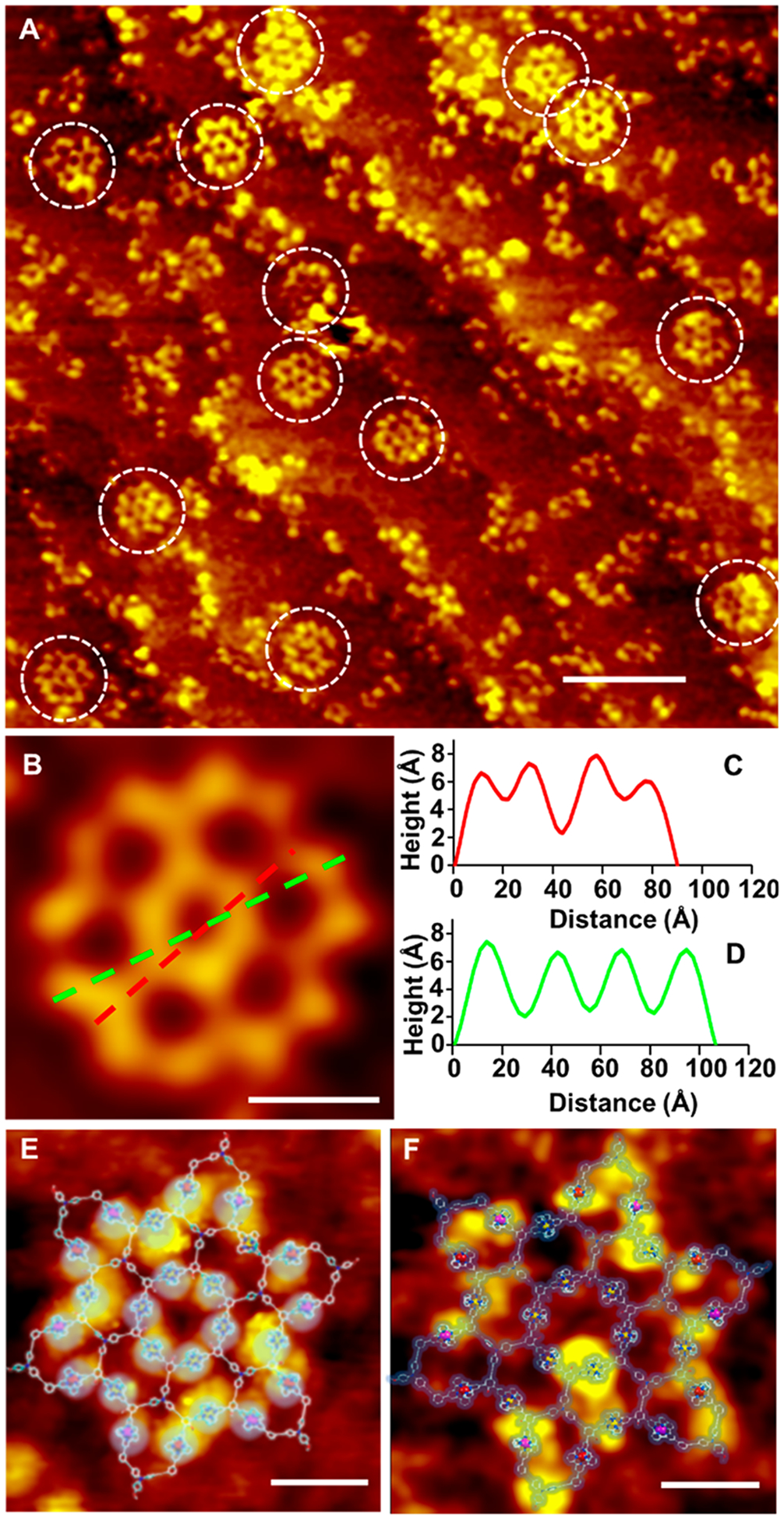
Coordination-driven self-assembly has been extensively employed to construct a variety of discrete structures as a bottom-up strategy. However, mechanistic understanding regarding whether self-assembly is under kinetic or thermodynamic control is less explored. To date, such mechanistic investigation has been limited to distinct, assembled structures. It still remains a formidable challenge to study the kinetic and thermodynamic behavior of self-assembly systems with multiple assembled isomers due to the lack of characterization methods. Herein, we use a stepwise strategy which combined self-recognition and self-assembly processes to construct giant metallo-supramolecules with 8 positional isomers in solution. With the help of ultrahigh-vacuum, low-temperature scanning tunneling microscopy and scanning tunneling spectroscopy, we were able to unambiguously differentiate 14 isomers on the substrate which correspond to 8 isomers in solution. Through measurement of 162 structures, the experimental probability of each isomer was obtained and compared with the theoretical probability. Such a comparison along with density functional theory (DFT) calculation suggested that although both kinetic and thermodynamic control existed in this self-assembly, the increased experimental probabilities of isomers compared to theoretical probabilities should be attributed to thermodynamic control.
配位驱动的自组装已被广泛用于构建各种离散结构作为自下而上的策略。然而,关于自组装是受动力学控制还是热力学控制的机制理解还没有得到充分探索。迄今为止,这种机制研究仅限于不同的组装结构。由于缺乏表征方法,研究具有多种组装异构体的自组装体系的动力学和热力学行为仍然是一个巨大的挑战。在这里,我们使用了一种逐步策略,该策略结合了自识别和自组装过程,在溶液中构建了具有 8 个位置异构体的巨型金属超分子。借助超高真空、低温扫描隧道显微镜和扫描隧道光谱学,我们能够在基底上明确区分出 14 种异构体,这些异构体对应于溶液中的 8 种异构体。通过测量 162 种结构,得到了每种异构体的实验概率,并与理论概率进行了比较。这种比较以及密度泛函理论(DFT)计算表明,尽管自组装中存在动力学和热力学控制,但与理论概率相比,异构体的实验概率增加应归因于热力学控制。