Jessee Matthew B, Buckner Samuel L, Mouser J Grant, Mattocks Kevin T, Dankel Scott J, Abe Takashi, Bell Zachary W, Bentley John P, Loenneke Jeremy P
School of Kinesiology, University of Southern Mississippi, Hattiesburg, MS, United States.
Exercise Science Program, University of South Florida, Tampa, FL, United States.
Front Physiol. 2018 Oct 16;9:1448. doi: 10.3389/fphys.2018.01448. eCollection 2018.
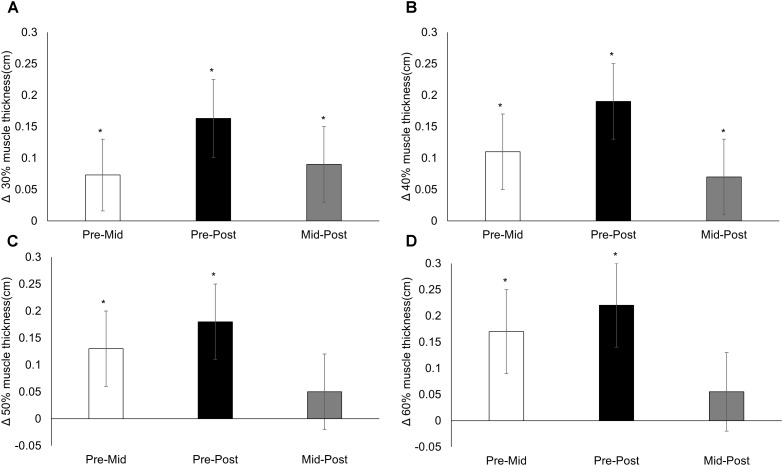
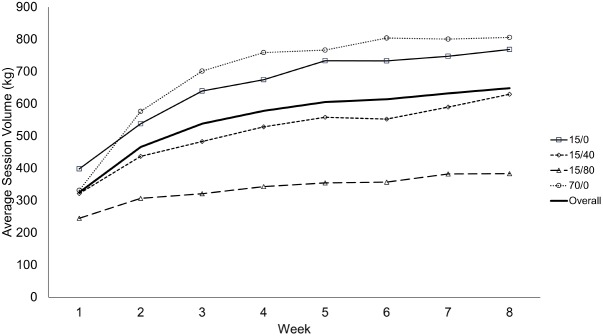
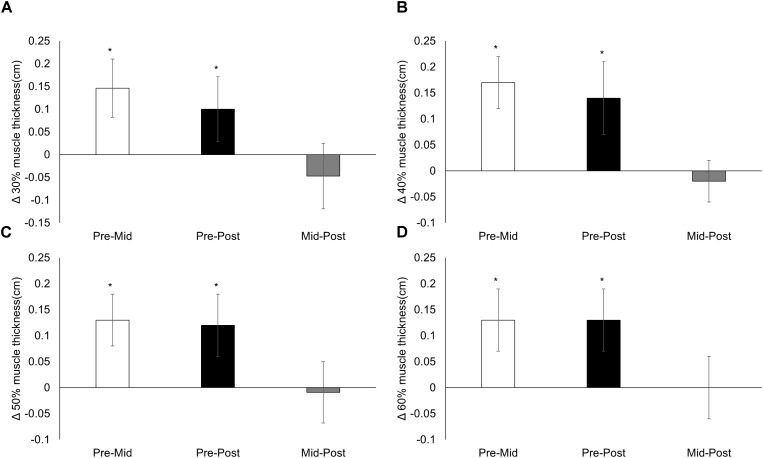
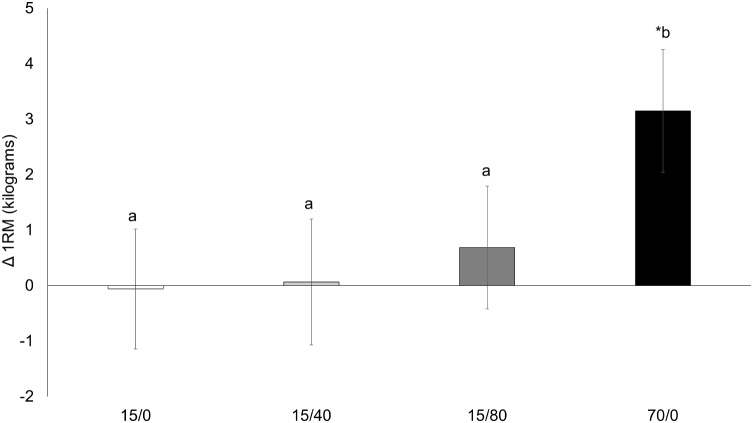
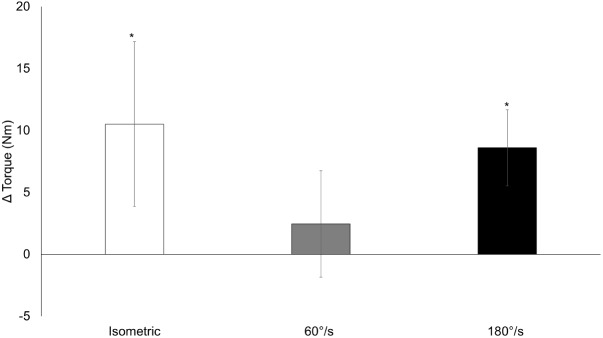
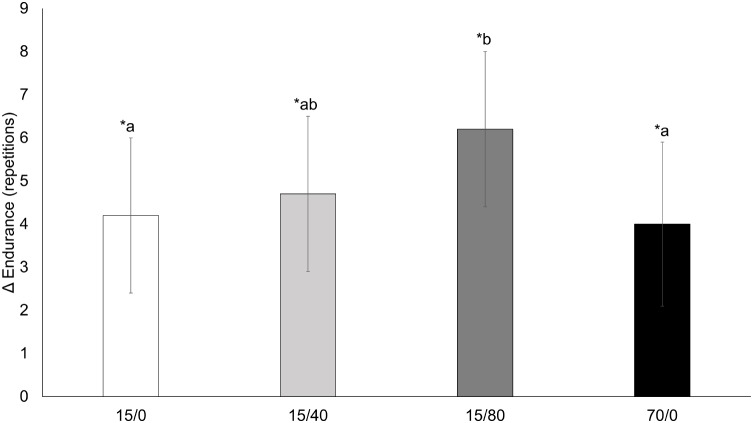
An inability to lift loads great enough to disrupt muscular blood flow may impair the ability to fatigue muscles, compromising the hypertrophic response. It is unknown what level of blood flow restriction (BFR) pressure, if any, is necessary to reach failure at very low-loads [i.e., 15% one-repetition maximum (1RM)]. The purpose of this study was to investigate muscular adaptations following resistance training with a very low-load alone (15/0), with moderate BFR (15/40), or with high BFR (15/80), and compare them to traditional high-load (70/0) resistance training. Using a within/between subject design, healthy young participants ( = 40) performed four sets of unilateral knee extension to failure (up to 90 repetitions/set), twice per week for 8 weeks. Data presented as mean change (95% CI). There was a condition by time interaction for 1RM ( < 0.001), which increased for 70/0 [3.15 (2.04,4.25) kg] only. A condition by time interaction ( = 0.028) revealed greater changes in endurance for 15/80 [6 (4,8) repetitions] compared to 15/0 [4 (2,6) repetitions] and 70/0 [4 (2,5) repetitions]. There was a main effect of time for isometric MVC [change = 10.51 (3.87,17.16) Nm, = 0.002] and isokinetic MVC at 180/s [change = 8.61 (5.54,11.68) Nm, < 0.001], however there was no change in isokinetic MVC at 60/s [2.45 (-1.84,6.74) Nm, = 0.261]. Anterior and lateral muscle thickness was assessed at 30, 40, 50, and 60% of the upper leg. There was no condition by time interaction for muscle thickness sites (all ≥ 0.313). There was a main effect of time for all sites, with increases over time (all < 0.001). With the exception of the 30% lateral site ( = 0.059) there was also a main effect of condition (all < 0.001). Generally, 70/0 was greater. Average weekly volume increased for all conditions across the 8 weeks, and was greatest for 70/0 followed by 15/0, 15/40, then 15/80. With the exception of 1RM, changes in strength and muscle size were similar regardless of load or restriction. The workload required to elicit these changes lowered with increased BFR pressure. These findings may be pertinent to rehabilitative settings, future research, and program design.
无法举起足以中断肌肉血流的负荷可能会削弱使肌肉疲劳的能力,从而影响肥大反应。目前尚不清楚在极低负荷(即15%的一次重复最大值[1RM])下达到疲劳需要何种程度的血流限制(BFR)压力(如果需要的话)。本研究的目的是调查单独进行极低负荷(15/0)、中度BFR(15/40)或高度BFR(15/80)的阻力训练后肌肉的适应性,并将其与传统的高负荷(70/0)阻力训练进行比较。采用组内/组间受试者设计,健康的年轻参与者(n = 40)进行四组单侧膝关节伸展至疲劳(每组最多90次重复),每周两次,共8周。数据以平均变化(95%置信区间)表示。1RM存在条件与时间的交互作用(p < 0.001),仅70/0组的1RM增加[3.15(2.04,4.25)kg]。条件与时间的交互作用(p = 0.028)显示,与15/0组[4(2,6)次重复]和70/0组[4(2,5)次重复]相比,15/80组[6(4,8)次重复]的耐力变化更大。等长最大自主收缩(MVC)存在时间的主效应[变化 = 10.51(3.87,17.16)Nm,p = 0.002],以及180°/秒时的等速MVC存在时间的主效应[变化 = 8.61(5.54,11.68)Nm,p < 0.001],然而60°/秒时的等速MVC没有变化[2.45(-1.84,6.74)Nm,p = 0.261]。在上腿部的30%、40%、50%和60%处评估前侧和外侧肌肉厚度。肌肉厚度部位不存在条件与时间的交互作用(所有p ≥ 0.313)。所有部位均存在时间的主效应,随时间增加(所有p < 0.001)。除30%外侧部位(p = 0.059)外,条件也存在主效应(所有p < 0.001)。一般来说,70/0组更大。在8周内,所有条件下的平均每周训练量都增加了,70/0组最大,其次是15/0组、15/40组,然后是15/80组。除1RM外,无论负荷或限制如何,力量和肌肉大小的变化相似。引发这些变化所需的工作量随着BFR压力的增加而降低。这些发现可能与康复环境、未来研究和项目设计相关。