Medical School, Cancer Research Institute, Key Laboratory of Tumor Cellular and Molecular Pathology of Hunan Province, University of South China, Chang Sheng Xi Avenue 28, Hengyang, 421001, Hunan, People's Republic of China.
Department of Pathology, Central Hospital of Shaoyang, Hunan, China.
Med Microbiol Immunol. 2019 Oct;208(5):573-583. doi: 10.1007/s00430-018-0570-1. Epub 2018 Nov 1.
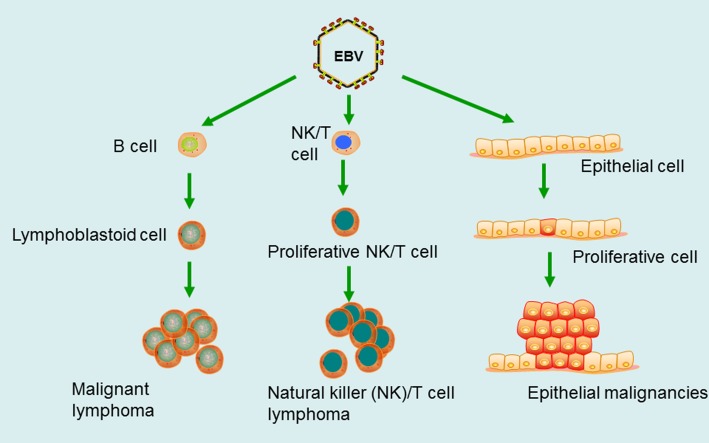
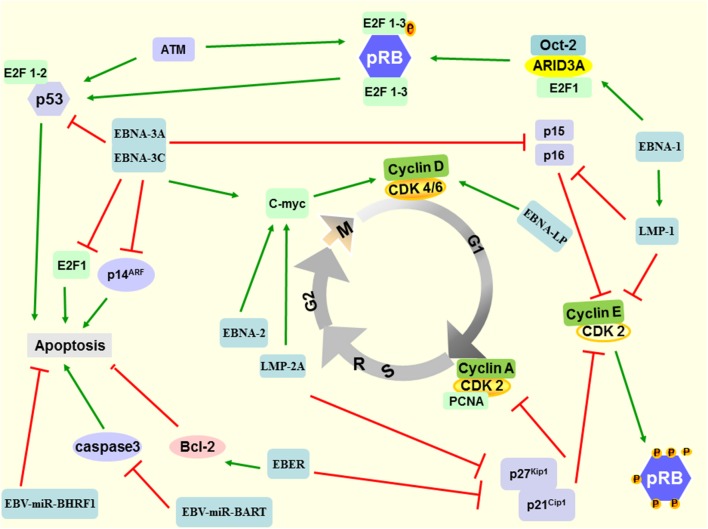
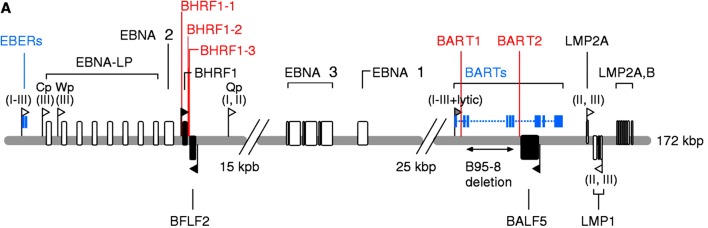
The early stage of oncogenesis is linked to the disorder of the cell cycle. Abnormal gene expression often leads to cell cycle disorders, resulting in malignant transformation of human cells. Epstein-Barr virus (EBV) is associated with a diverse range of human neoplasms, such as malignant lymphoma, nasopharyngeal carcinoma and gastric cancer. EBV mainly infects human lymphocytes and oropharyngeal epithelial cells. EBV is latent in lymphocytes for a long period of time, is detached from the cytoplasm by circular DNA, and can integrate into the chromosome of cells. EBV expresses a variety of latent genes during latent infection. The interaction between EBV latent genes and oncogenes leads to host cell cycle disturbances, including the promotion of G/S phase transition and inhibition of cell apoptosis, thereby promoting the development of EBV-associated neoplasms. Molecular mechanisms of EBV-driven cell cycle progression and oncogenesis involve diverse genes and signal pathways. Here, we review the molecular mechanisms of EBV-driven cell cycle progression and promoting oncogenesis.
肿瘤发生的早期阶段与细胞周期紊乱有关。异常基因表达常导致细胞周期紊乱,从而导致人类细胞的恶性转化。 Epstein-Barr 病毒(EBV)与多种人类肿瘤有关,如恶性淋巴瘤、鼻咽癌和胃癌。EBV 主要感染人类淋巴细胞和口咽上皮细胞。EBV 在淋巴细胞中长期潜伏,通过环状 DNA 从细胞质中分离出来,并可整合到细胞染色体中。EBV 在潜伏感染时表达多种潜伏基因。EBV 潜伏基因与癌基因的相互作用导致宿主细胞周期紊乱,包括促进 G1/S 期转变和抑制细胞凋亡,从而促进 EBV 相关肿瘤的发展。EBV 驱动的细胞周期进展和致癌的分子机制涉及多种基因和信号通路。在这里,我们综述了 EBV 驱动的细胞周期进展和促进致癌的分子机制。