Department of Family Medicine and Public Health, University of California San Diego, La Jolla, California, United States of America.
Moores Cancer Center, University of California San Diego, La Jolla, California, United States of America.
PLoS One. 2018 Nov 2;13(11):e0206921. doi: 10.1371/journal.pone.0206921. eCollection 2018.
The California Tobacco-Use Prevention Education (TUPE) program promotes the use of evidence-based tobacco-specific prevention and cessation programs for adolescents within the school setting. Through a competitive grant process, schools are funded to provide programs for grades 6-12. This research evaluates the association between TUPE funding and tobacco prevention activities and tobacco use prevalence.
This study utilized two data sources: (1) 2016 California Educator Tobacco Survey (CETS), and (2) 2015-2016 California Student Tobacco Survey (CSTS). The CETS collected data from educators about school prevention efforts, priority of tobacco prevention, and confidence in addressing tobacco issues with students. A total of 3,564 educators from 590 schools participated in CETS. The CSTS collected data from 8th, 10th, and 12th graders in California on their exposure to, attitudes about, and utilization of tobacco products. A total of 47,981 students from 117 schools participated in CSTS.
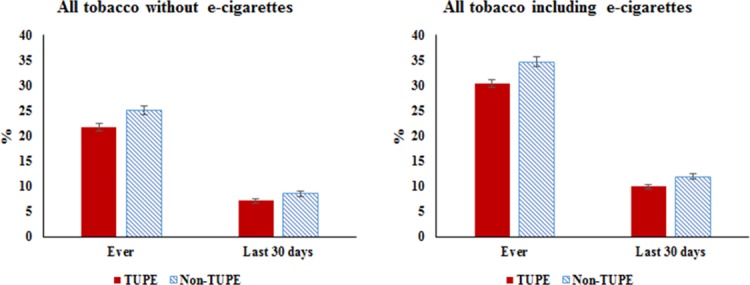
This study found that TUPE-funded schools were more likely to provide tobacco-specific health education programs, to place a priority on tobacco-prevention efforts, and to prepare educators to address tobacco use than non-TUPE schools. Educators at both types of schools felt better prepared to talk with students about traditional tobacco products than about emerging products such as e-cigarettes. Overall, students at TUPE-funded schools were more likely to report receiving anti-tobacco messages from school-based programs than those at non-TUPE schools. The former were also less likely to use tobacco products, even when the analysis controlled for demographics and school-level characteristics (OR = 0.82 [95% CI = 0.70-0.96]).
TUPE funding was associated with an increase in schools' tobacco-specific prevention activities and these enhanced activities were associated with lower tobacco use among students. This study also found that education and prevention efforts regarding emerging tobacco products need to be strengthened across all schools.
加州烟草使用预防教育(TUPE)计划在学校环境中推广使用基于证据的针对青少年的特定烟草预防和戒烟计划。通过竞争拨款程序,为提供 6-12 年级课程的学校提供资金。本研究评估了 TUPE 资金与烟草预防活动以及烟草使用流行率之间的关联。
本研究利用了两个数据源:(1)2016 年加州教育者烟草调查(CETS),和(2)2015-2016 年加州学生烟草调查(CSTS)。CETS 从教育者那里收集了关于学校预防工作、烟草预防重点以及有信心与学生讨论烟草问题的数据。共有来自 590 所学校的 3564 名教育者参加了 CETS。CSTS 从加利福尼亚州的 8 年级、10 年级和 12 年级学生那里收集了他们接触、对烟草产品的态度以及使用烟草产品的情况。共有来自 117 所学校的 47981 名学生参加了 CSTS。
本研究发现,与非 TUPE 学校相比,获得 TUPE 资助的学校更有可能提供特定于烟草的健康教育计划,将烟草预防工作列为优先事项,并为教育者提供解决烟草使用问题的培训。两类学校的教育者都觉得更有准备与学生讨论传统烟草产品,而不是新兴产品,如电子烟。总的来说,获得 TUPE 资助的学校的学生更有可能从基于学校的项目中收到反烟草信息,而不是非 TUPE 学校的学生。前者使用烟草产品的可能性也较小,即使在分析控制了人口统计数据和学校层面的特征后(OR = 0.82 [95% CI = 0.70-0.96])。
TUPE 资金的投入与学校特定烟草预防活动的增加有关,这些活动的增加与学生吸烟率的降低有关。本研究还发现,所有学校都需要加强针对新兴烟草产品的教育和预防工作。