New York University, United States.
New York University, United States.
Curr Opin Psychol. 2018 Dec;24:83-91. doi: 10.1016/j.copsyc.2018.10.003. Epub 2018 Oct 9.
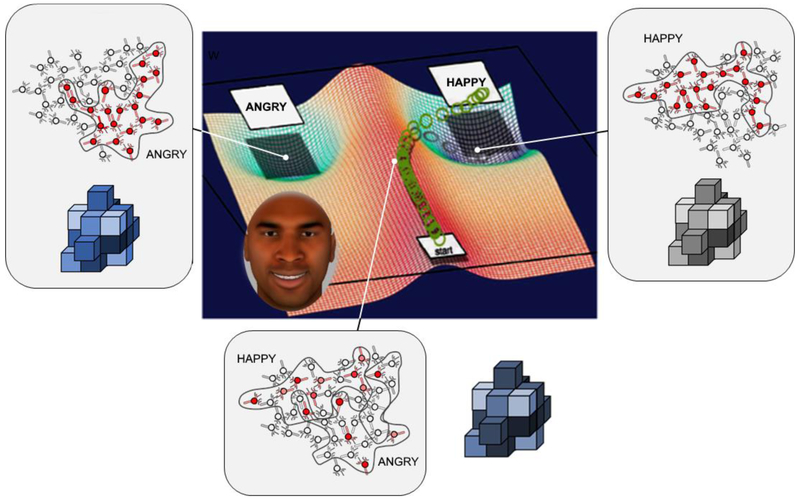
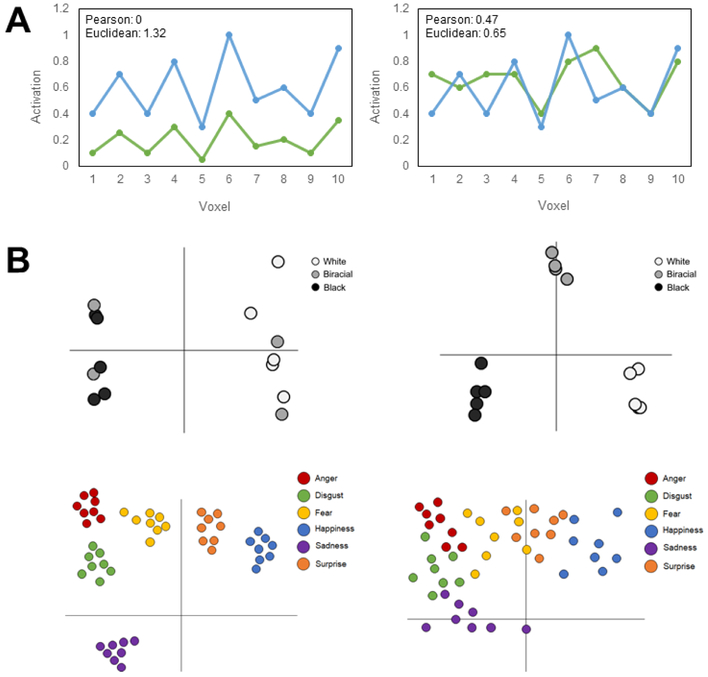
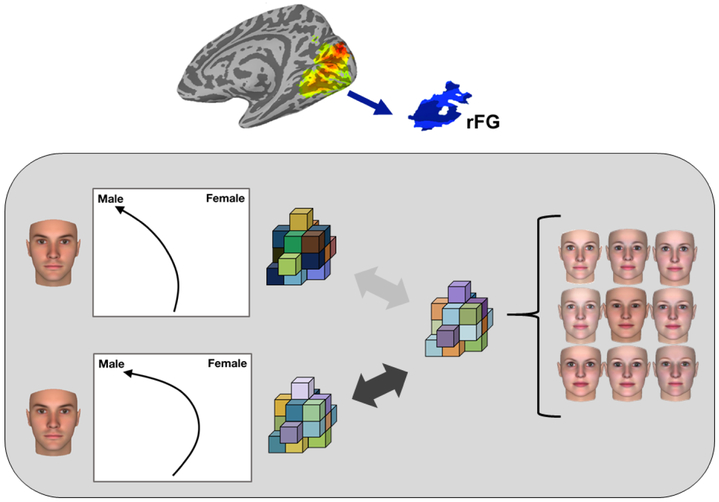
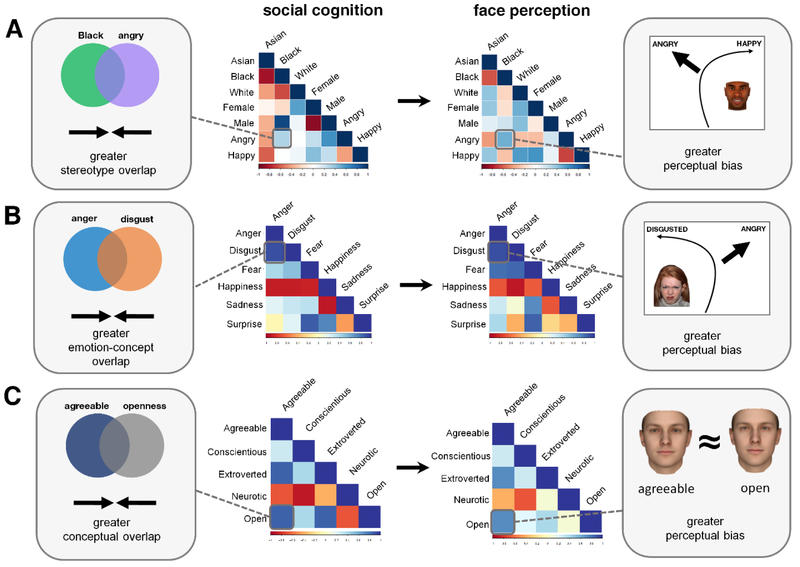
An emerging focus on the geometry of representational structures is advancing a variety of areas in social perception, including social categorization, emotion perception, and trait impressions. Here, we review recent studies adopting a representational geometry approach, and argue that important advances in social perception can be gained by triangulating on the structure of representations via three levels of analysis: neuroimaging, behavioral measures, and computational modeling. Among other uses, this approach permits broad and comprehensive tests of how bottom-up facial features and visual processes as well as top-down social cognitive factors and conceptual processes shape perceptions of social categories, emotion, and personality traits. Although such work is only in its infancy, a focus on corroborating representational geometry across modalities is allowing researchers to use multiple levels of analysis to constrain theoretical models in social perception. This approach holds promise to further our understanding of the multiply determined nature of social perception and its neural basis.
新兴的代表性结构几何研究重点正在推动社会感知的多个领域的发展,包括社会分类、情绪感知和特质印象。在这里,我们回顾了最近采用代表性几何方法的研究,并认为通过三个分析层面(神经影像学、行为测量和计算建模)对代表的结构进行三角测量,可以在社会感知方面取得重要进展。这种方法除其他用途外,还可以广泛而全面地检验面部特征和视觉过程等自下而上的因素以及社会认知因素和概念过程等自上而下的因素如何塑造对社会类别、情绪和人格特质的感知。尽管这项工作还处于起步阶段,但关注不同模式下的代表性几何一致性可以使研究人员利用多个分析层面来约束社会感知的理论模型。这种方法有望进一步加深我们对社会感知及其神经基础的多重决定性质的理解。