School of Nursing, University of British Columbia, T201 - 2211 Wesbrook Mall, Vancouver, BC, V6T 2B5, Canada.
Department of Kinesiology, University of Waterloo, 200 University Avenue West, Waterloo, ON, N2L 3G1, Canada.
Health Res Policy Syst. 2018 Nov 3;16(1):103. doi: 10.1186/s12961-018-0376-z.
Issues with the uptake of research findings in applied health services research remain problematic. Part of this disconnect is attributed to the exclusion of knowledge users at the outset of a study, which often results in the generation of knowledge that is not usable at the point of care. Integrated knowledge translation blended with qualitative methodologies has the potential to address this issue by working alongside knowledge users throughout the research process. Nevertheless, there is currently a paucity of literature about how integrated knowledge translation can be integrated into qualitative methodology; herein, we begin to address this gap in methodology discourse. The purpose of this paper is to describe our experience of conducting a focused ethnography with a collaborative integrated knowledge translation approach, including the synergies and potential sources of discord between integrated knowledge translation and focused ethnography.
We describe the specific characteristics and synergies that exist when using an integrated knowledge translation approach with focused ethnography, using a research exemplar about the experiences of frail, older adults undergoing a transcatheter aortic valve implantation.
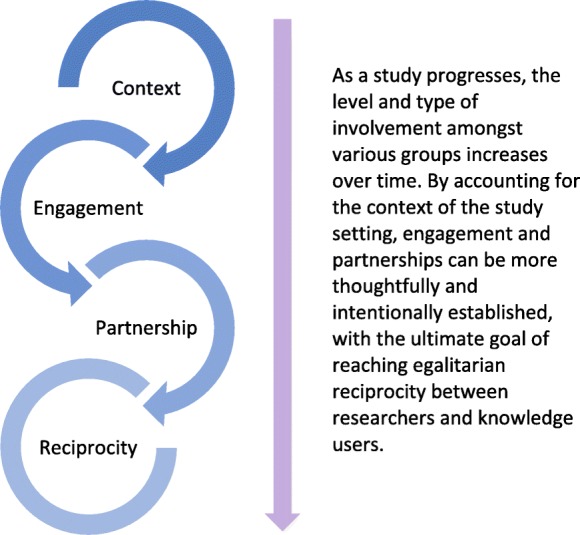
Embedding integrated knowledge translation within focused ethnography resulted in (1) an increased focus on the culture and values of the context under study, (2) a higher level of engagement among researchers, study participants and knowledge users, and (3) a commitment to partnership between researchers and knowledge users as part of a larger programme of research, resulting in a (4) greater emphasis on the importance of reciprocity and trustworthiness in the research process.
Engaging in integrated knowledge translation from the outset of a study ensures that research findings are relevant for application at the point of care. The integration of integrated knowledge translation within focused ethnography allows for real-time uptake of meaningful and emerging findings, the strengthening of collaborative research teams, and opportunities for sustained programmes of research and relationships in the field of health services research. Further exploration of the integration of knowledge translation approaches with qualitative methodologies is recommended.
在应用健康服务研究中,研究结果的应用仍然存在问题。这种脱节的部分原因是在研究开始时排除了知识使用者,这通常导致产生的知识在护理点无法使用。通过在研究过程中与知识使用者合作,综合知识转化与定性方法相结合,有可能解决这个问题。然而,目前关于如何将综合知识转化融入定性方法的文献很少;在此,我们开始解决方法论述中的这一差距。本文的目的是描述我们使用协作式综合知识转化方法进行重点民族志研究的经验,包括综合知识转化与重点民族志之间的协同作用和潜在分歧来源。
我们使用关于脆弱、老年患者经导管主动脉瓣植入术体验的研究范例,描述了在重点民族志中使用综合知识转化方法时存在的具体特征和协同作用。
将综合知识转化嵌入重点民族志中,导致(1)更加关注研究背景下的文化和价值观,(2)研究人员、研究参与者和知识使用者之间的更高水平的参与,以及(3)承诺研究人员和知识使用者之间建立伙伴关系,作为更大的研究计划的一部分,从而(4)更加重视研究过程中互惠和值得信赖的重要性。
从研究一开始就进行综合知识转化可以确保研究结果与护理点的应用相关。将综合知识转化纳入重点民族志中,可以实时吸收有意义和新兴的研究结果,加强协作研究团队,并为健康服务研究领域的持续研究计划和关系提供机会。建议进一步探索知识转化方法与定性方法的整合。