Selik Richard M, Linley Laurie
Division of HIV/AIDS and Prevention, National Center for HIV/AIDS, Viral Hepatitis, STD, and TB Prevention, Centers for Disease Control and Prevention, Atlanta, GA, United States.
JMIR Public Health Surveill. 2018 Nov 5;4(4):e10770. doi: 10.2196/10770.
Early (including acute) HIV infection is associated with viral loads higher than those in later stages.
This study aimed to examine the association between acute infection and viral loads near the time of diagnosis using data reported to the US National HIV Surveillance System.
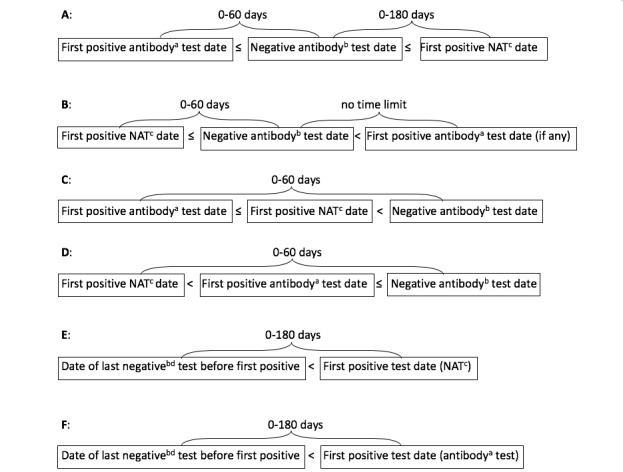
We analyzed data on infections diagnosed in 2012-2016 and reported through December 2017. Diagnosis and staging were based on the 2014 US surveillance case definition for HIV infection. We divided early HIV-1 infection (stage 0) into two subcategories. Subcategory 0α: a negative or indeterminate HIV-1 antibody test was ≤60 days after the first confirmed positive HIV-1 test or a negative or indeterminate antibody test or qualitative HIV-1 nucleic acid test (NAT) was ≤180 days before the first positive test, the latter being a NAT or detectable viral load. Subcategory 0β: a negative or indeterminate antibody or qualitative NAT was ≤180 days before the first positive test, the latter being an HIV antibody or antigen/antibody test. We compared median earliest viral loads for each stage and subcategory in each of the first 6 weeks after diagnosis using only the earliest viral load for each individual.
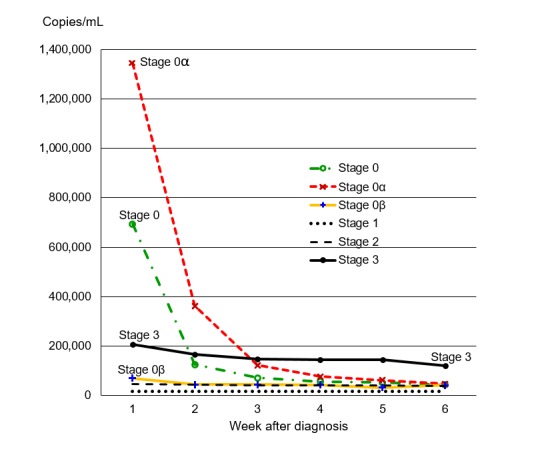
Of 203,392 infections, 56.69% (115,297/203,392) were reported with a quantified earliest viral load within 6 weeks after diagnosis and criteria sufficient to determine the stage at diagnosis. Among 5081 infections at stage 0, the median earliest viral load fell from 694,000 copies/mL in week 1 to 125,022 in week 2 and 43,473 by week 6. Among 30,910 infections in stage 1, the median earliest viral load ranged 15,412-17,495. Among 42,784 infections in stage 2, the median viral load declined from 44,973 in week 1 to 38,497 in week 6. Among 36,522 infections in stage 3 (AIDS), the median viral load dropped from 205,862 in week 1 to 119,000 in week 6. The median earliest viral load in stage 0 subcategory 0α fell from 1,344,590 copies/mL in week 1 to 362,467 in week 2 and 47,320 in week 6, while that in subcategory 0β was 70,114 copies/mL in week 1 and then 32,033 to 44,067 in weeks 2-6. The median viral load in subcategory 0α was higher than that in subcategory 0β in each of the first 6 weeks after diagnosis (P<.001).
In the 1st week after diagnosis, viral loads in early infections are generally several times higher than those in later stages at diagnosis. By the 3rd week, however, most are lower than those in stage 3. High viral loads in early infection are much more common in subcategory 0α than in subcategory 0β, consistent with 0α comprising mostly acute infections and 0β comprising mostly postacute early infections. These findings may inform the prioritization of interventions for prevention.
早期(包括急性期)HIV感染与高于后期阶段的病毒载量相关。
本研究旨在利用向美国国家HIV监测系统报告的数据,研究急性感染与诊断时附近病毒载量之间的关联。
我们分析了2012 - 2016年诊断并截至2017年12月报告的感染数据。诊断和分期基于2014年美国HIV感染监测病例定义。我们将早期HIV - 1感染(0期)分为两个亚类。亚类0α:首次确认HIV - 1检测呈阳性后≤60天的HIV - 1抗体检测为阴性或不确定,或首次阳性检测前≤180天的HIV - 1抗体检测或定性HIV - 1核酸检测(NAT)为阴性或不确定,后者为NAT或可检测到的病毒载量。亚类0β:首次阳性检测前≤180天的HIV - 1抗体或定性NAT为阴性或不确定,后者为HIV抗体或抗原/抗体检测。我们仅使用每个个体最早的病毒载量,比较诊断后前6周内每个阶段和亚类的最早病毒载量中位数。
在203,392例感染中,56.69%(115,297/203,392)报告了诊断后6周内的最早定量病毒载量以及足以确定诊断阶段的标准。在5081例0期感染中,最早病毒载量中位数从第1周的694,000拷贝/mL降至第2周的125,022拷贝/mL,到第6周为43,473拷贝/mL。在30,910例1期感染中,最早病毒载量中位数在15,412 - 17,495拷贝/mL之间。在42,784例2期感染中,病毒载量中位数从第1周的44,973拷贝/mL降至第6周的38,497拷贝/mL。在36,522例3期(艾滋病)感染中,病毒载量中位数从第1周的205,862拷贝/mL降至第6周的119,000拷贝/mL。0期亚类0α最早病毒载量中位数从第1周的1,344,590拷贝/mL降至第2周的362,467拷贝/mL,到第6周为47,320拷贝/mL,而亚类0β在第1周为70,114拷贝/mL,在第2 - 6周为32,033至44,067拷贝/mL。诊断后前6周内,亚类0α的病毒载量中位数在各周均高于亚类0β(P <.001)。
在诊断后的第1周,早期感染中的病毒载量通常比诊断时的后期阶段高出数倍。然而,到第3周时,大多数早期感染的病毒载量低于3期。早期感染中高病毒载量在亚类0α中比在亚类0β中更为常见,这与0α主要包括急性感染而0β主要包括急性后期早期感染一致。这些发现可能为预防干预措施的优先排序提供参考。