Stern Chen, Grinvald Shmuel, Kirshner Moshe, Sinai Ofer, Oksman Mark, Alon Hadas, Meiron Oren E, Bar-Sadan Maya, Houben Lothar, Naveh Doron
Faculty of Engineering and Institute for Nanotechnology and Advanced Materials, Bar-Ilan University, Ramat Gan, Israel.
Department of Chemistry and Institute for Nanotechnology and Advanced Materials, Bar-Ilan University, Ramat Gan, Israel.
Sci Rep. 2018 Nov 7;8(1):16480. doi: 10.1038/s41598-018-34222-z.
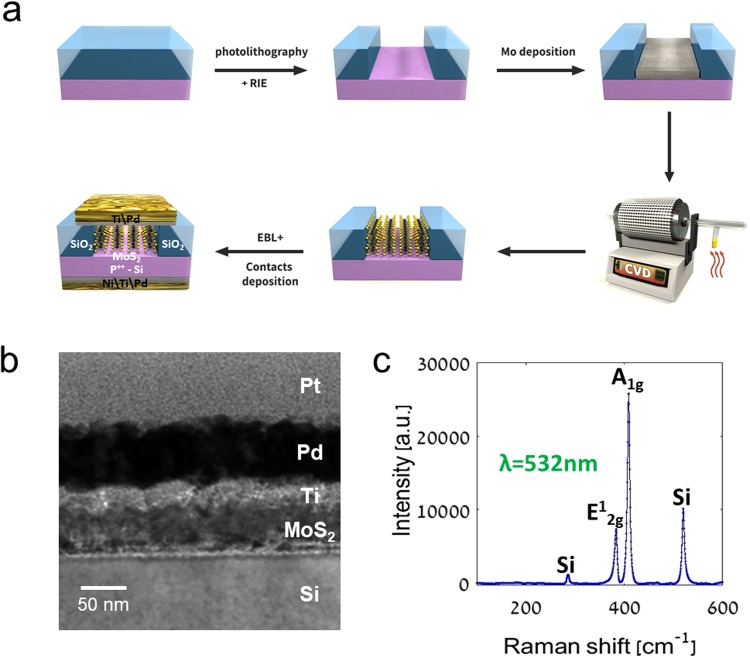
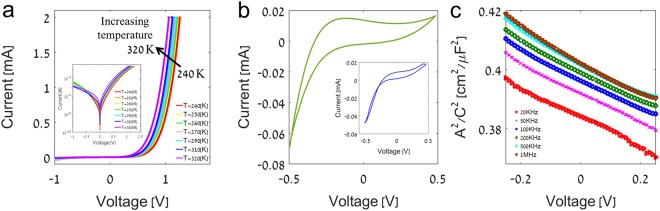
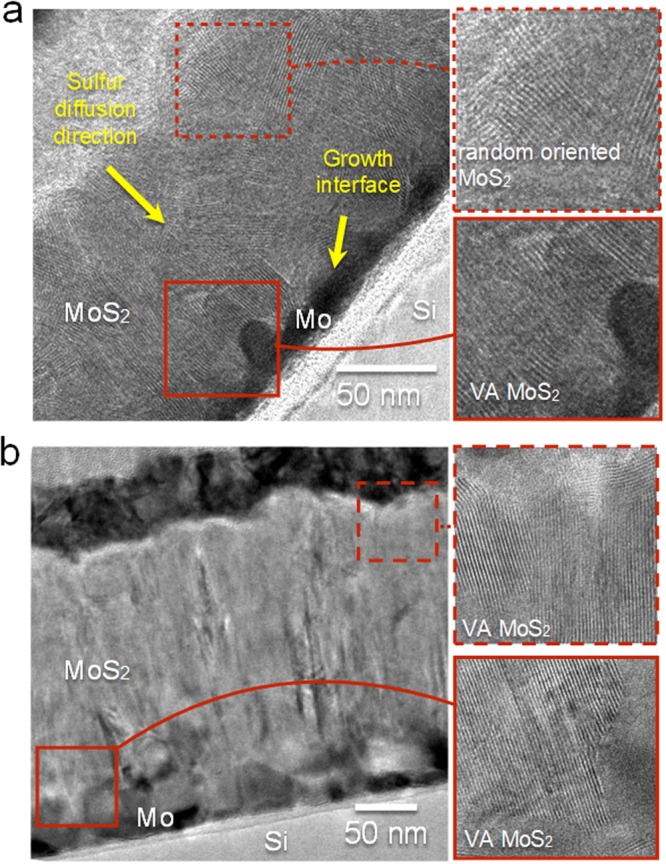
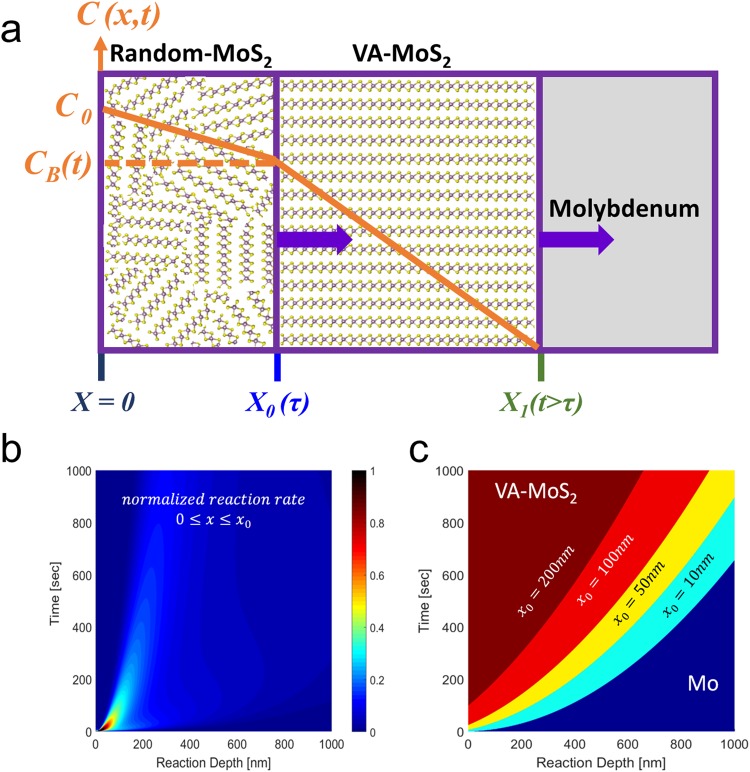
Thin films of layered semiconductors emerge as highly promising materials for energy harvesting and storage, optoelectronics and catalysis. Their natural propensity to grow as oriented crystals and films is one of their distinct properties under recent focal interest. Specifically, the reaction of transition metal films with chalcogen vapor can result in films of vertically aligned (VA) layers, while metal-oxides react with chalcogens in vapor phase to produce horizontally aligned crystals and films. The growth mechanisms of vertically oriented films are not yet fully understood, as well as their dependence on the initial metal film thickness and growth conditions. Moreover, the resulting electronic properties and the role of defects and disorder had not yet been studied, despite their critical influence on catalytic and device performance. In this work, we study the details of oriented growth of MoS with complementary theoretical and experimental approaches. We present a general theoretical model of diffusion-reaction growth that can be applied to a large variety of layered materials synthesized by solid-vapor reaction. Moreover, we inspect the relation of electronic properties to the structure of vertically aligned MoS and shed light on the density and character of defects in this material. Our measurements on Si-MoS p-n hetero-junction devices point to the existence of polarizable defects that impact applications of vertical transition-metal dichalcogenide materials.
层状半导体薄膜成为用于能量收集与存储、光电子学和催化领域的极具前景的材料。它们易于生长成取向晶体和薄膜的天然倾向是近期备受关注的独特特性之一。具体而言,过渡金属薄膜与硫族元素蒸汽反应可生成垂直排列(VA)层的薄膜,而金属氧化物与硫族元素在气相中反应会产生水平排列的晶体和薄膜。垂直取向薄膜的生长机制尚未完全理解,其对初始金属薄膜厚度和生长条件的依赖性也不清楚。此外,尽管缺陷和无序对催化和器件性能有至关重要的影响,但所得电子性质以及它们的作用尚未得到研究。在这项工作中,我们用互补的理论和实验方法研究了MoS取向生长的细节。我们提出了一个扩散 - 反应生长的通用理论模型,该模型可应用于通过固 - 气反应合成的多种层状材料。此外,我们考察了电子性质与垂直排列的MoS结构之间的关系,并阐明了该材料中缺陷的密度和特性。我们对Si - MoS p - n异质结器件的测量表明存在可极化缺陷,这些缺陷会影响垂直过渡金属二硫属化物材料的应用。