Lin Guisen, Zhuang Caiyu, Shen Zhiwei, Xiao Gang, Chen Yanzi, Shen Yuanyu, Zong Xiaodan, Wu Renhua
Department of Medical Imaging, The Second Affiliated Hospital, Medical College of Shantou University, Shantou, China.
Department of Mathematics and Statistics, Hanshan Normal University, Chaozhou, China.
Front Neurol. 2018 Oct 23;9:901. doi: 10.3389/fneur.2018.00901. eCollection 2018.
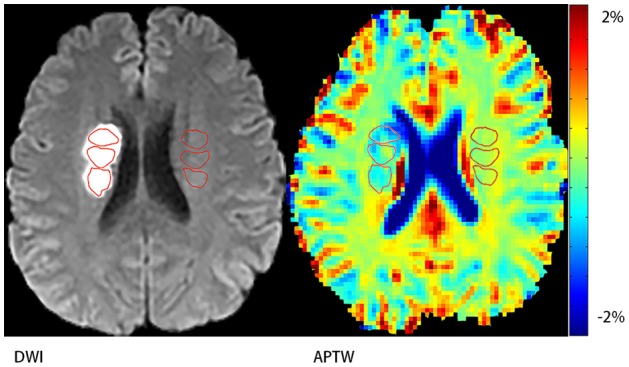
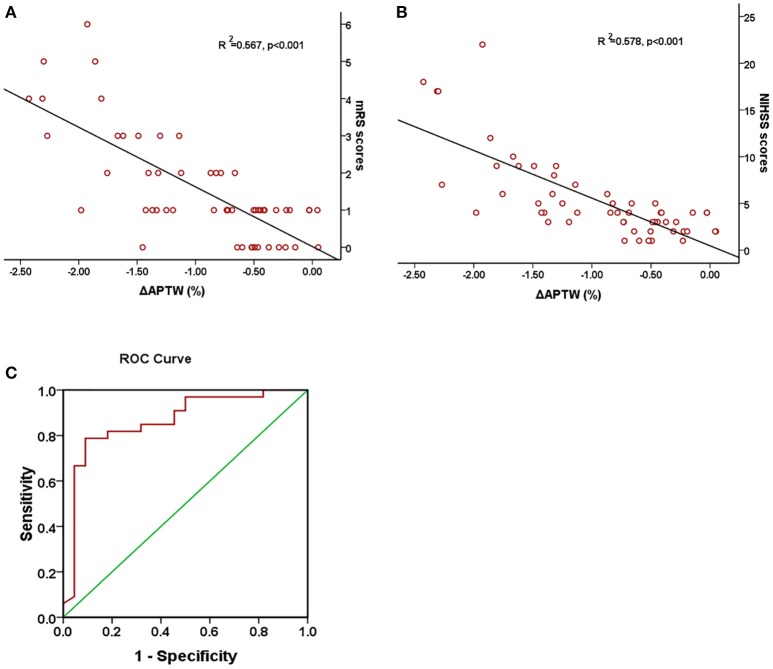
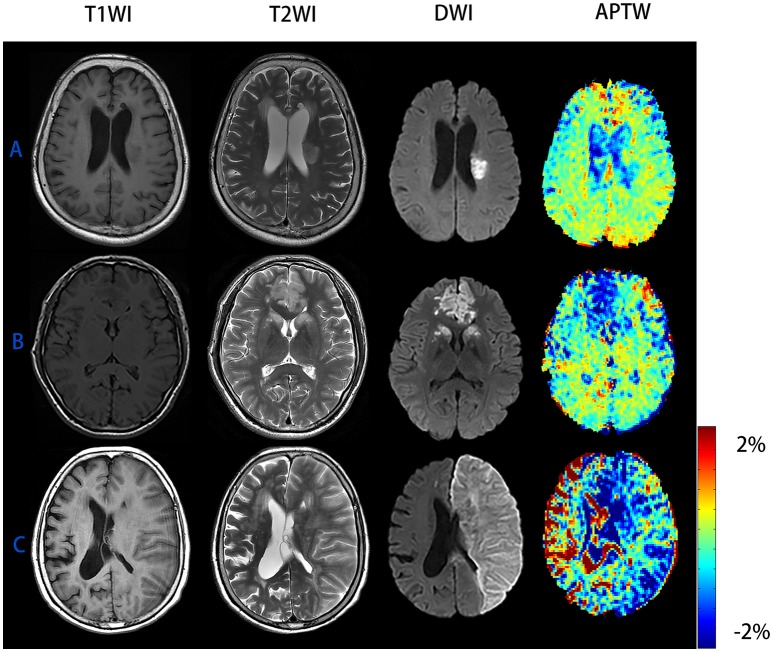
To explore the capability of the amide-proton-transfer weighted (APTW) magnetic resonance imaging (MRI) in the evaluation of clinical neurological deficit at the time of hospitalization and assessment of long-term daily functional outcome for patients with acute ischemic stroke (AIS). We recruited 55 AIS patients with brain MRI acquired within 24-48 h of symptom onset and followed up with their 90-day modified Rankin Scale (mRS) score. APT weighted MRI was performed for all the study subjects to measure APTW signal quantitatively in the acute ischemic area (APTW) and the contralateral side (APTW). Change of the APT signal between the acute ischemic region and the contralateral side (ΔAPTW) was calculated. Maximum APTW signal (APTW) and minimal APTW signal (APTW) were also acquired to demonstrate APTW signals heterogeneity (APTW). In addition, all the patients were divided into 2 groups according to their 90-day mRS score (good prognosis group with mRS score <2 and poor prognosis group with mRS score ≥2). In the meantime, ΔAPTW of these groups was compared. We found that ΔAPTW was in good correlation with National Institutes of Health Stroke Scale (NIHSS) score ( = 0.578, < 0.001) and 90-day mRS score ( = 0.55, < 0.001). There was significant difference of ΔAPTW between patients with good prognosis and patients with poor prognosis. Plus, APTW was significantly different between two groups. These results suggested that APT weighted MRI could be used as an effective tool to assess the stroke severity and prognosis for patients with AIS, with APTW signal heterogeneity as a possible biomarker.
探讨酰胺质子转移加权(APTW)磁共振成像(MRI)在评估急性缺血性卒中(AIS)患者住院时临床神经功能缺损及长期日常功能预后中的能力。我们招募了55例在症状发作后24 - 48小时内进行脑部MRI检查的AIS患者,并随访其90天改良Rankin量表(mRS)评分。对所有研究对象进行APTW MRI检查,以定量测量急性缺血区域(APTW)和对侧(APTW)的APTW信号。计算急性缺血区域与对侧之间的APT信号变化(ΔAPTW)。还获取最大APTW信号(APTW)和最小APTW信号(APTW)以显示APTW信号异质性(APTW)。此外,根据患者90天mRS评分将所有患者分为两组(mRS评分<2的预后良好组和mRS评分≥2的预后不良组)。同时,比较这些组的ΔAPTW。我们发现ΔAPTW与美国国立卫生研究院卒中量表(NIHSS)评分(r = 0.578,P < 0.001)和90天mRS评分(r = 0.55,P < 0.001)具有良好的相关性。预后良好组和预后不良组患者的ΔAPTW存在显著差异。此外,两组之间的APTW也有显著差异。这些结果表明,APTW MRI可作为评估AIS患者卒中严重程度和预后的有效工具,APTW信号异质性可能作为生物标志物。