Imani Saber, Wu Ray-Chang, Fu Junjiang
Key Laboratory of Epigenetics and Oncology, the Research Center for Preclinical Medicine, Southwest Medical University, Luzhou, Sichuan 646000, P.R. China.
Department of Biochemistry and Molecular Medicine, the George Washington University, Washington, DC 20052, USA.
J Cancer. 2018 Sep 28;9(20):3765-3775. doi: 10.7150/jca.25576. eCollection 2018.
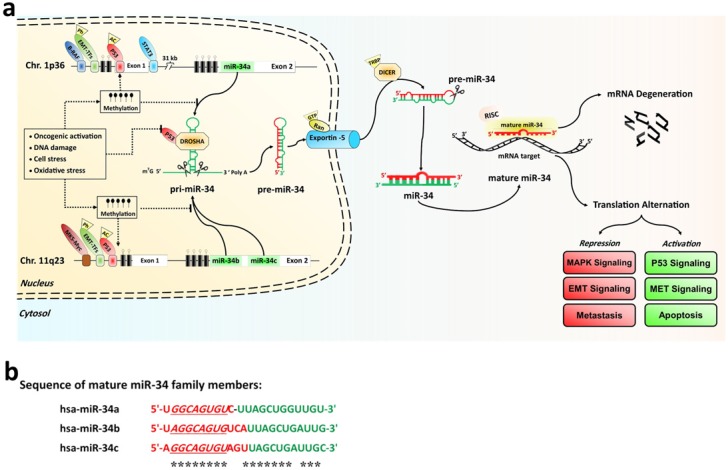
MicroRNA (miRNA)-34 family (miR-34s), including miR-34a/b/c, is the most well studied non-coding RNAs that regulate gene expression post-transcriptionally. The miR-34s mediates the tumor suppressor function of p53 in the pathogenesis of breast cancer by targeting different oncogenes. This review focuses on the anti-oncogenic regulation of the miR-34s, emphasizing the major signaling pathways that are involved in the modulation of miR-34s in breast cancer. Moreover, it highlights how epigenetic modification by the p53/miR-34s axis regulates the proliferation, invasiveness, chemoresistance, and sternness of breast cancer. A better understanding of the molecular mechanisms of miR-34s will open new opportunities for the development of novel therapeutic strategies and define a new approach in identifying potential biomarkers for early diagnosis of breast cancer.
微小RNA(miRNA)-34家族(miR-34s),包括miR-34a/b/c,是研究最为深入的非编码RNA,可在转录后水平调控基因表达。miR-34s通过靶向不同的癌基因,在乳腺癌发病机制中介导p53的肿瘤抑制功能。本综述聚焦于miR-34s的抗癌调控作用,着重阐述参与乳腺癌中miR-34s调控的主要信号通路。此外,还强调了p53/miR-34s轴的表观遗传修饰如何调节乳腺癌的增殖、侵袭性、化疗耐药性和干性。更好地理解miR-34s的分子机制将为开发新的治疗策略带来新机遇,并为确定乳腺癌早期诊断的潜在生物标志物提供新方法。