Weckman Timo, Laasonen Kari
Department of Chemistry and Materials Science, School of Chemical Engineering, Aalto University, Espoo 00076, Finland.
J Phys Chem C Nanomater Interfaces. 2018 Apr 12;122(14):7685-7694. doi: 10.1021/acs.jpcc.7b11469. Epub 2018 Mar 22.
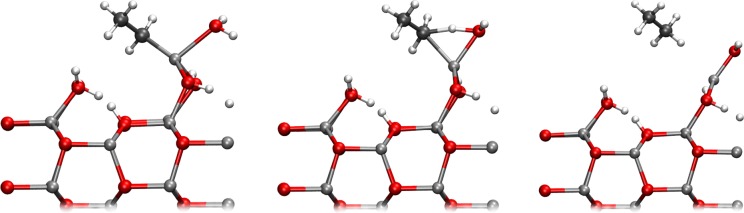
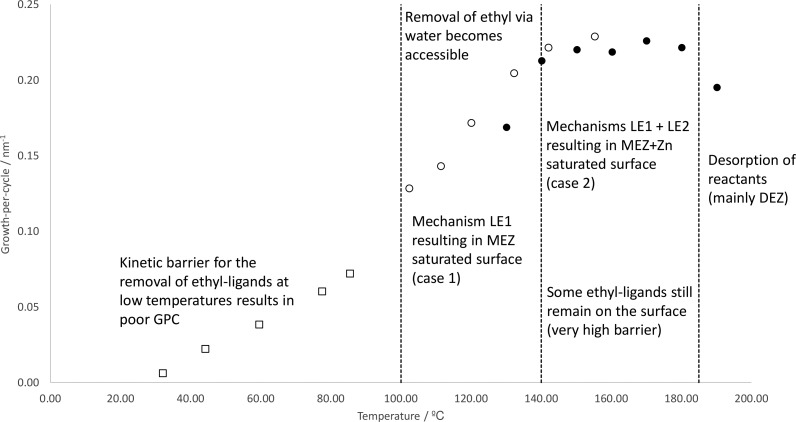
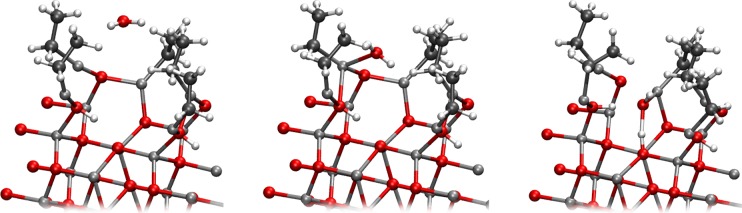
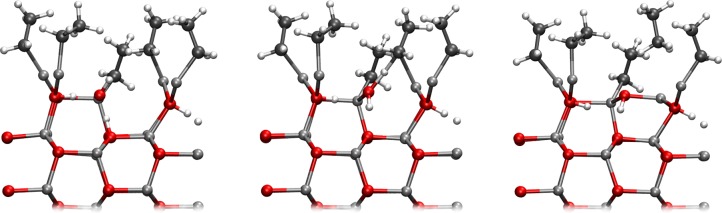
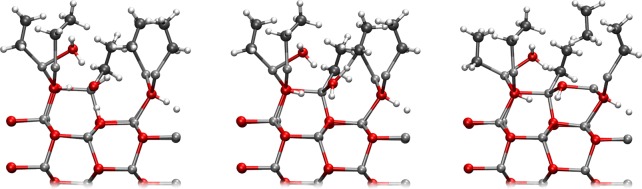
Atomic layer deposition (ALD) of zinc oxide thin films has been under intense research in the past few years. The most common precursors used in this process are diethyl zinc (DEZ) and water. The surface chemistry related to the growth of a zinc oxide thin film via atomic layer deposition is not entirely clear, and the ideal model of the process has been contradicted by experimental data, e.g., the incomplete elimination of the ethyl ligands from the surface and the non-negative mass change during the water pulse. In this work we investigate the surface reactions of water during the atomic layer deposition of zinc oxide. The adsorption and ligand-exchange reactions of water are studied on ethyl-saturated surface structures to grasp the relevant surface chemistry contributing to the deposition process. The complex ethyl-saturated surface structures are adopted from a previous publication on the DEZ/HO-process, and different configurations are sampled using molecular dynamics in order to find a suitable minimum structure. Water molecules are found to adsorb exothermically onto the ethyl-covered surface at all the ethyl concentrations considered. We do not observe an adsorption barrier for water at 0 K; however, the adsorption energy for any additional water molecules decreases rapidly at high ethyl concentrations. Ligand-exchange reactions are studied at various surface ethyl coverages. The water pulse ligand-exchange reactions have overall larger activation energies than surface reactions for diethyl zinc pulse. For some of the configurations considered, the reaction barriers may be inaccessible at the process conditions, suggesting that some ligands may be inert toward ligand-exchange with water. The activation energies for the surface reactions show only a weak dependence on the surface ethyl concentration. The sensitivity of the adsorption of water at high ethyl coverages suggests that at high ligand-coverages the kinetics may be somewhat hindered due to steric effects. Calculations on the ethyl-covered surfaces are compared to a simple model containing a single monoethyl zinc group. The calculated activation energy for this model is in line with calculations done on the complex model, but the adsorption of water is poorly described. The weak adsorption bond onto a single monoethyl zinc is probably due to a cooperative effect between the surface zinc atoms. A cooperative effect between water molecules is also observed; however, the effect on the activation energies is not as significant as has been reported for other ALD processes.
在过去几年中,氧化锌薄膜的原子层沉积(ALD)一直是深入研究的课题。该过程中最常用的前驱体是二乙基锌(DEZ)和水。通过原子层沉积生长氧化锌薄膜所涉及的表面化学并不完全清楚,而且该过程的理想模型已被实验数据所反驳,例如,表面上的乙基配体未完全消除以及水脉冲期间质量无负变化。在这项工作中,我们研究了氧化锌原子层沉积过程中水的表面反应。研究了水在乙基饱和表面结构上的吸附和配体交换反应,以掌握对沉积过程有贡献的相关表面化学。复杂的乙基饱和表面结构取自先前关于DEZ/H₂O过程的一篇论文,并使用分子动力学对不同构型进行采样,以找到合适的最小结构。发现在所考虑的所有乙基浓度下,水分子都以放热方式吸附到乙基覆盖的表面上。在0 K时,我们未观察到水的吸附势垒;然而,在高乙基浓度下,任何额外水分子的吸附能都会迅速降低。在各种表面乙基覆盖率下研究了配体交换反应。水脉冲配体交换反应的总体活化能比二乙基锌脉冲的表面反应活化能大。对于所考虑的一些构型,在工艺条件下反应势垒可能无法达到,这表明一些配体可能对与水的配体交换呈惰性。表面反应的活化能仅对表面乙基浓度有微弱的依赖性。高乙基覆盖率下水吸附的敏感性表明,在高配体覆盖率下,动力学可能会因空间位阻效应而受到一定阻碍。将乙基覆盖表面的计算结果与包含单个单乙基锌基团的简单模型进行了比较。该模型计算出的活化能与复杂模型的计算结果一致,但水的吸附情况描述不佳。单个单乙基锌上较弱的吸附键可能是由于表面锌原子之间的协同效应。还观察到水分子之间的协同效应;然而,对活化能的影响不如其他ALD过程所报道的那么显著。