Laboratory of Animal Physiology, Department of Biochemistry and Biotechnology, University of Thessaly, 41500 Viopolis, Larissa, Greece.
Laboratory of Exercise Biochemistry, Exercise Physiology and Sports Nutrition (SmArT Lab), Department of Physical Education and Sport Science, University of Thessaly, 42100 Trikala, Greece.
Oxid Med Cell Longev. 2018 Oct 11;2018:3053704. doi: 10.1155/2018/3053704. eCollection 2018.
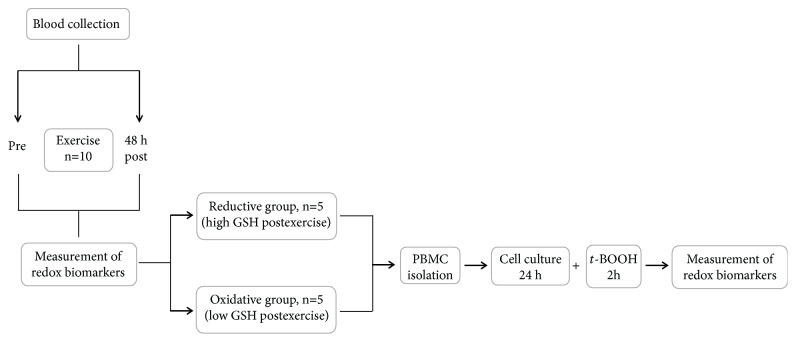
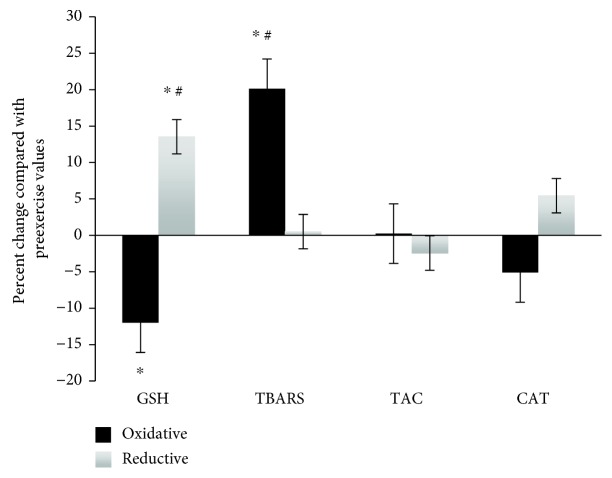
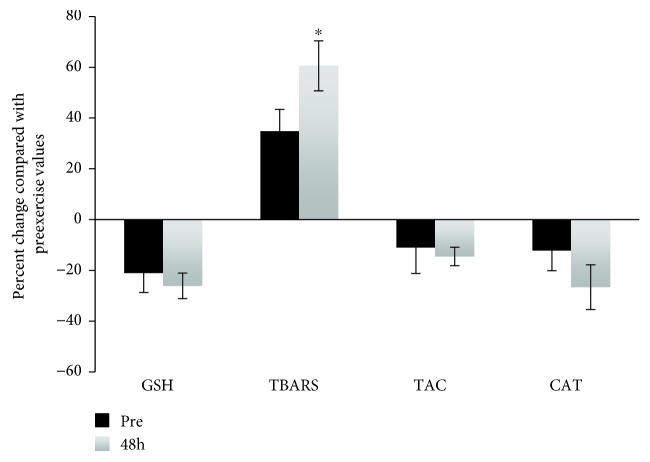
Eccentric exercise is a well-studied modality that induces oxidative stress and muscle damage. Furthermore, it promotes inflammatory response in which peripheral blood mononuclear cells (PBMCs) are the major mediators. Although free radicals are necessary in a specific range of concentrations, yet unknown, it remains unclear whether reductive redox status (i.e., increased antioxidant defenses and impaired free radical generation) is beneficial or not. Thus, the aim of the present investigation was to examine the effects of reductive stress and the impact of reduced glutathione (GSH) baseline values on the ability of PBMCs to counteract oxidative stress induced by a potent oxidative agent. PBMCs were isolated from the blood of subjects who performed eccentric exercise and treated with BOOH for 24 h. The subjects were clustered in the reductive and the oxidative group on the basis of increased or decreased GSH concentration postexercise compared to preexercise values, respectively. According to our results in PBMCs, lipid peroxidation levels as depicted by thiobarbituric acid reactive substances (TBARS) remained unchanged in the reductive group contrary to the observed enhancement in the oxidative group. In addition, GSH concentration and catalase activity increased in the reductive group, whereas they were not affected in the oxidative group. In conclusion, the effects of an oxidizing agent on the redox status of PBMCs isolated from the blood of athletes after acute eccentric exercise are dependent on the baseline values of GSH in erythrocytes. Otherwise, reductive stress defined by increased GSH levels is a protective mechanism, at least when followed by an oxidative stimulus.
离心运动是一种经过充分研究的运动方式,它会引起氧化应激和肌肉损伤。此外,它还会促进炎症反应,其中外周血单核细胞(PBMC)是主要的介质。虽然自由基在特定的浓度范围内是必要的,但目前尚不清楚还原性氧化还原状态(即增加抗氧化防御和削弱自由基生成)是否有益。因此,本研究旨在检查还原性应激的影响以及谷胱甘肽(GSH)基线值的降低对 PBMC 抵抗由强氧化剂引起的氧化应激的能力的影响。从进行离心运动的受试者的血液中分离出 PBMC,并在 24 小时内用 BOOH 处理。根据运动后 GSH 浓度与运动前相比增加或减少的情况,将受试者分为还原性组和氧化性组。根据我们在 PBMC 中的结果,丙二醛(TBARS)所示的脂质过氧化水平在还原性组中保持不变,而在氧化性组中观察到增强。此外,还原性组中的 GSH 浓度和过氧化氢酶活性增加,而氧化性组中不受影响。总之,急性离心运动后从运动员血液中分离的 PBMC 对氧化剂的氧化还原状态的影响取决于红细胞中 GSH 的基线值。否则,由 GSH 水平升高定义的还原性应激是一种保护机制,至少在随后受到氧化刺激时是如此。