National Food Institute, Technical University of Denmark, Kgs. Lyngby, Denmark.
Department of Applied Mathematics and Computer Science, Technical University of Denmark, Kgs. Lyngby, Denmark.
PLoS One. 2018 Nov 8;13(11):e0207032. doi: 10.1371/journal.pone.0207032. eCollection 2018.
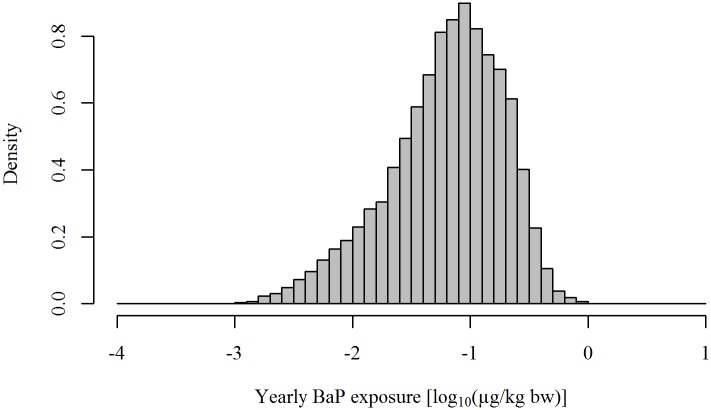
Consumption of meat prepared by barbecuing is associated with risk of cancer due to formation of carcinogenic compounds including benzo[a]pyrene (BaP). Assessment of a population's risk of disease and people's individual probability of disease given specific consumer attributes may direct food safety strategies to where impact on public health is largest. The aim of this study was to propose a model that estimates the risk of cancer caused by exposure to BaP from barbecued meat in Denmark, and to estimate the probability of developing cancer in subgroups of the population given different barbecuing frequencies.
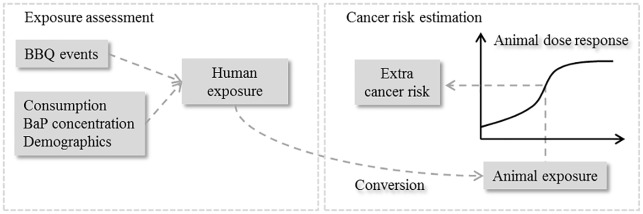
We developed probabilistic models applying two dimensional Monte Carlo simulation to take into account the variation in exposure given age and sex and in the individuals' sensitivity to develop cancer after exposure to BaP, and the uncertainty in the dose response model. We used the Danish dietary consumption survey, monitoring data of chemical concentrations, data on consumer behavior of frequency of barbecuing, and animal dose response data.
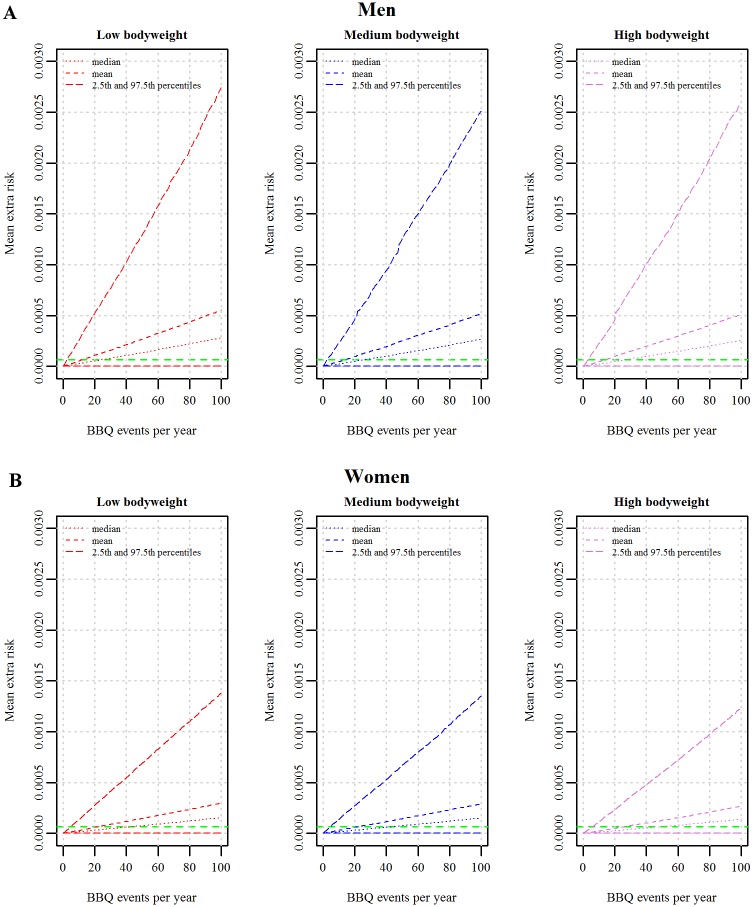
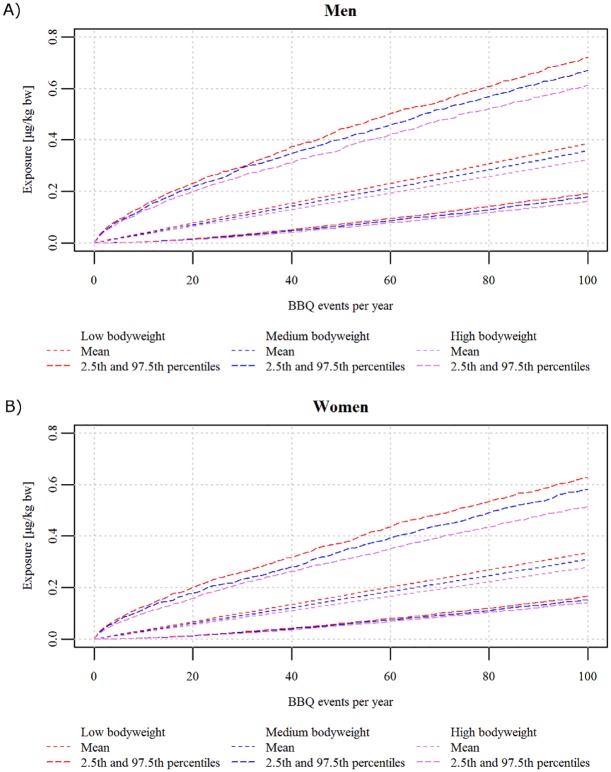
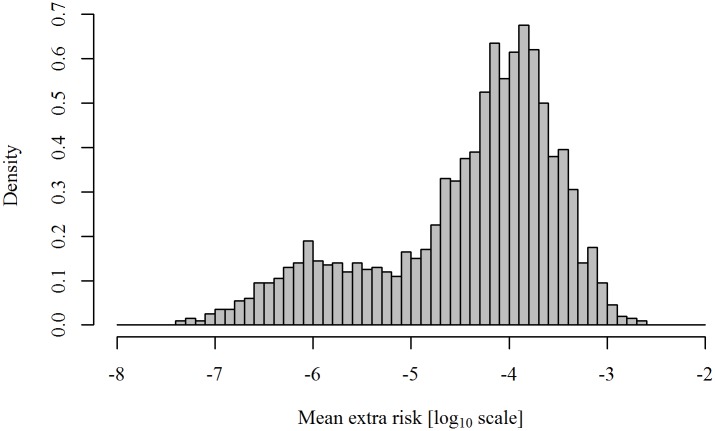
We estimated an average extra lifetime risk of cancer due to BaP from barbecued meat of 6.8 × 10⁻⁵ (95% uncertainty interval 2.6 × 10⁻⁷ - 7.0 × 10⁻⁴) in the Danish population. This corresponds to approximately one to 4,074 extra cancer cases over a lifetime, reflecting wide uncertainty. The impact per barbecuing event on the risk of cancer for men and women of low body weight was higher compared to higher bodyweight. However, the difference due to sex and bodyweight between subgroups are dwarfed by the uncertainty.
This study proposes a model that can be applied to other substances and routes of exposure, and allows for deriving the change in risk following a specific change in behaviour. The presented methodology can serve as a valuable tool for risk management, allowing for the formulation of behaviour advice targeted to specific sub-groups in the population.
由于形成致癌化合物,包括苯并[a]芘(BaP),烤肉的消费与癌症风险相关。评估人群的疾病风险以及给定特定消费者属性的个体疾病概率可以将食品安全策略引导到对公共健康影响最大的地方。本研究的目的是提出一种模型,该模型估计丹麦烤肉中 BaP 暴露引起的癌症风险,并估计在不同烤肉频率下,人群亚组中患癌症的概率。
我们应用二维蒙特卡罗模拟开发了概率模型,以考虑到暴露于 BaP 后年龄和性别以及个体对癌症发展的敏感性的变化,以及剂量反应模型的不确定性。我们使用丹麦饮食消费调查、化学浓度监测数据、烧烤频率消费者行为数据和动物剂量反应数据。
我们估计由于烤肉中 BaP,丹麦人口的平均额外终生癌症风险为 6.8×10⁻⁵(95%置信区间为 2.6×10⁻⁷-7.0×10⁻⁴)。这相当于一生中大约增加了 1 到 4074 例癌症病例,反映出很大的不确定性。与高体重相比,低体重的男性和女性每次烤肉事件对癌症风险的影响更高。然而,由于性别和体重之间的差异在亚组之间被不确定性所掩盖。
本研究提出了一种可应用于其他物质和暴露途径的模型,并允许在特定行为变化后得出风险变化。所提出的方法可以作为风险管理的有用工具,允许针对人群中的特定亚组制定有针对性的行为建议。