Department of Ecology and Evolutionary Biology, University of California, Los Angeles, Los Angeles, CA 90095, USA.
Department of Ecology and Evolutionary Biology, University of California, Los Angeles, Los Angeles, CA 90095, USA.
Curr Biol. 2018 Nov 5;28(21):3487-3494.e4. doi: 10.1016/j.cub.2018.08.066. Epub 2018 Oct 25.
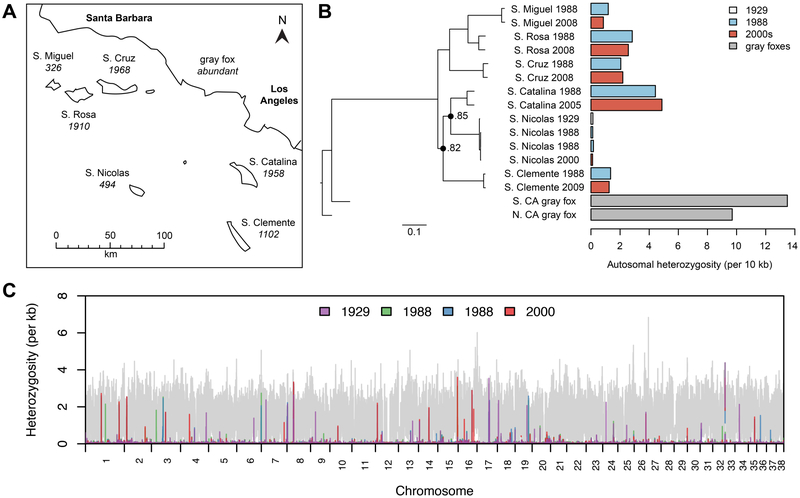
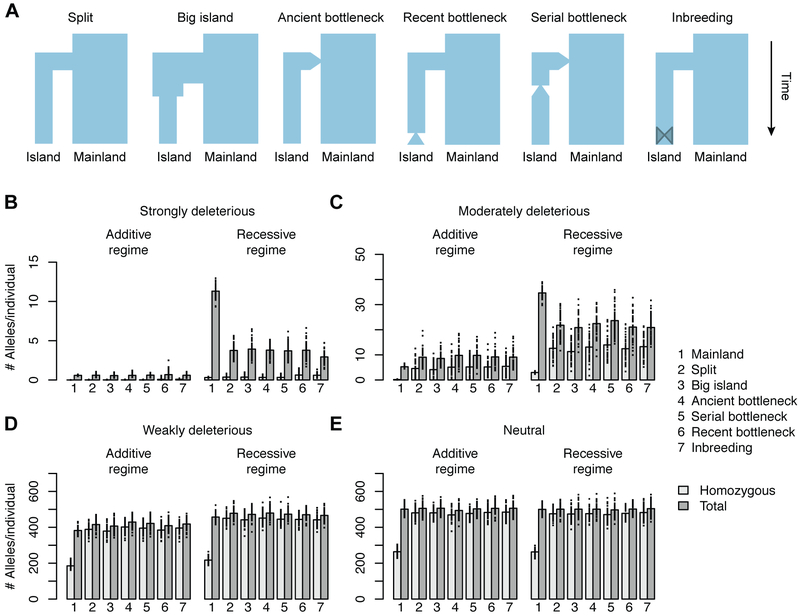
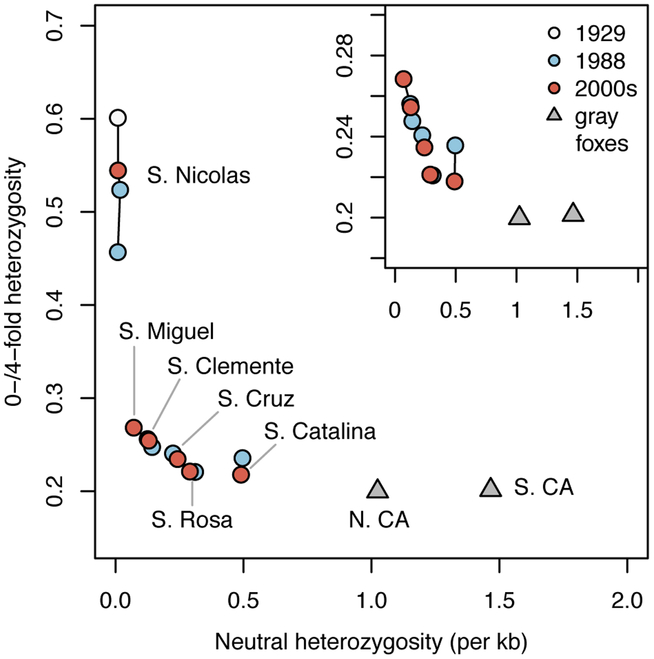
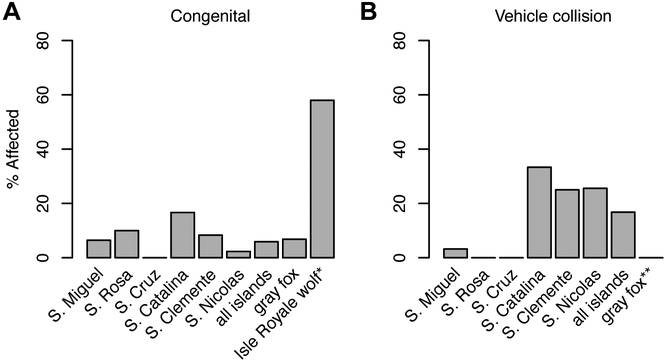
The recovery and persistence of rare and endangered species are often threatened by genetic factors, such as the accumulation of deleterious mutations, loss of adaptive potential, and inbreeding depression [1]. Island foxes (Urocyon littoralis), the dwarfed descendants of mainland gray foxes (Urocyon cinereoargenteus), have inhabited California's Channel Islands for >9,000 years [2-4]. Previous genomic analyses revealed that island foxes have exceptionally low levels of diversity and elevated levels of putatively deleterious variation [5]. Nonetheless, all six populations have persisted for thousands of generations, and several populations rebounded rapidly after recent severe bottlenecks [6, 7]. Here, we combine morphological and genomic data with population-genetic simulations to determine the mechanism underlying the enigmatic persistence of these foxes. First, through analysis of genomes from 1929 to 2009, we show that island foxes have remained at small population sizes with low diversity for many generations. Second, we present morphological data indicating an absence of inbreeding depression in island foxes, confirming that they are not afflicted with congenital defects common to other small and inbred populations. Lastly, our population-genetic simulations suggest that long-term small population size results in a reduced burden of strongly deleterious recessive alleles, providing a mechanism for the absence of inbreeding depression in island foxes. Importantly, the island fox illustrates a scenario in which genetic restoration through human-assisted gene flow could be a counterproductive or even harmful conservation strategy. Our study sheds light on the puzzle of island fox persistence, a unique success story that provides a model for the preservation of small populations.
稀有和濒危物种的恢复和存续常常受到遗传因素的威胁,例如有害突变的积累、适应潜力的丧失和近交衰退[1]。岛屿狐(Urocyon littoralis)是大陆灰狐(Urocyon cinereoargenteus)的矮化后代,已经在加利福尼亚海峡群岛上生活了>9000 年[2-4]。以前的基因组分析表明,岛屿狐的多样性水平极低,且存在大量可能有害的变异[5]。尽管如此,所有六个种群都已经存续了数千代,而且在最近的严重瓶颈之后,有几个种群迅速恢复[6,7]。在这里,我们结合形态学和基因组数据以及群体遗传学模拟,来确定这些狐狸能够神秘存续的机制。首先,通过对 1929 年至 2009 年的基因组进行分析,我们发现岛屿狐的种群规模一直很小,且多样性水平低,已经持续了许多代。其次,我们提出的形态学数据表明,岛屿狐不存在近交衰退,这证实了它们没有其他小型和近交种群中常见的先天缺陷。最后,我们的群体遗传学模拟表明,长期的小种群规模导致强有害隐性等位基因的负担减轻,这为岛屿狐不存在近交衰退提供了一种机制。重要的是,岛屿狐说明了通过人类辅助基因流进行遗传恢复可能是一种适得其反甚至有害的保护策略。我们的研究揭示了岛屿狐存续之谜,这是一个独特的成功案例,为小种群的保护提供了一个模型。