Department of Molecular Cell Biology and Immunology, Amsterdam University Medical Center, Cancer Center Amsterdam, Amsterdam Infection and Immunity Institute, Vrije Universiteit Amsterdam, Amsterdam, Netherlands.
Front Immunol. 2018 Oct 26;9:2472. doi: 10.3389/fimmu.2018.02472. eCollection 2018.
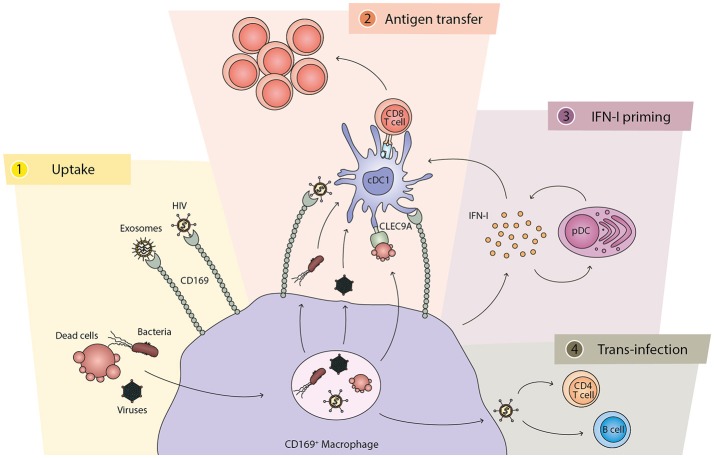
Since the seminal discovery of dendritic cells (DCs) by Steinman and Cohn in 1973, there has been an ongoing debate to what extent macrophages and DCs are related and perform different functions. The current view is that macrophages and DCs originate from different lineages and that only DCs have the capacity to initiate adaptive immunity. Nevertheless, as we will discuss in this review, lymphoid tissue resident CD169 macrophages have been shown to act in concert with DCs to promote or suppress adaptive immune responses for pathogens and self-antigens, respectively. Accordingly, we propose a functional alliance between CD169 macrophages and DCs in which a division of tasks is established. CD169 macrophages are responsible for the capture of pathogens and are frequently the first cell type infected and thereby provide a confined source of antigen. Subsequently, cross-presenting DCs interact with these antigen-containing CD169 macrophages, pick up antigens and activate T cells. The cross-priming of T cells by DCs is enhanced by the localized production of type I interferons (IFN-I) derived from CD169 macrophages and plasmacytoid DCs (pDCs) that induces DC maturation. The interaction between CD169 macrophages and DCs appears not only to be essential for immune responses against pathogens, but also plays a role in the induction of self-tolerance and immune responses against cancer. In this review we will discuss the studies that demonstrate the collaboration between CD169 macrophages and DCs in adaptive immunity.
自斯坦曼和科恩(Steinman and Cohn)于 1973 年发现树突状细胞(DCs)以来,一直存在一个争论,即巨噬细胞和 DCs 在何种程度上相关并发挥不同的功能。目前的观点是,巨噬细胞和 DCs 起源于不同的谱系,只有 DCs 具有启动适应性免疫的能力。然而,正如我们将在这篇综述中讨论的那样,已经表明淋巴组织驻留的 CD169 巨噬细胞与 DC 协同作用,分别促进或抑制针对病原体和自身抗原的适应性免疫反应。因此,我们提出 CD169 巨噬细胞和 DC 之间存在功能联盟,其中建立了分工。CD169 巨噬细胞负责捕获病原体,并且经常是第一个被感染的细胞类型,从而提供了有限的抗原来源。随后,交叉呈递的 DC 与这些含有抗原的 CD169 巨噬细胞相互作用,摄取抗原并激活 T 细胞。CD169 巨噬细胞和浆细胞样 DC(pDC)产生的 I 型干扰素(IFN-I)局部产生,增强了 DC 的交叉呈递,诱导 DC 成熟。CD169 巨噬细胞和 DC 之间的相互作用不仅对针对病原体的免疫反应至关重要,而且在诱导自身耐受和针对癌症的免疫反应中也发挥作用。在这篇综述中,我们将讨论证明 CD169 巨噬细胞和 DC 之间在适应性免疫中的协作的研究。