Gazzinelli-Guimaraes Pedro H, Nutman Thomas B
Laboratory of Parasitic Diseases, National Institute of Allergy and Infectious Diseases, National Institutes of Health, 4 Center Drive, Building 4, Room 211, Bethesda, MD, 20892, USA.
F1000Res. 2018 Oct 23;7. doi: 10.12688/f1000research.15596.1. eCollection 2018.
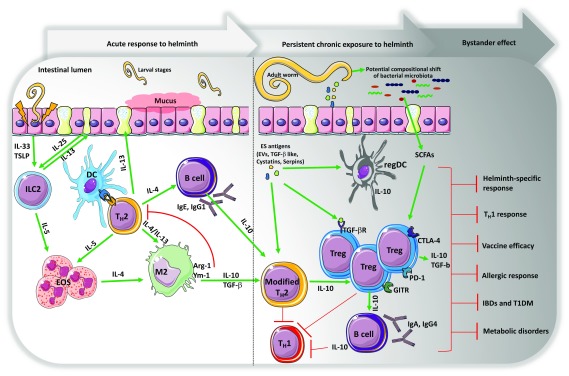
Helminth parasites are complex metazoans that belong to different taxonomic families but that collectively share the capacity to downregulate the host immune response directed toward themselves (parasite-specific immunoregulation). During long-standing chronic infection, these helminths appear able to suppress immune responses to bystander pathogens/antigens and atopic, autoimmune, and metabolic disorders. Helminth-induced immunoregulation occurs through the induction of regulatory T cells or Th2-type cells (or both). However, secreted or excreted parasite metabolites, proteins, or extracellular vesicles (or a combination of these) may also directly induce signaling pathways in host cells. Therefore, the focus of this review will be to highlight recent advances in understanding the immune responses to helminth infection, emphasizing the strategies/molecules and some of the mechanisms used by helminth parasites to modulate the immune response of their hosts.
蠕虫寄生虫是复杂的后生动物,属于不同的分类科,但它们共同具有下调宿主针对自身的免疫反应(寄生虫特异性免疫调节)的能力。在长期的慢性感染过程中,这些蠕虫似乎能够抑制对旁观者病原体/抗原以及特应性、自身免疫性和代谢性疾病的免疫反应。蠕虫诱导的免疫调节是通过诱导调节性T细胞或Th2型细胞(或两者)来实现的。然而,分泌或排泄的寄生虫代谢产物、蛋白质或细胞外囊泡(或这些的组合)也可能直接诱导宿主细胞中的信号通路。因此,本综述的重点将是突出在理解对蠕虫感染的免疫反应方面的最新进展,强调蠕虫寄生虫用于调节其宿主免疫反应的策略/分子和一些机制。