Neuroingeneering Area, Health Division, TECNALIA, San Sebastian, Gipuzkoa, Spain.
Department of Design Innovation, Maynooth University, Maynooth, Co. Kildare, Ireland.
PLoS One. 2018 Nov 12;13(11):e0207136. doi: 10.1371/journal.pone.0207136. eCollection 2018.
Rhythmic Auditory Stimulation (RAS) is an effective technique to improve gait and reduce freezing episodes for Persons with Parkinson's Disease (PwPD). The BeatHealth system, which comprises a mobile application, gait sensors, and a website, exploits the potential of the RAS technique. This paper describes the tools used for co-designing and evaluating the system and discusses the results and conclusions.
Personas, interviews, use cases, and ethnographic observations were used to define the functional requirements of the system. Low fidelity prototypes were created for iterative and incremental evaluation with end-users. Field trials were also performed with the final system. The process followed a user centered design methodology defined for this project with the aim of building a useful, usable, and easy-to-use system.
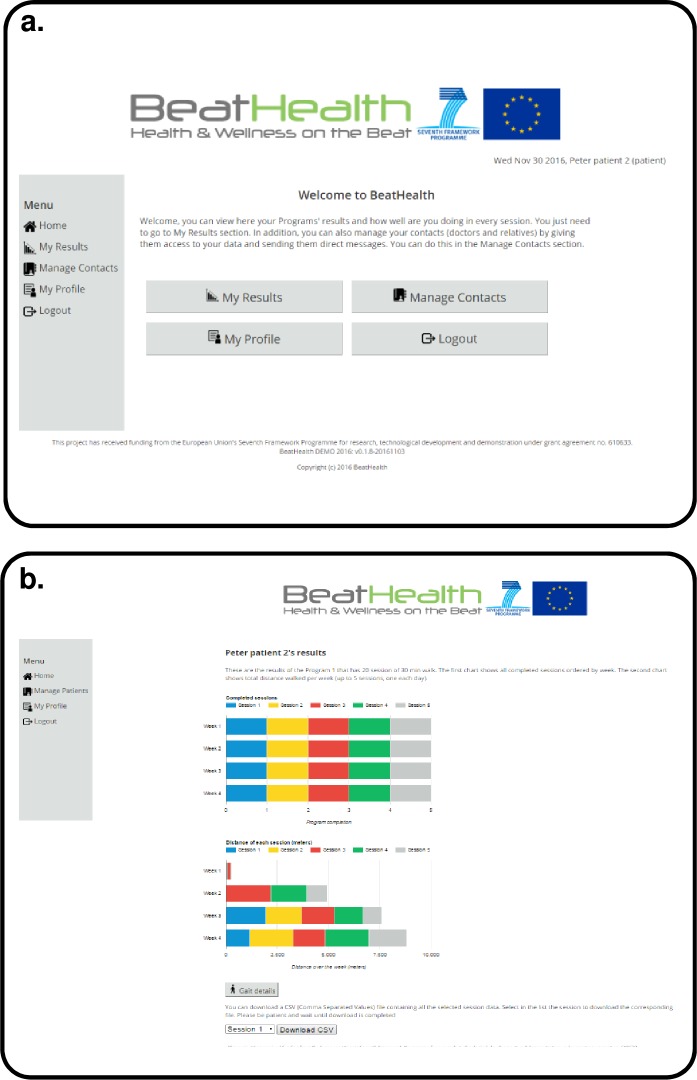
Functional requirements of the system were produced as a result of the initial exploration phase. Building upon these, mock-ups for the BeatHealth system were created. The mobile application was iterated twice, with the second version of it achieving a rating of 75 when assessed by participants through the System Usability Scale (SUS). After another iteration field trials were performed and the mobile application was rated with an average 78.6 using SUS. Participants rated two website mock-ups, one for health professionals and another for end-users, as good except from minor issues related to visual design (e.g. font size), which were resolved in the final version.
The high ratings obtained in the evaluation of the BeatHealth system demonstrate the benefit of applying a user centered design methodology which involves stakeholders from the very beginning. Other important lessons were learned through the process of design and development of the system, such as the importance of motivational aspects, the techniques which work best, and the extra care that has to be taken when evaluating non-functional mock-ups with end users.
节奏听觉刺激(RAS)是一种有效的技术,可以改善帕金森病患者(PwPD)的步态并减少冻结事件。BeatHealth 系统由移动应用程序、步态传感器和网站组成,利用了 RAS 技术的潜力。本文介绍了用于共同设计和评估系统的工具,并讨论了结果和结论。
使用人物角色、访谈、用例和民族志观察来定义系统的功能要求。为了与最终用户进行迭代和增量评估,创建了低保真原型。还对最终系统进行了现场试验。该过程遵循了为该项目定义的用户为中心的设计方法,旨在构建有用、可用且易于使用的系统。
系统的功能要求是通过初始探索阶段产生的。在此基础上,创建了 BeatHealth 系统的模型。移动应用程序迭代了两次,第二次迭代通过系统可用性量表(SUS)评估,获得了 75 分的评分。经过另一轮迭代,进行了现场试验,移动应用程序的 SUS 平均评分为 78.6。参与者对两个网站模型进行了评分,一个是针对健康专业人员的,另一个是针对最终用户的,除了与视觉设计(例如字体大小)相关的小问题外,都被评为良好,这些问题在最终版本中得到了解决。
在对 BeatHealth 系统的评估中获得的高分表明,从一开始就涉及利益相关者的用户为中心的设计方法是有益的。在系统的设计和开发过程中还学到了其他重要的经验教训,例如动机方面的重要性、最有效的技术以及在评估最终用户的非功能模型时需要格外小心。