Gulin Francine Sanchez, Menegueti Mayra Goncalves, Auxiliadora-Martins Maria, de Araujo Thamiris Ricci, Bellissimo-Rodrigues Fernando, Nassiff Aline, Basile-Filho Anibal, Laus Ana Maria
Department of Fundamental Nursing, University of Sao Paulo at Ribeirao Preto College of Nursing, Ribeirao Preto, Sao Paulo, Brazil.
Department of Surgery and Anatomy, Division of Intensive Care University of Sao Paulo at Ribeirao Preto Medical School, Ribeirao Preto, Sao Paulo, Brazil.
J Clin Med Res. 2018 Dec;10(12):898-903. doi: 10.14740/jocmr3636. Epub 2018 Oct 30.
The aim of this study was to identify factors associated with pressure injury (PI) occurrence in critically ill patients. This was a retrospective cohort study conducted at a mixed intensive care unit (ICU).
Univariate analysis and logistic regression were used to identify which variables are associated with PI.
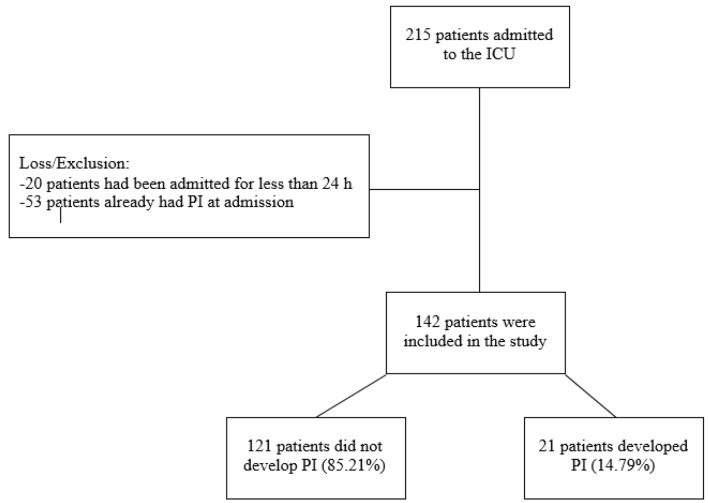
Twenty-one (15%) of 142 patients developed PI. The median and the range of the variables in the groups without and with PI were as follows: Braden scale risk score, 13 (8 - 20) and 10 (8 - 14) points, respectively; Acute Physiology and Chronic Health Evaluation II (APACHE II) death risk, 39% (2 - 97%) and 75% (26 - 96%), respectively; and length of stay in the ICU, 4 (2 - 36) and 16 (5 - 29) days, respectively. The socio-demographic variables included in the logistic regression were age (P = 0.09), Braden scale risk score (P = 0.0003), APACHE II death risk (P < 0.0001), length of stay in the ICU (P < 0.0001) and reason for ICU admission (P = 0.09). Only APACHE II death risk and length of stay in the ICU presented significant differences; the odds ratios were 1.05 and 1.25, respectively, and the 95% confidence intervals were 1.01 - 1.09 and 1.12 - 1.39, respectively.
APACHE II death risk and length of stay in the ICU are probably associated with PI occurrence in the study population.
本研究旨在确定危重症患者发生压力性损伤(PI)的相关因素。这是一项在综合性重症监护病房(ICU)进行的回顾性队列研究。
采用单因素分析和逻辑回归来确定哪些变量与PI相关。
142例患者中有21例(15%)发生了PI。无PI组和有PI组变量的中位数及范围如下:Braden量表风险评分分别为13分(8 - 20分)和10分(8 - 14分);急性生理与慢性健康状况评价II(APACHE II)死亡风险分别为39%(2 - 97%)和75%(26 - 96%);ICU住院时间分别为4天(2 - 36天)和16天(5 - 29天)。纳入逻辑回归的社会人口统计学变量包括年龄(P = 0.09)、Braden量表风险评分(P = 0.0003)、APACHE II死亡风险(P < 0.0001)、ICU住院时间(P < 0.0001)和入住ICU的原因(P = 0.09)。只有APACHE II死亡风险和ICU住院时间存在显著差异;优势比分别为1.05和1.25,95%置信区间分别为1.01 - 1.09和1.12 - 1.39。
在本研究人群中,APACHE II死亡风险和ICU住院时间可能与PI的发生有关。