Kutuk Zeynep B, Ergin Esra, Cakir Filiz Y, Gurgan Sevil
Hacettepe University, Department of Restorative Dentistry, Ankara, Turkey.
J Appl Oral Sci. 2018 Nov 8;27:e20180233. doi: 10.1590/1678-7757-2018-0233.
To analyze color change, microhardness and chemical composition of enamel bleached with in-office bleaching agent with different desensitizing application protocols.
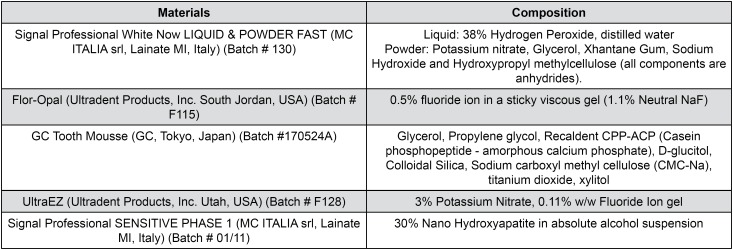
One hundred and seventeen polished anterior human enamel surfaces were obtained and randomly divided into nine groups (n = 13). After recording initial color, microhardness and chemical composition, the bleaching treatments were performed as G1: Signal Professional White Now POWDER&LIQUID FAST 38% Hydrogen peroxide(S); G2: S+Flor Opal/0.5% fluoride ion(F); G3: S+GC Tooth Mousse/Casein Phosphopeptide-Amorphous Calcium Phosphate (CPP-ACP) paste(TM); G4: S+UltraEZ/3% potassium nitrate&0.11% fluoride(U); G5: S+Signal Professional SENSITIVE PHASE 1/30% Nano-Hydroxyapatite (n-HAP) suspension(SP); G6: S-F mixture; G7: S-TM mixture; G8: S-U mixture; G9: S-SP mixture. Color, microhardness and chemical composition measurements were repeated after 1 and 14 days. The percentage of microhardness loss (PML) was calculated 1 and 14 days after bleaching. Data were analyzed with ANOVA, Welch ANOVA, Tukey and Dunnett T3 tests (p<0.05).
Color change was observed in all groups. The highest ΔE was observed at G7 after 1 day, and ΔE at G8 was the highest after 14 days (p<0.05). A decrease in microhardness was observed in all groups except G6 and G7 after 1 day. The microhardness of all groups increased after 14 days in comparison with 1 day after bleaching (p>0.05). PML was observed in all groups except G6 and G7 after bleaching and none of the groups showed PML after 14 days. No significant changes were observed after bleaching at Ca and P levels and Ca/P ratios at 1 or 14 days after bleaching (p>0.05). F mass increased only in G2 and G6, 1 day after bleaching (p<0.05).
The use of desensitizing agents containing fluoride, CPP-ACP, potassium nitrate or n-HAP after in-office bleaching or mixed in bleaching agent did not inhibit the bleaching effect. However, they all recovered microhardness of enamel 14 days after in-office bleaching.
分析采用不同脱敏应用方案的诊室漂白剂漂白后牙釉质的颜色变化、显微硬度及化学成分。
获取117个经抛光处理的人前牙牙釉质表面,并随机分为9组(每组n = 13)。记录初始颜色、显微硬度及化学成分后,进行如下漂白处理:G1组:Signal Professional White Now POWDER&LIQUID FAST 38%过氧化氢(S);G2组:S + Flor Opal/0.5%氟离子(F);G3组:S + GC Tooth Mousse/酪蛋白磷酸肽 - 无定形磷酸钙(CPP - ACP)糊剂(TM);G4组:S + UltraEZ/3%硝酸钾和0.11%氟化物(U);G5组:S + Signal Professional SENSITIVE PHASE 1/30%纳米羟基磷灰石(n - HAP)悬浮液(SP);G6组:S - F混合物;G7组:S - TM混合物;G8组:S - U混合物;G9组:S - SP混合物。漂白1天和14天后重复进行颜色、显微硬度及化学成分测量。计算漂白1天和14天后的显微硬度损失百分比(PML)。数据采用方差分析、韦尔奇方差分析、Tukey检验和Dunnett T3检验进行分析(p<0.05)。
所有组均观察到颜色变化。漂白1天后,G7组的ΔE值最高;漂白14天后,G8组ΔE值最高(p<0.05)。漂白1天后,除G6组和G7组外,所有组的显微硬度均降低。与漂白后1天相比,所有组在漂白14天后显微硬度均有所增加(p>0.05)。漂白后,除G6组和G7组外,所有组均观察到PML,且14天后所有组均未出现PML。漂白1天或14天后,Ca和P水平及Ca/P比值在漂白后均未观察到显著变化(p>0.05)。仅在漂白1天后,G2组和G6组的F质量增加(p<0.05)。
诊室漂白后使用含氟化物、CPP - ACP、硝酸钾或n - HAP的脱敏剂或与漂白剂混合使用,均不会抑制漂白效果。然而,它们均能在诊室漂白14天后恢复牙釉质的显微硬度。