Institute of Psychology, Clinical Psychology Unit, Leiden University, Leiden, the Netherlands.
Department of Child Development and Education, University of Amsterdam, Amsterdam, the Netherlands.
Dev Sci. 2019 May;22(3):e12772. doi: 10.1111/desc.12772. Epub 2019 Jan 13.
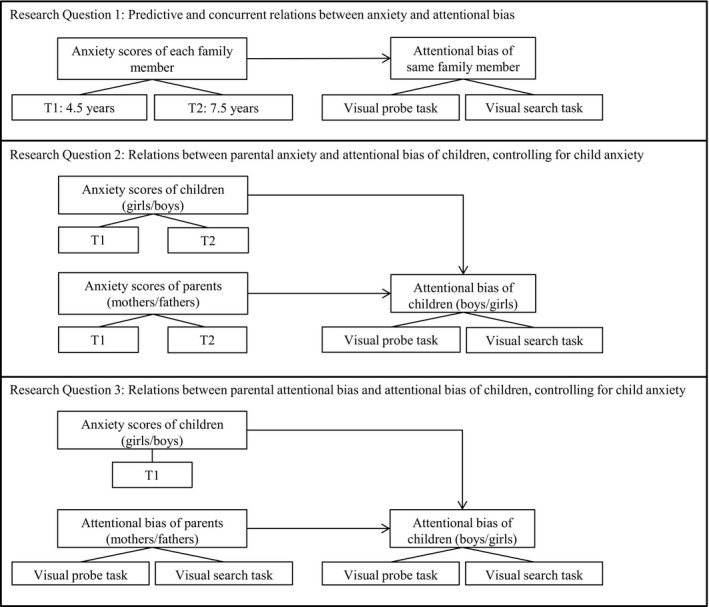
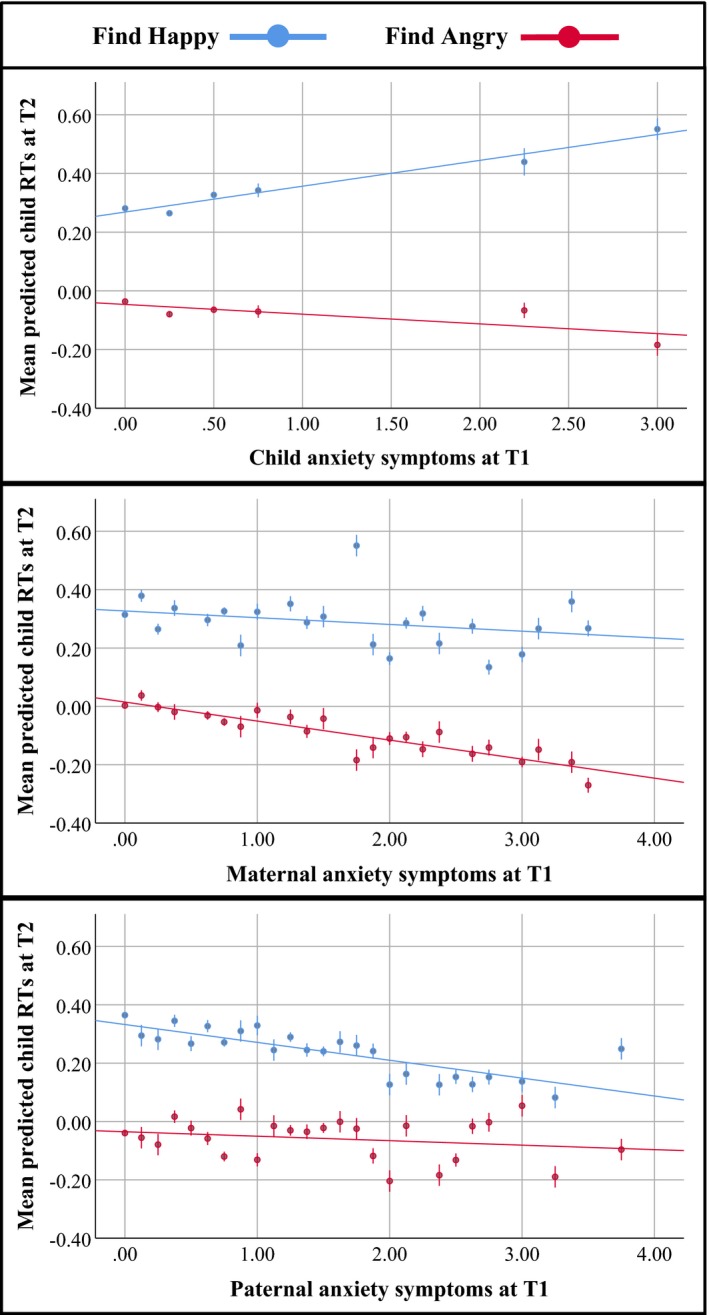
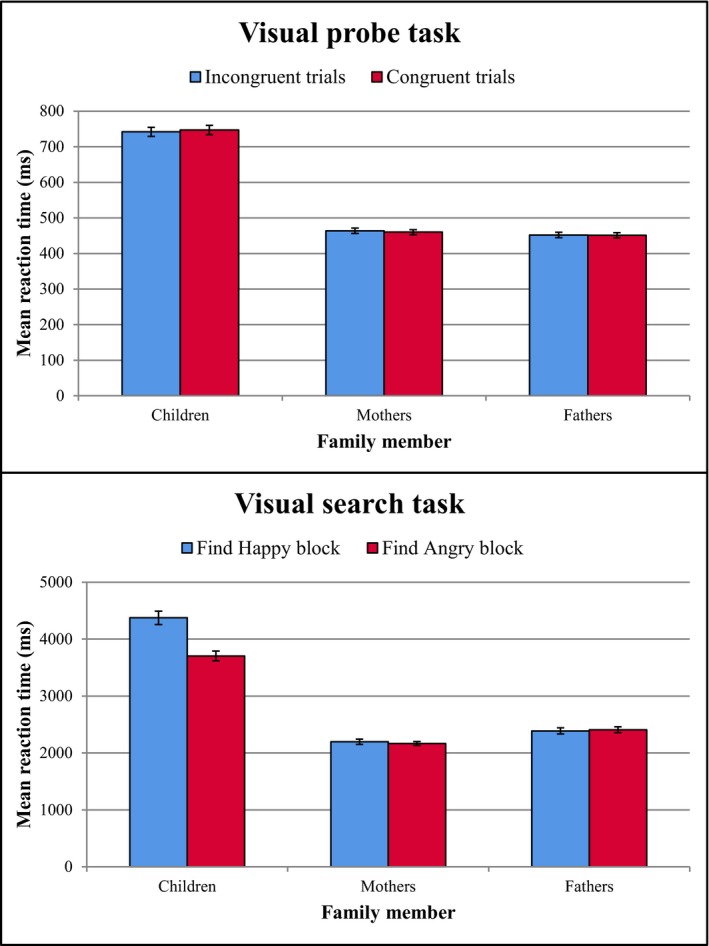
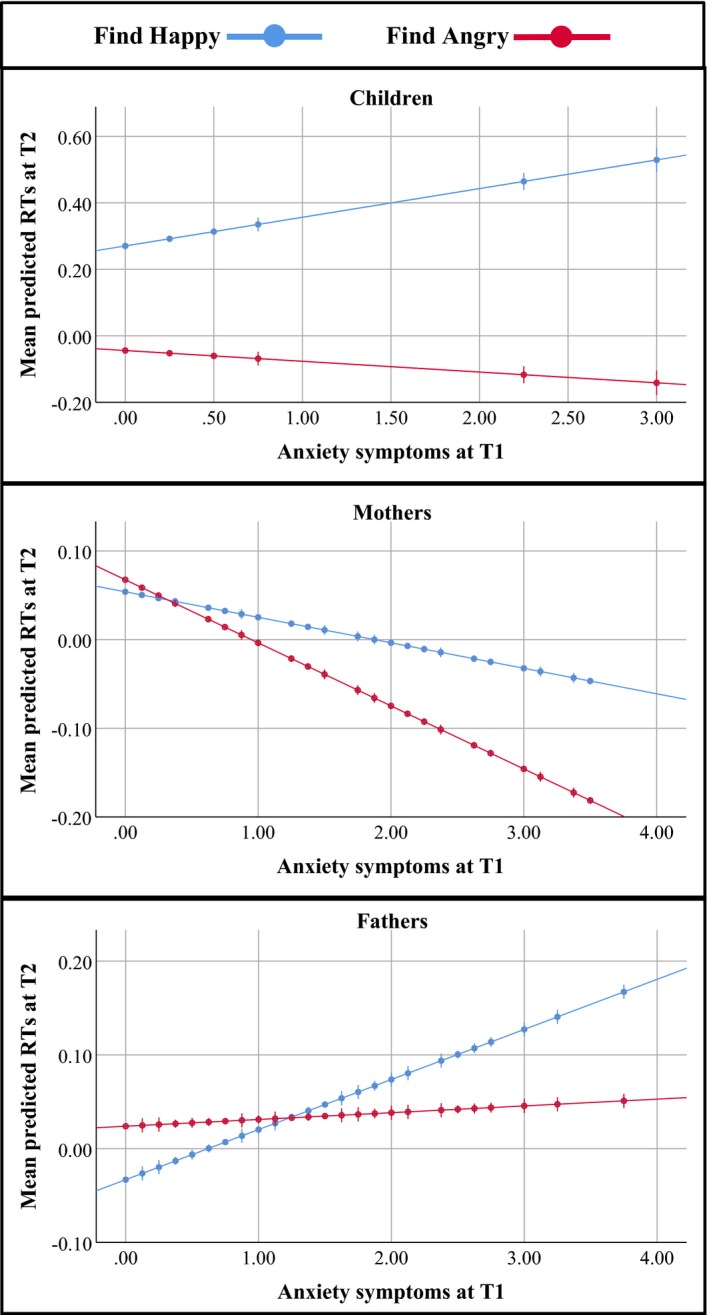
Earlier evidence has revealed a bi-directional causal relationship between anxiety and attention biases in adults and children. This study investigated the prospective and concurrent relations between anxiety and attentional bias in a sample of 89 families (mothers, fathers, and first-born children). Parents' and children's attentional bias was measured when children were 7.5 years old, using both a visual probe task and visual search task with angry versus happy facial expressions. Generalized and social anxiety symptoms in parents and children were measured when children were 4.5 and 7.5 years old. Anxiety in parents and children was prospectively (but not concurrently) related to their respective attentional biases to threat: All participants showed a larger attentional bias to threat in the visual search (but not in the visual probe) task if they were more anxious at the 4.5 (but not at the 7.5) year measurement. Moreover, parents' anxiety levels were prospectively predictive of the visual search attentional bias of their children after controlling for child anxiety. More anxiety in mothers at 4.5 years was related to a faster detection of angry among happy faces, while more anxiety in fathers predicted a faster detection of happy among angry faces in children at 7.5 years. We found no direct association between parental and child attentional biases. Our study contributes to the recently emerging literature on attentional biases as a potential mechanism in the intergenerational transmission of anxiety by showing that parents' anxiety rather than parents' attentional bias contributes to the intergenerational transmission of risk for child anxiety.
先前的证据表明,焦虑和注意力偏向在成年人和儿童之间存在双向因果关系。本研究在 89 个家庭(母亲、父亲和长子/女)样本中调查了焦虑和注意力偏向之间的前瞻性和同期关系。当孩子 7.5 岁时,使用视觉探测任务和带有愤怒与快乐表情的视觉搜索任务来测量父母和孩子的注意力偏向。当孩子 4.5 岁和 7.5 岁时,测量父母和孩子的一般和社交焦虑症状。父母和孩子的焦虑与他们各自对威胁的注意力偏向呈前瞻性(而非同期)相关:如果所有参与者在 4.5 岁(而非 7.5 岁)的测量中更焦虑,则他们在视觉搜索(而非视觉探测)任务中对威胁的注意力偏向更大。此外,在控制了孩子的焦虑后,父母的焦虑水平可以预测孩子在视觉搜索中的注意力偏向。母亲在 4.5 岁时的焦虑程度与在快乐面孔中更快地检测到愤怒有关,而父亲在 7.5 岁时的焦虑程度与孩子在愤怒面孔中更快地检测到快乐有关。我们没有发现父母和孩子的注意力偏向之间存在直接关联。我们的研究通过表明父母的焦虑而不是父母的注意力偏向会导致孩子焦虑的风险在代际间传递,为注意力偏向作为焦虑代际传递的潜在机制的新兴文献做出了贡献。