School of Electrical Engineering, Korea Advanced Institute of Science and Technology (KAIST), Daejeon 34141, Republic of Korea.
Sci Adv. 2018 Nov 9;4(11):eaas9530. doi: 10.1126/sciadv.aas9530. eCollection 2018 Nov.
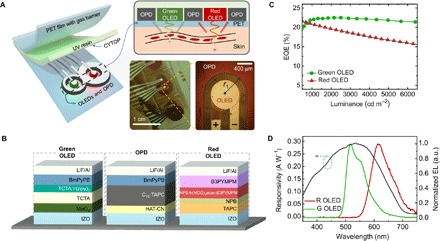
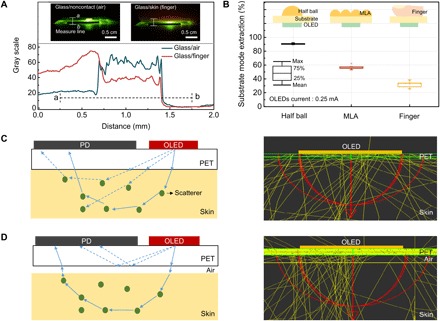
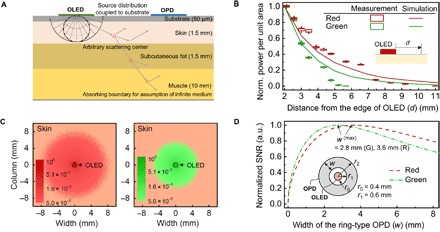
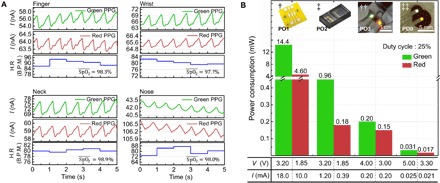
Pulse oximetry sensors have been playing a key role as devices to monitor elemental yet critical human health states. Conventional pulse oximetry sensors, however, have relatively large power consumption, impeding their use as stand-alone, continuous monitoring systems that can easily be integrated with everyday life. Here, we exploit the design freedom offered by organic technologies to realize a reflective patch-type pulse oximetry sensor with ultralow power consumption. On the basis of flexible organic light-emitting diodes and organic photodiodes designed via an optical simulation of color-sensitive light propagation within human skin, the proposed monolithically integrated organic pulse oximetry sensor heads exhibit successful operation at electrical power as low as 24 μW on average. We thereby demonstrate that organic devices not only have form factor advantages for such applications but also hold great promise as enablers for all-day wearable health monitoring systems.
脉搏血氧仪传感器在监测基本但关键的人体健康状态方面发挥着关键作用。然而,传统的脉搏血氧仪传感器的功耗相对较高,这阻碍了它们作为独立的、连续监测系统的使用,这些系统可以轻松集成到日常生活中。在这里,我们利用有机技术提供的设计自由度,实现了具有超低功耗的反射式贴片式脉搏血氧仪传感器。基于通过对人皮肤内色敏光传播的光学模拟设计的柔性有机发光二极管和有机光电二极管,所提出的单片集成有机脉搏血氧仪传感器头在低至 24 μW 的平均电功率下成功运行。因此,我们证明了有机器件不仅在这种应用中具有外形尺寸优势,而且作为全天候可穿戴健康监测系统的推动者也具有很大的潜力。