Civil Engineering, Indian Institute of Technology Gandhinagar, Gujarat, 382355, India.
Sci Rep. 2018 Nov 16;8(1):16922. doi: 10.1038/s41598-018-35348-w.
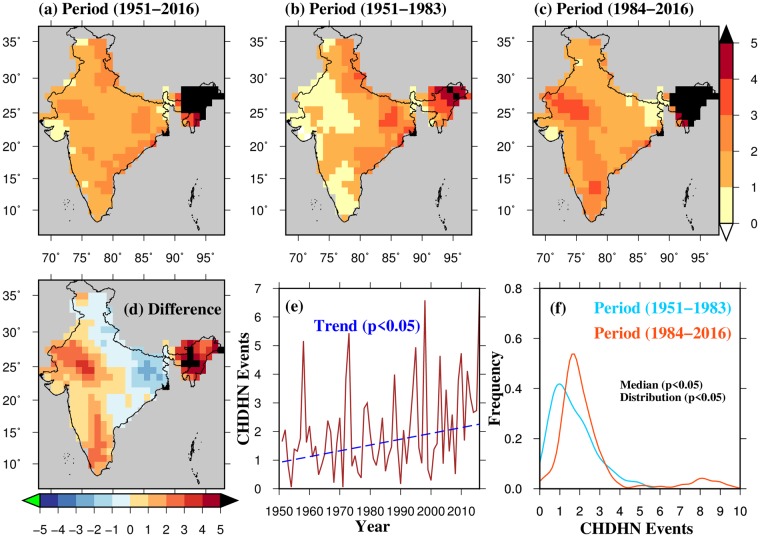
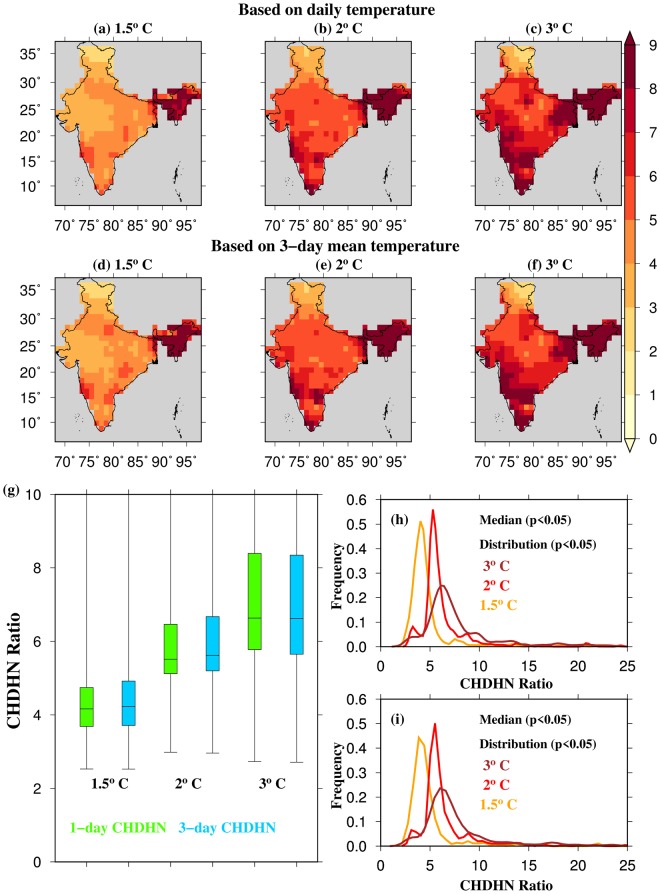
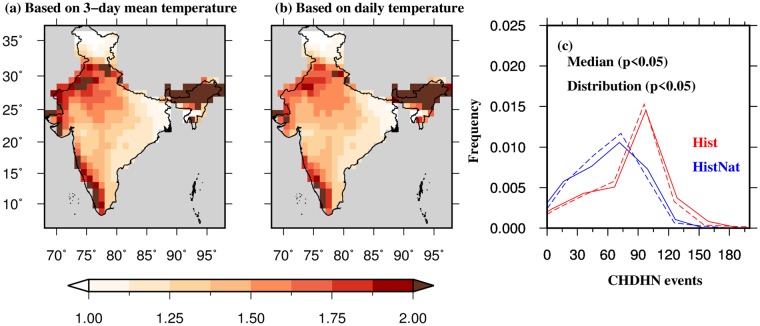
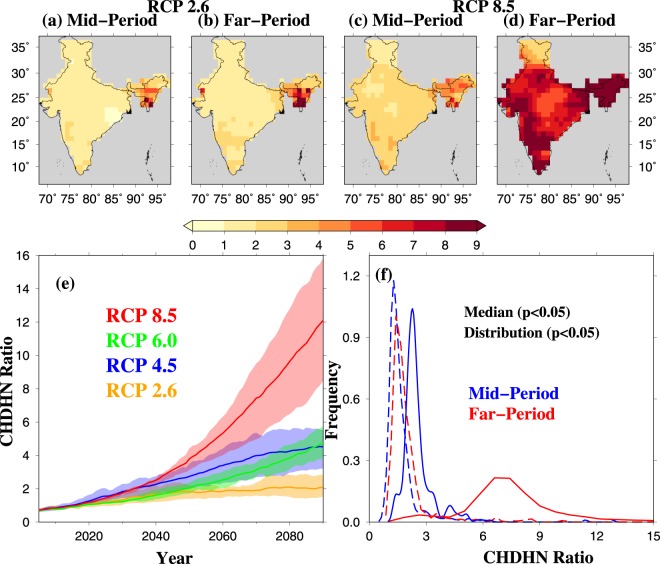
Heatwaves with severe impacts have increased and projected to become more frequent under warming climate in India. Concurrent day and nighttime heatwaves can exacerbate human discomfort causing high morbidity and mortality; however, their changes in the observed and projected climate remain unrecognized. Here using observations and model simulations from climate of 20 century plus (C20C+) detection and attribution (D&A) and coupled model intercomparison project 5 (CMIP5) projects, we show that 1 and 3-day concurrent hot day and hot night (CHDHN) events have significantly increased during the observed climate in India. Our results show that the anthropogenic emissions contribute considerably to the increase of 1 and 3-day CHDHN events in India. The frequency of 3-day CHDHN events is projected to increase 12-fold of the current level by the end of 21 century and 4-fold by the mid 21 century under the high emission pathway of RCP 8.5. The increase in 3-day CHDHN events can be limited to only 2-fold by the end of 21 century under low emission scenario of RCP 2.6. One and 3-day CHDHN events are projected to increase by 4, 6, and 8 folds of the current level in India under the 1.5, 2, and 3 °C warming worlds, respectively. Restricting global mean temperature below 1.5° from the pre-industrial level can substantially reduce the risk of 1 and 3-day CHDHN events and associated implications in India.
热浪对印度的影响日益严重,预计在气候变暖的情况下会更加频繁。同时发生的白天和夜间热浪会加剧人体不适,导致高发病率和死亡率;然而,在观测和预测气候中,它们的变化仍然没有被认识到。在这里,我们使用气候 20 世纪加(C20C+)检测归因(D&A)和耦合模式比较计划 5(CMIP5)项目的观测和模型模拟,表明在印度的观测气候中,1 天和 3 天同时发生的炎热白天和炎热夜晚(CHDHN)事件显著增加。我们的研究结果表明,人为排放对印度 1 天和 3 天 CHDHN 事件的增加有很大贡献。在 RCP8.5 高排放路径下,到 21 世纪末,3 天 CHDHN 事件的频率预计将比目前水平增加 12 倍,到 21 世纪中叶增加 4 倍。在 RCP2.6 低排放情景下,到 21 世纪末,3 天 CHDHN 事件的增加可限制在仅 2 倍以内。在印度,预计 1.5°C、2°C 和 3°C 变暖世界下,1 天和 3 天 CHDHN 事件将分别比目前水平增加 4 倍、6 倍和 8 倍。将全球平均温度限制在工业化前水平以下 1.5°C,可以大大降低印度发生 1 天和 3 天 CHDHN 事件的风险及其相关影响。