Oniszczenko Włodzimierz, Stanisławiak Ewa
Faculty of Psychology, University of Warsaw, Stawki 5-7, 00-183, Warsaw, Poland.
Faculty of Psychology, University of Finance and Management, Pawia 55, 01-030, Warsaw, Poland.
Eat Weight Disord. 2019 Apr;24(2):291-298. doi: 10.1007/s40519-018-0617-8. Epub 2018 Nov 17.
The main purpose of the present study was to investigate the association between sex and body mass index (BMI) as mediated by the temperament traits postulated by the regulative theory of temperament.
A group of 317 subjects, including 122 men and 195 women 18-82 years old (M = 31.93; SD = 12.64 years), was recruited from the general population to participate in the study. A cross-sectional design was applied in this study. Temperament was assessed using the formal characteristics of behaviour-temperament inventory revised version (FCB-TIR). In the sample, BMIs ranged from 16.51 to 35.56 kg/m (M = 23.31 kg/m; SD = 3.61 kg/m).
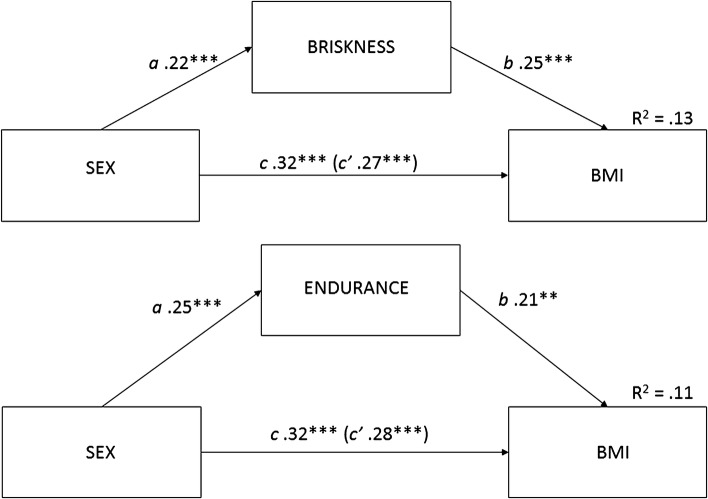
The male group had significantly higher BMI, briskness and endurance levels and significantly lower perseveration, sensory sensitivity and emotional reactivity levels compared to the female group. No significant differences between these groups were noted in terms of activity and rhythmicity. The correlations between BMI and briskness and between BMI and endurance were positive, while the correlations between BMI and perseveration and between BMI and activity were negative. The correlations among BMI, sensory sensitivity, emotional reactivity and rhythmicity were not statistically significant. The mediation analysis showed that briskness and endurance were significant partial mediators of the relationship between sex and BMI.
Sex and two temperament traits, briskness and endurance, were the best predictors of BMI. Briskness and endurance partially mediated the relationship between sex and BMI.
Descriptive cross-sectional study. Level V.
本研究的主要目的是探讨气质调节理论所假定的气质特质介导的性别与体重指数(BMI)之间的关联。
从普通人群中招募了317名受试者,包括122名男性和195名18 - 82岁的女性(M = 31.93;SD = 12.64岁)参与研究。本研究采用横断面设计。使用行为气质量表修订版(FCB - TIR)的形式特征来评估气质。样本中的BMI范围为16.51至35.56kg/m²(M = 23.31kg/m²;SD = 3.61kg/m²)。
与女性组相比,男性组的BMI、活力和耐力水平显著更高,而坚持性、感官敏感性和情绪反应性水平显著更低。在活动和节律性方面,这些组之间未观察到显著差异。BMI与活力之间以及BMI与耐力之间的相关性为正,而BMI与坚持性之间以及BMI与活动之间的相关性为负。BMI、感官敏感性、情绪反应性和节律性之间的相关性无统计学意义。中介分析表明,活力和耐力是性别与BMI之间关系的显著部分中介因素。
性别以及活力和耐力这两种气质特质是BMI的最佳预测因素。活力和耐力部分介导了性别与BMI之间的关系。
描述性横断面研究。V级。