Fitzgerald John S, Orysiak Joanna, Wilson Patrick B, Mazur-Różycka Joanna, Obminski Zbigniew
Human Performance Laboratory, Department of Kinesiology and Public Health Education, University of North Dakota, Grand Forks, ND, USA.
Department of Nutrition Physiology and Dietetics, Institute of Sport - National Research Institute, Warsaw, Poland.
Biol Sport. 2018 Sep;35(3):207-213. doi: 10.5114/biolsport.2018.74631. Epub 2018 Mar 31.
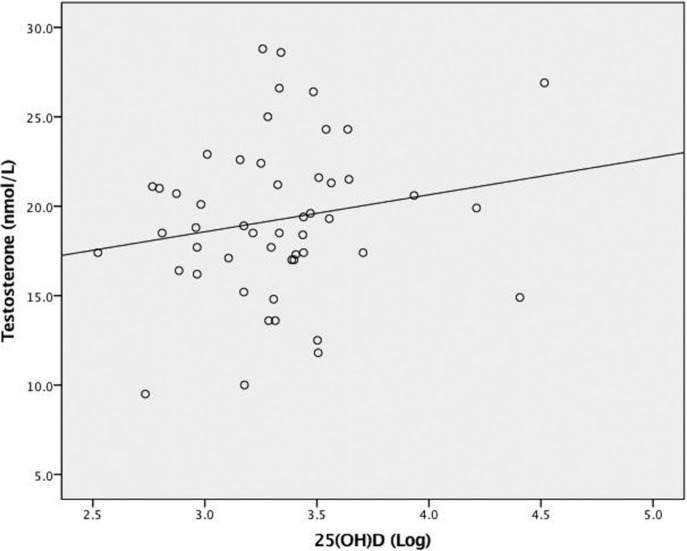
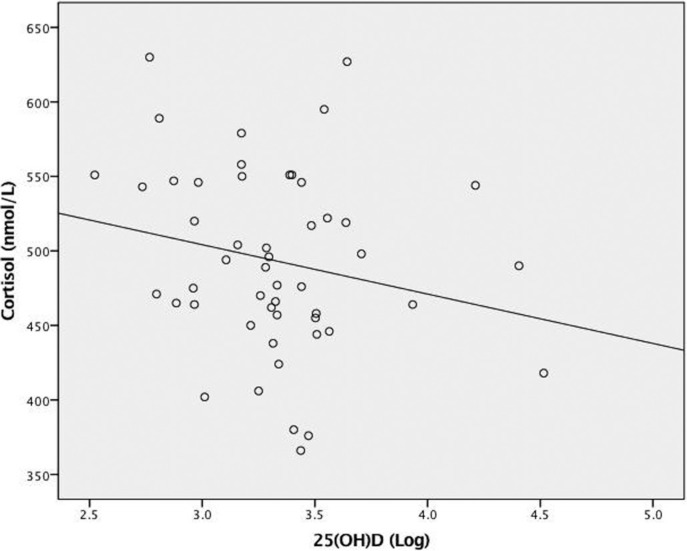
The identification of the vitamin D receptor in tissues related to testosterone and cortisol production, in conjunction with the observed correlations between vitamin D levels and these hormones in the general population, suggest vitamin D may influence testosterone and cortisol concentrations in athletes. A cross-sectional study design was used to evaluate the association between 25(OH)D and testosterone and cortisol concentrations in young male ice hockey players ( = 50). All athletes were recruited during October from the Sosnowiec area, Poland (50° N). Commercially available ELISA kits were used to determine total serum 25(OH)D, testosterone and cortisol concentrations. Serum 25(OH)D concentration was analyzed as both a continuous and dichotomous variable, binned at the criteria for deficiency (< 20 ng·ml), to investigate a threshold effect. Neither continuous (r = 0.18, p = 0.20) nor dichotomous ( = 0.16, = 0.27) 25(OH)D concentration was significantly correlated with testosterone concentration. A small, inverse correlation ( = -0.30, = 0.04) was detected between 25(OH)D and cortisol concentrations when analyzed as a dichotomous variable only. Serum 25(OH)D concentration was neither associated with testosterone ( = 0.09) nor cortisol concentrations ( = 0.11) after adjusting for age, fat free mass and fat mass in sequential linear regression. The inability of vitamin D status to independently predict testosterone and cortisol concentrations suggests that any performance-enhancing effects of vitamin D in athletes are unlikely to be mediated primarily through these hormones, at least amongst young male ice-hockey players.
在与睾酮和皮质醇生成相关的组织中发现了维生素D受体,再结合普通人群中维生素D水平与这些激素之间观察到的相关性,表明维生素D可能会影响运动员体内睾酮和皮质醇的浓度。本研究采用横断面研究设计,评估25(OH)D与年轻男性冰球运动员(n = 50)睾酮和皮质醇浓度之间的关联。所有运动员于10月从波兰索斯诺维茨地区(北纬50°)招募。使用市售ELISA试剂盒测定血清总25(OH)D、睾酮和皮质醇浓度。血清25(OH)D浓度作为连续变量和二分变量进行分析,以<20 ng·ml的缺乏标准进行分组,以研究阈值效应。25(OH)D浓度无论是连续变量(r = 0.18,p = 0.20)还是二分变量(β = 0.16,p = 0.27)均与睾酮浓度无显著相关性。仅将25(OH)D作为二分变量分析时,发现其与皮质醇浓度之间存在小的负相关(β = -0.30,p = 0.04)。在连续线性回归中调整年龄、去脂体重和脂肪量后,血清25(OH)D浓度与睾酮(β = 0.09)和皮质醇浓度(β = 0.11)均无关联。维生素D状态无法独立预测睾酮和皮质醇浓度,这表明维生素D对运动员的任何增强运动表现的作用不太可能主要通过这些激素介导,至少在年轻男性冰球运动员中是这样。