Muñoz-Gutiérrez Pablo Andrés, Giraldo Eduardo, Bueno-López Maximiliano, Molinas Marta
Electronic Instrumentation Technology, Universidad del Quindío, Armenia, Colombia.
Department of Electrical Engineering, Universidad Tecnológica de Pereira, Pereira, Colombia.
Front Integr Neurosci. 2018 Nov 2;12:55. doi: 10.3389/fnint.2018.00055. eCollection 2018.
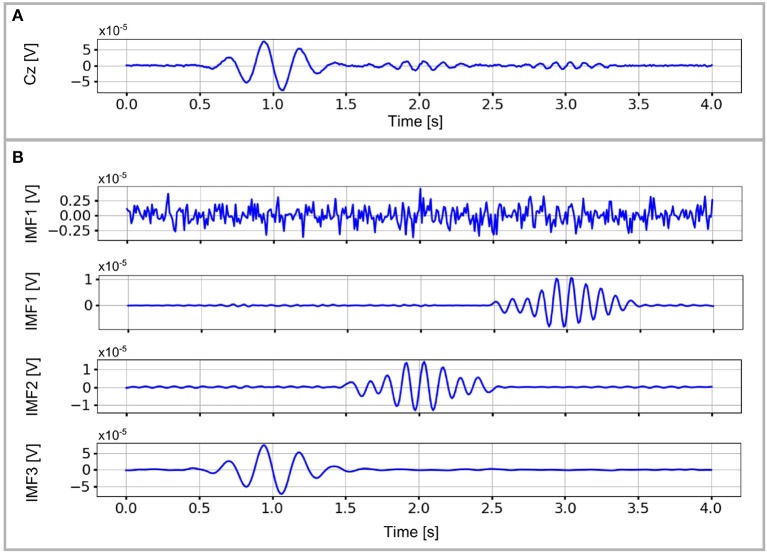
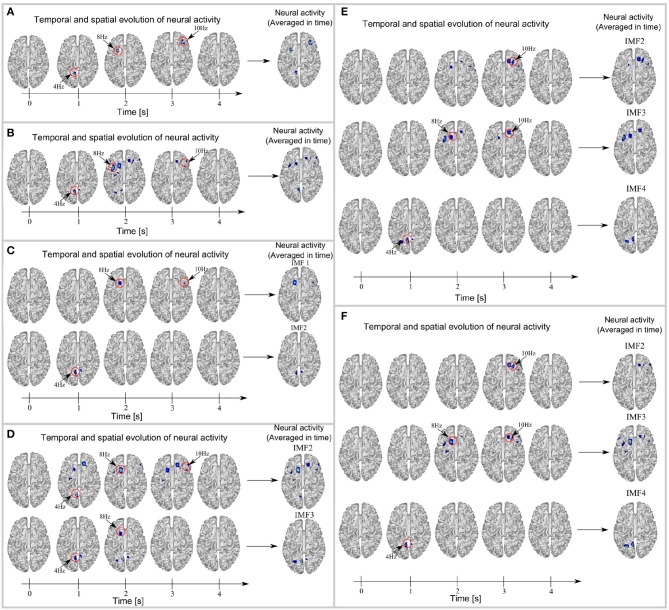
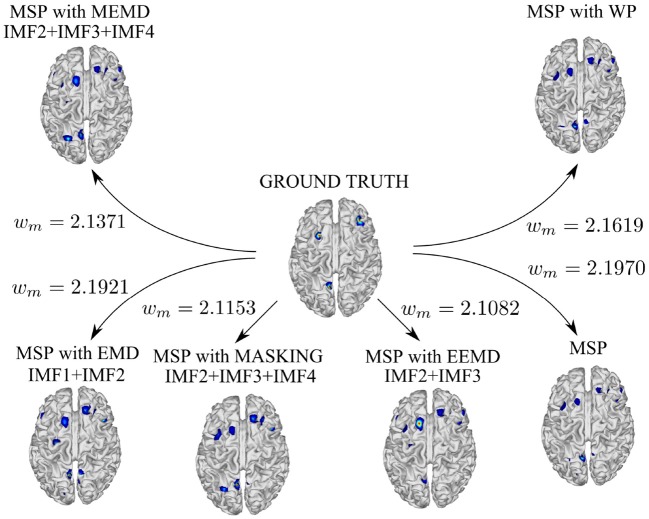
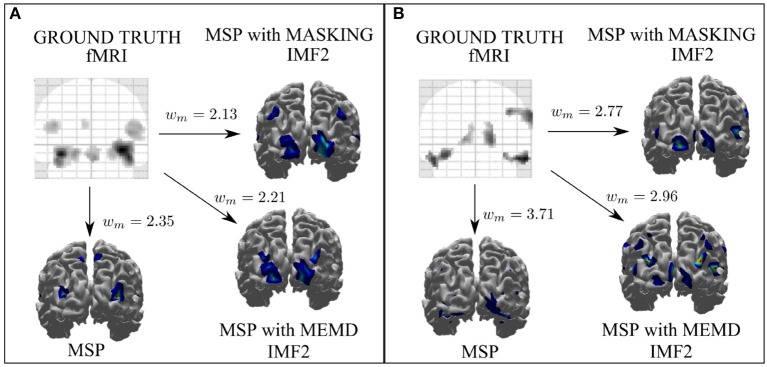
The localization of active brain sources from Electroencephalogram (EEG) is a useful method in clinical applications, such as the study of localized epilepsy, evoked-related-potentials, and attention deficit/hyperactivity disorder. The distributed-source model is a common method to estimate neural activity in the brain. The location and amplitude of each active source are estimated by solving the inverse problem by regularization or using Bayesian methods with spatio-temporal constraints. Frequency and spatio-temporal constraints improve the quality of the reconstructed neural activity. However, separation into frequency bands is beneficial when the relevant information is in specific sub-bands. We improved frequency-band identification and preserved good temporal resolution using EEG pre-processing techniques with good frequency band separation and temporal resolution properties. The identified frequency bands were included as constraints in the solution of the inverse problem by decomposing the EEG signals into frequency bands through various methods that offer good frequency and temporal resolution, such as empirical mode decomposition (EMD) and wavelet transform (WT). We present a comparative analysis of the accuracy of brain-source reconstruction using these techniques. The accuracy of the spatial reconstruction was assessed using the Wasserstein metric for real and simulated signals. We approached the mode-mixing problem, inherent to EMD, by exploring three variants of EMD: masking EMD, Ensemble-EMD (EEMD), and multivariate EMD (MEMD). The results of the spatio-temporal brain source reconstruction using these techniques show that masking EMD and MEMD can largely mitigate the mode-mixing problem and achieve a good spatio-temporal reconstruction of the active sources. Masking EMD and EEMD achieved better reconstruction than standard EMD, Multiple Sparse Priors, or wavelet packet decomposition when EMD was used as a pre-processing tool for the spatial reconstruction (averaged over time) of the brain sources. The spatial resolution obtained using all three EMD variants was substantially better than the use of EMD alone, as the mode-mixing problem was mitigated, particularly with masking EMD and EEMD. These findings encourage further exploration into the use of EMD-based pre-processing, the mode-mixing problem, and its impact on the accuracy of brain source activity reconstruction.
从脑电图(EEG)中定位活跃脑源是一种在临床应用中很有用的方法,例如用于局部癫痫、诱发相关电位以及注意力缺陷多动障碍的研究。分布式源模型是估计大脑神经活动的常用方法。通过正则化求解逆问题或使用具有时空约束的贝叶斯方法来估计每个活跃源的位置和幅度。频率和时空约束可提高重建神经活动的质量。然而,当相关信息存在于特定子频段时,将信号分离为不同频段是有益的。我们利用具有良好频段分离和时间分辨率特性的EEG预处理技术改进了频段识别并保留了良好的时间分辨率。通过诸如经验模态分解(EMD)和小波变换(WT)等提供良好频率和时间分辨率的各种方法,将EEG信号分解为不同频段,识别出的频段被作为约束条件纳入逆问题的求解中。我们对使用这些技术进行脑源重建的准确性进行了比较分析。使用Wasserstein度量对真实信号和模拟信号评估空间重建的准确性。我们通过探索EMD的三种变体:掩蔽EMD、集合EMD(EEMD)和多变量EMD(MEMD)来解决EMD固有的模态混叠问题。使用这些技术进行时空脑源重建的结果表明,掩蔽EMD和MEMD在很大程度上可以减轻模态混叠问题,并实现对活跃源的良好时空重建。当将EMD用作脑源空间重建(时间平均)的预处理工具时,掩蔽EMD和EEMD比标准EMD、多重稀疏先验或小波包分解实现了更好的重建。使用所有三种EMD变体获得的空间分辨率明显优于单独使用EMD,因为模态混叠问题得到了缓解,特别是掩蔽EMD和EEMD。这些发现鼓励进一步探索基于EMD的预处理、模态混叠问题及其对脑源活动重建准确性的影响。