Ghazi Sherbaf Farzaneh, Mohajer Bahram, Ashraf-Ganjouei Amir, Mojtahed Zadeh Mahtab, Javinani Ali, Sanjari Moghaddam Hossein, Shirin Shandiz Mehdi, Aarabi Mohammad Hadi
Faculty of Medicine, Tehran University of Medical Sciences, Tehran, Iran.
Non-communicable Diseases Research Center, Endocrinology and Metabolism Population Sciences Institute, Tehran University of Medical Sciences, Tehran, Iran.
Front Endocrinol (Lausanne). 2018 Nov 2;9:608. doi: 10.3389/fendo.2018.00608. eCollection 2018.
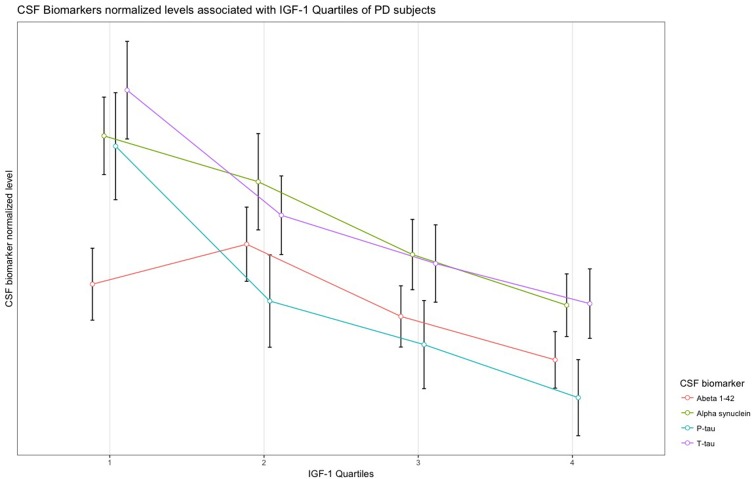
Growing evidence shows that impaired signaling of Insulin-like Growth Factor-1 (IGF-1) is associated with neurodegenerative disorders, such as Parkinson's disease (PD). However, there is still controversy regarding its proinflammatory or neuroprotective function. In an attempt to elucidate the contribution of IGF-1 in PD, we aimed to discover the relation between serum IGF-1 levels in drug-naïve early PD patients and cerebrospinal fluid (CSF) biomarkers as well as microstructural changes in brain white matter. The association between quartiles of serum IGF-1 levels and CSF biomarkers (α-synuclein, dopamine, amyloid-β, total tau, and phosphorylated tau) was investigated using adjusted regression models in 404 drug-naïve early PD patients with only mild motor manifestations and 188 age- and sex-matched healthy controls (HC) enrolled in the Parkinson's Progression Markers Initiative (PPMI). By using region of interest analysis and connectometry approach, we tracked the white matter microstructural integrity and diffusivity patterns in a subgroup of study participants with available diffusion MRI data to investigate the association between subcomponents of neural pathways with serum IGF-1 levels. PD patients had higher levels of IGF-1 compared to HC, although not statistically significant (mean difference: 3.60, = 0.44). However, after adjustment for possible confounders and correction for False Discovery Rate (FDR), IGF-1 was negatively correlated with CSF α-synuclein, total and phosphorylated tau levels only in PD subjects. The imaging analysis proved a significant negative correlation (FDR corrected -value = 0.013) between continuous levels of serum IGF-1 in patients with PD and the connectivity, but not integrity, in following fibers while controlling for age, sex, body mass index, depressive symptoms, education years, cognitive status and disease duration: middle cerebellar peduncle, cingulum, genu and splenium of the corpus callosum. No significant association was found between brain white matter microstructral measures or CSF markers of healthy controls and levels of IGF-1. Altered connectivity in specific white matter structures, mainly involved in cognitive and motor deterioration, in association with higher serum IGF-1 levels might propose IGF-1 as a potential associate of worse outcome in response to higher burden of α-synucleinopathy and tauopathy in PD.
越来越多的证据表明,胰岛素样生长因子-1(IGF-1)信号受损与神经退行性疾病有关,如帕金森病(PD)。然而,关于其促炎或神经保护功能仍存在争议。为了阐明IGF-1在PD中的作用,我们旨在发现初治早期PD患者的血清IGF-1水平与脑脊液(CSF)生物标志物以及脑白质微观结构变化之间的关系。在帕金森病进展标志物倡议(PPMI)中登记的404例仅有轻度运动表现的初治早期PD患者和188例年龄及性别匹配的健康对照(HC)中,使用校正回归模型研究血清IGF-1水平四分位数与CSF生物标志物(α-突触核蛋白、多巴胺、淀粉样β蛋白、总tau蛋白和磷酸化tau蛋白)之间的关联。通过使用感兴趣区域分析和连接测量方法,我们在一组有可用扩散MRI数据的研究参与者中追踪白质微观结构完整性和扩散模式,以研究神经通路子成分与血清IGF-1水平之间的关联。与HC相比,PD患者的IGF-1水平更高,尽管无统计学意义(平均差异:3.60,P = 0.44)。然而,在对可能的混杂因素进行校正并对错误发现率(FDR)进行校正后,IGF-1仅在PD受试者中与CSFα-突触核蛋白、总tau蛋白和磷酸化tau蛋白水平呈负相关。影像学分析证明,在控制年龄、性别、体重指数、抑郁症状、受教育年限、认知状态和疾病持续时间的情况下,PD患者血清IGF-1的连续水平与以下纤维的连接性(而非完整性)之间存在显著负相关(FDR校正P值 = 0.013):小脑中脚、扣带束、胼胝体膝部和压部。在健康对照的脑白质微观结构测量或CSF标志物与IGF-1水平之间未发现显著关联。特定白质结构中连接性的改变,主要涉及认知和运动功能恶化,与较高的血清IGF-1水平相关,这可能提示IGF-1是PD中α-突触核蛋白病和tau蛋白病负担加重导致预后较差的潜在相关因素。