Department of Molecular Biology, Cardiac Hypertrophy Laboratory, School of Biological Sciences, Madurai Kamaraj University, Madurai-625 021, Tamil Nadu, India.
DST Unit of Nanoscience & TUE, Department of Chemistry, Indian Institute of Technology, Chennai-600 036, Tamilnadu, India.
Sci Rep. 2018 Nov 19;8(1):17037. doi: 10.1038/s41598-018-35071-6.
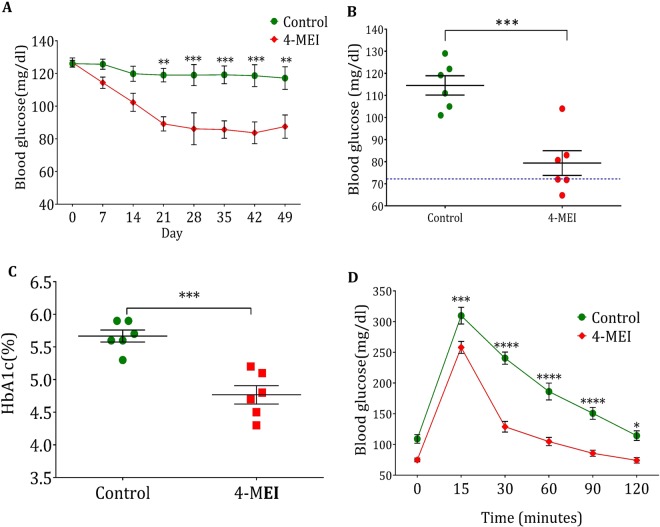
Caramel colours are the preferential food colouring agent globally, reaches wide age groups through eatables. Colas, a sweetened carbonated drink are most common caramel coloured beverage and its consumption is linked with diabetes, obesity, pancreatic cancer and other endocrine disorders. A major by-product produced during caramelization is 4-methylimidazole (4-MEI) that is detected in noteworthy concentrations in colas and other beverages. Previous studies revealed the neurotoxic and carcinogenic potential of 4-MEI in animals at higher doses but the effect of 4-MEI at theoretical maximum daily intake dose on glucose homeostasis is unexplored. Here, mice treated with 4-MEI (32 µg/kg bodyweight/day) for seven weeks exhibited severe hypoglycaemia and hyperinsulinemia mediated by hyperplasia of pancreatic beta cells and induces metabolic alterations. On combinatorial treatment, 4-MEI suppressed the glucogenic potential of non-artificial sweeteners and promotes lipogenesis. Furthermore, increased levels of C-peptide, LDL-cholesterol and triglycerides were observed in the humans with regular intake of 4-MEI containing beverages. In summary, 4-MEI induced pancreatic beta cell hyperplasia and leads to disruption of glucose and lipid homeostasis. This study suggests the need for further assessment and reconsideration of the wide usage of 4-MEI containing caramels as food additives.
焦糖色素是全球首选的食用色素,通过食品在广泛的年龄段中流行。可乐等加糖碳酸饮料是最常见的焦糖色素饮料,其消费与糖尿病、肥胖、胰腺癌和其他内分泌紊乱有关。焦糖化过程中产生的一种主要副产物是 4-甲基咪唑(4-MEI),在可乐和其他饮料中检测到其含量很高。先前的研究表明,4-MEI 在较高剂量下对动物具有神经毒性和致癌潜力,但在理论上的最大每日摄入剂量下,4-MEI 对葡萄糖稳态的影响尚未得到探索。在这里,用 4-MEI(32μg/kg 体重/天)处理七周的小鼠表现出严重的低血糖和高胰岛素血症,这是由胰岛β细胞增生介导的,并诱导代谢改变。在联合治疗中,4-MEI 抑制了非人工甜味剂的生糖作用,并促进了脂肪生成。此外,经常摄入含 4-MEI 的饮料的人群中观察到 C 肽、LDL 胆固醇和甘油三酯水平升高。总之,4-MEI 诱导胰岛β细胞增生,导致葡萄糖和脂质稳态紊乱。这项研究表明,需要进一步评估和重新考虑广泛使用含 4-MEI 的焦糖作为食品添加剂。