Department of Neurology, National Cheng Kung University Hospital and College of Medicine, National Cheng Kung University, Tainan, Taiwan.
Department of Family Medicine, National Cheng Kung University Hospital and College of Medicine, National Cheng Kung University, Tainan, Taiwan.
Sci Rep. 2018 Nov 19;8(1):17052. doi: 10.1038/s41598-018-35229-2.
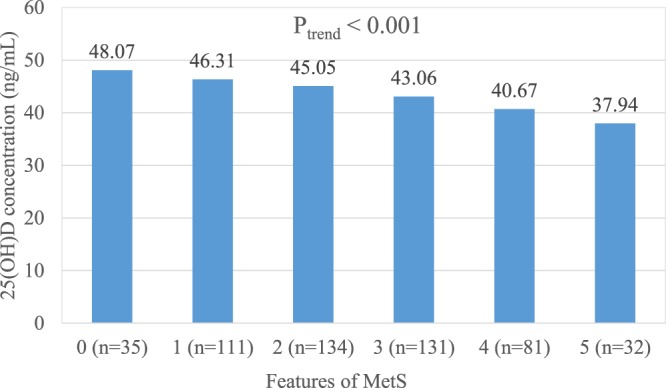
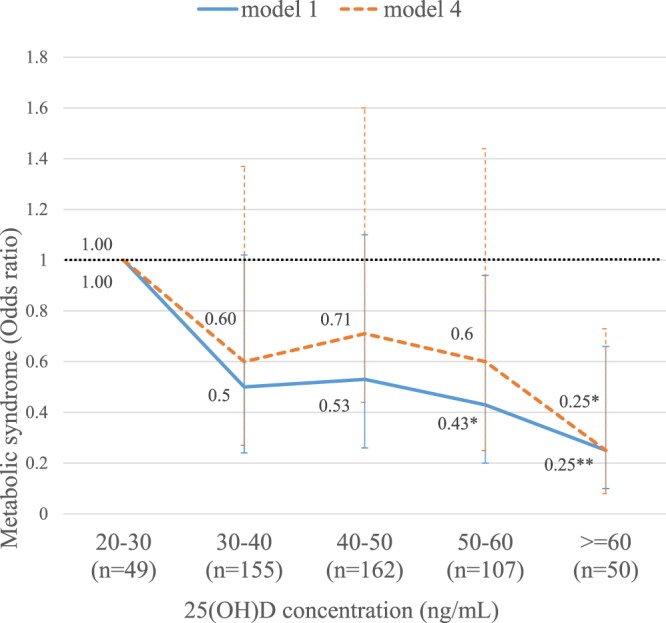
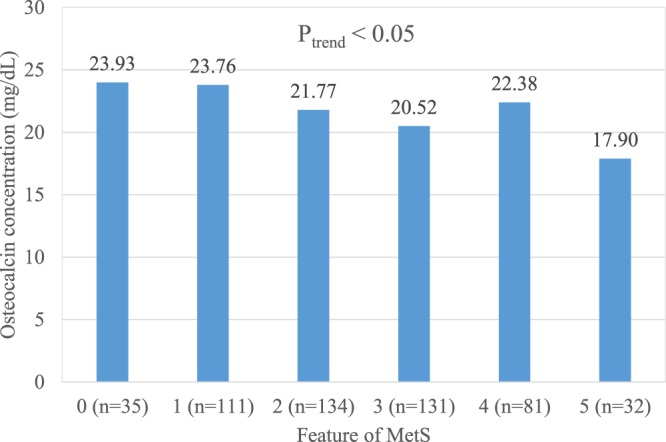
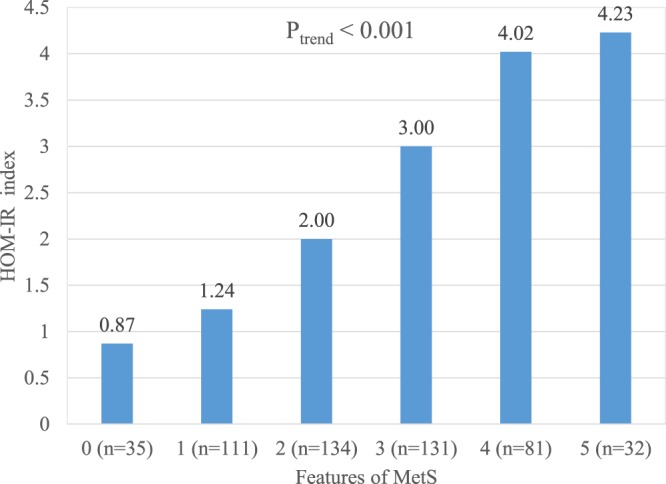
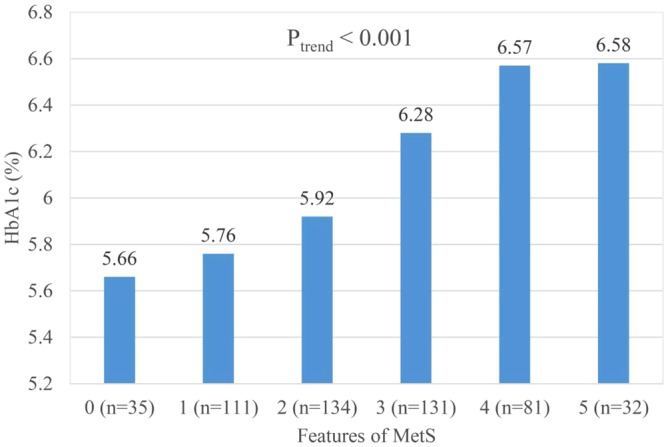
Vitamin D status is inversely associated with the prevalence of metabolic syndrome (MetS). Whether this is true in the elderly without vitamin D deficiency is rarely investigated. Our data source is a cross-sectional survey of 1,966 community-dwelling elderly Taiwanese in 2012. An overnight fasting blood were obtained for biochemistry variables. Vitamin D deficiency was defined as serum 25-hydroxyvitamin D3 [25(OH)D] concentration <20 ng/mL. MetS is defined using modified ATP-III criteria. Of 523 participants without vitamin D deficiency (Men/Women = 269/254, age = 76.0 ± 6.2 years old [65-102 years old]), mean 25(OH)D was 44.0 ± 11.1 ng/mL, and the MetS prevalence of MS was 46.5%. Serum 25(OH)D was negatively associated with osteocalcin, the homeostatic model assessment insulin resistance (HOMA-IR) index, body mass index (BMI), and glycated hemoglobin A1c. Participants with more MetS features have lower serum 25(OH)D and osteocalcin. Binary logistic regression models showed that 25(OH)D, physical activity, and osteocalcin were negatively independent MetS factors, but that the HOMA-IR index, BMI, and being female were positively independent factors. The risk of MetS was progressively lower along with the increased 25(OH)D concentration, even above 60 ng/mL. In conclusion, a low 25(OH)D concentration is an independent risk factor for MetS in elderly people without vitamin D deficiency.
维生素 D 状态与代谢综合征(MetS)的患病率呈负相关。在没有维生素 D 缺乏的老年人中,这种情况是否属实很少有研究调查。我们的数据来源是 2012 年对 1966 名居住在社区的台湾老年人进行的一项横断面调查。采集过夜禁食后的血液样本用于生化变量检测。维生素 D 缺乏定义为血清 25-羟维生素 D3 [25(OH)D]浓度<20ng/mL。MetS 采用改良的 ATP-III 标准定义。在 523 名无维生素 D 缺乏的参与者中(男性/女性=269/254,年龄=76.0±6.2 岁[65-102 岁]),平均 25(OH)D 为 44.0±11.1ng/mL,MetS 的 MS 患病率为 46.5%。血清 25(OH)D 与骨钙素、稳态模型评估胰岛素抵抗指数(HOMA-IR)指数、体重指数(BMI)和糖化血红蛋白 A1c 呈负相关。具有更多 MetS 特征的参与者血清 25(OH)D 和骨钙素水平较低。二元逻辑回归模型显示,25(OH)D、体力活动和骨钙素是 MetS 的负独立因素,而 HOMA-IR 指数、BMI 和女性是 MetS 的正独立因素。随着 25(OH)D 浓度的增加,MetS 的风险逐渐降低,甚至超过 60ng/mL。综上所述,在没有维生素 D 缺乏的老年人中,低 25(OH)D 浓度是 MetS 的独立危险因素。