Geden Matthew J, Romero Selena E, Deshmukh Mohanish
Department of Cell Biology and Physiology, University of North Carolina, Chapel Hill, NC, 27599, USA; Neuroscience Center, University of North Carolina, Chapel Hill, NC, 27599, USA.
Department of Cell Biology and Physiology, University of North Carolina, Chapel Hill, NC, 27599, USA; Neuroscience Center, University of North Carolina, Chapel Hill, NC, 27599, USA.
Neurosci Res. 2019 Feb;139:3-8. doi: 10.1016/j.neures.2018.11.007. Epub 2018 Nov 16.
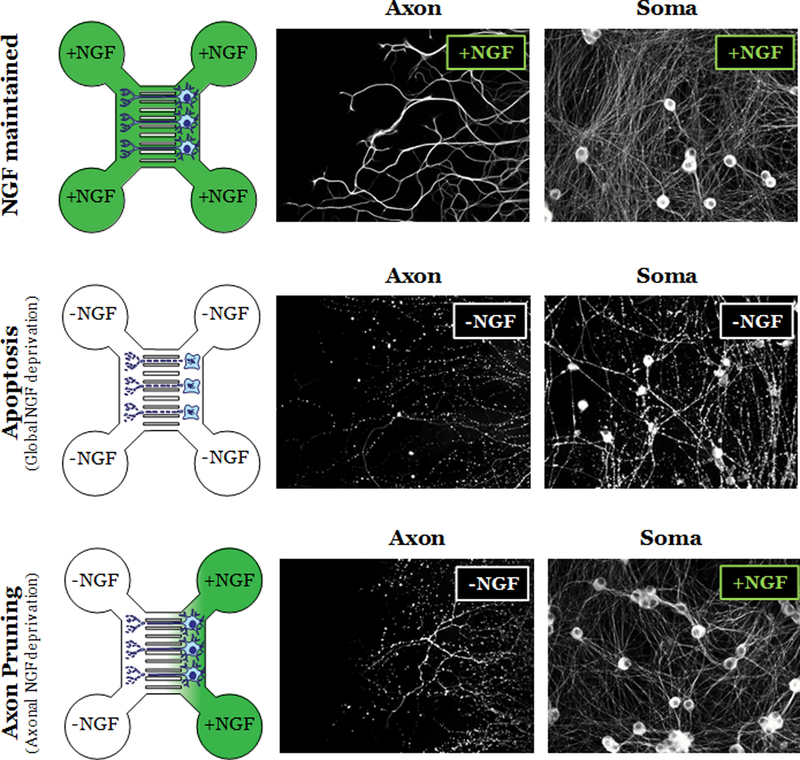
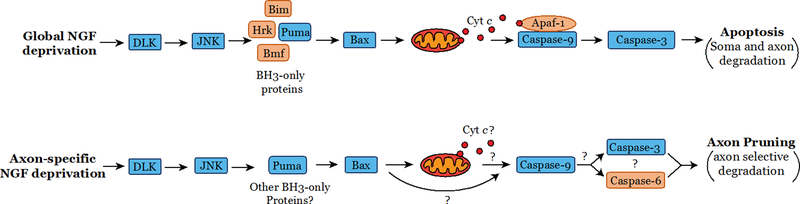
Neurons are capable of degenerating their axons for the physiological clearance and refinement of unnecessary connections via the programmed degenerative pathways of apoptosis and axon pruning. While both pathways mediate axon degeneration they are however distinct. Whereas in apoptosis the entire neuron, both axons and cell body, degenerates, in the context of axon pruning only the targeted axon segments are selectively degenerated. Interestingly, the molecular pathways mediating axon degeneration in these two contexts have significant mechanistic overlap but also retain distinct differences. In this review, we describe the peripheral neuronal cell culture models used to study the molecular pathways of apoptosis and pruning. We outline what is known about the molecular mechanisms of apoptosis and axon pruning and focus on highlighting the similarities and differences of these two pathways.
神经元能够通过凋亡和轴突修剪等程序性退化途径,使其轴突退化,以实现对不必要连接的生理性清除和优化。虽然这两种途径都介导轴突退化,但它们是不同的。在凋亡过程中,整个神经元,包括轴突和细胞体都会退化,而在轴突修剪的情况下,只有靶向的轴突段会选择性地退化。有趣的是,介导这两种情况下轴突退化的分子途径在机制上有显著重叠,但也存在明显差异。在这篇综述中,我们描述了用于研究凋亡和修剪分子途径的外周神经元细胞培养模型。我们概述了关于凋亡和轴突修剪分子机制的已知信息,并着重强调这两种途径的异同。