Division of General Internal Medicine, Department of Medicine, Weill Cornell Medical College, 1300 York Avenue, New York, NY, USA.
Center for Global Health, Weill Cornell Medicine, New York, USA.
BMC Public Health. 2018 Nov 19;18(1):1269. doi: 10.1186/s12889-018-6115-0.
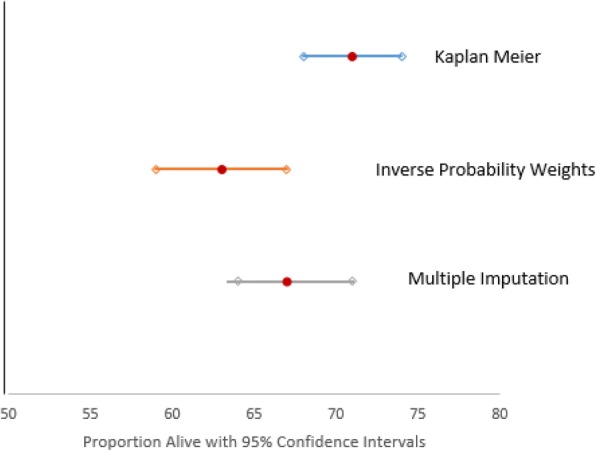
HIV programs are often assessed by the proportion of patients who are alive and retained in care; however some patients are categorized as lost to follow-up (LTF) and have unknown vital status. LTF is not an outcome but a mixed category of patients who have undocumented death, transfer and disengagement from care. Estimating vital status (dead versus alive) among this category is critical for survival analyses and program evaluation.
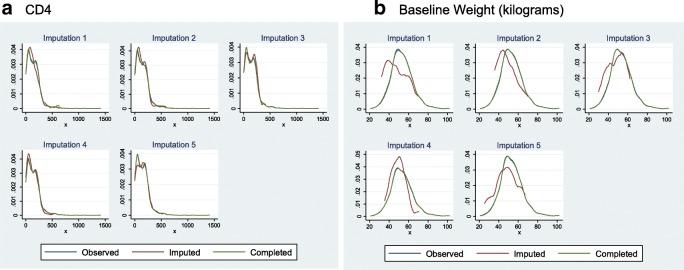
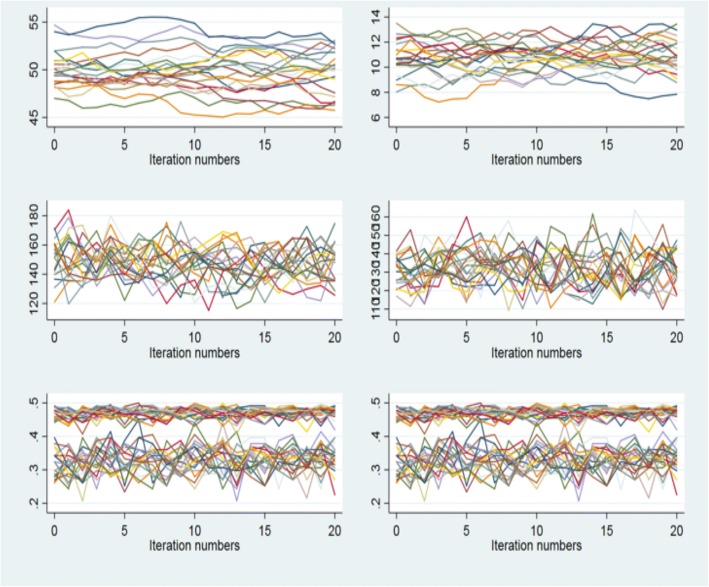
We used three methods to estimate survival in the cohort and to ascertain factors associated with death among the first cohort of HIV positive patients to receive antiretroviral therapy in Haiti: complete case (CC) (drops missing), Inverse Probability Weights (IPW) (uses tracking data) and Multiple Imputation with Chained Equations (MICE) (imputes missing data). Logistic regression was used to calculate odds ratios and 95% confidence intervals for adjusted models for death at 10 years. The logistic regression models controlled for sex, age, severe poverty (living on <$1 USD per day), Port-au-Prince residence and baseline clinical characteristics of weight, CD4, WHO stage and tuberculosis diagnosis.
Age, severe poverty, baseline weight and WHO stage were statistically significant predictors of AIDS related mortality across all models. Gender was only statistically significant in the MICE model but had at least a 10% difference in odds ratios across all models.
Each of these methods had different assumptions and differed in the number of observations included due to how missing values were addressed. We found MICE to be most robust in predicting survival status as it allowed us to impute missing data so that we had the maximum number of observations to perform regression analyses. MICE also provides a complementary alternative for estimating survival among patients with unassigned vital status. Additionally, the results were easier to interpret, less likely to be biased and provided an alternative to a problem that is often commented upon in the extant literature.
艾滋病毒项目通常通过生存和保留在护理中的患者比例来评估;然而,一些患者被归类为失访(LTF),且其生死状况未知。LTF 不是一种结果,而是指无记录的死亡、转移和脱离护理的患者的混合类别。在该类别中估计生死状况(死亡与存活)对于生存分析和项目评估至关重要。
我们使用三种方法来估计队列中的生存率,并确定与海地第一批接受抗逆转录病毒治疗的艾滋病毒阳性患者死亡相关的因素:完整病例(CC)(忽略缺失值)、逆概率加权(IPW)(使用跟踪数据)和链式方程多重插补(MICE)(插补缺失数据)。逻辑回归用于计算 10 年内死亡的调整模型的比值比和 95%置信区间。逻辑回归模型控制了性别、年龄、极度贫困(每天生活费低于 1 美元)、太子港居住和体重、CD4、世界卫生组织(WHO)阶段和结核病诊断等基线临床特征。
年龄、极度贫困、基线体重和 WHO 阶段在所有模型中都是艾滋病相关死亡率的统计学显著预测因素。性别仅在 MICE 模型中具有统计学意义,但在所有模型中比值比至少有 10%的差异。
由于处理缺失值的方式不同,每种方法都有不同的假设,并且纳入的观察数量也不同。我们发现 MICE 在预测生存状况方面最为稳健,因为它允许我们插补缺失数据,以便我们有最多的观察值进行回归分析。MICE 还为估计生死状况未知的患者的生存提供了一种补充选择。此外,结果更容易解释,不太可能存在偏差,并为现有文献中经常提到的问题提供了替代方案。