Gu Runxia, Yang Xue, Wei Hui
Leukemia Center, Institute of Hematology and Blood Diseases Hospital, Chinese Academy of Medical Sciences & Peking Union Medical College, Tianjin, 300020 People's Republic of China.
Biomark Res. 2018 Nov 8;6:32. doi: 10.1186/s40364-018-0146-7. eCollection 2018.
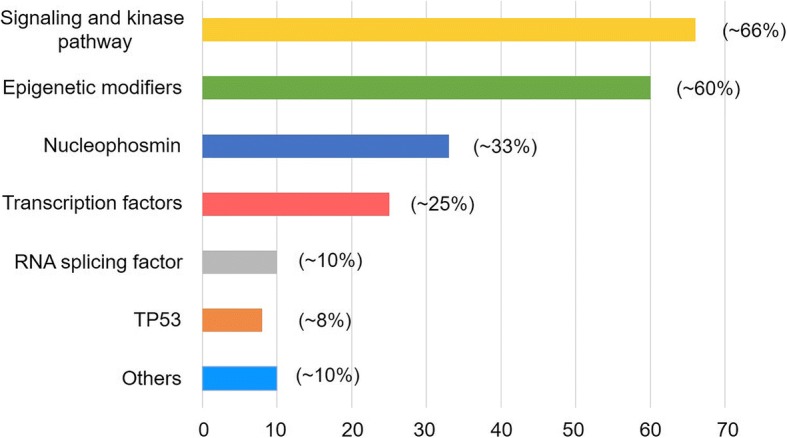
For decades, genetic aberrations including chromosome and molecular abnormalities are important diagnostic and prognostic factors in acute myeloid leukemia (AML). ATRA and imatinib have been successfully used in AML and chronic myelogenous leukemia, which proved that targeted therapy by identifying molecular lesions could improve leukemia outcomes. Recent advances in next generation sequencing have revealed molecular landscape of AML, presenting us with many molecular abnormalities. The individual prognostic information derived from a specific mutation could be modified by other molecular lesions. Therefore, the genomic complexity in AML poses a huge challenge to successful translation into more accurate risk stratification and targeted therapy. Herein, a summary of these mutations and targeted therapies are described. We focus on the prognostic information of recent identified molecular lesions and emerging targeted therapy.
几十年来,包括染色体和分子异常在内的基因畸变是急性髓系白血病(AML)重要的诊断和预后因素。全反式维甲酸(ATRA)和伊马替尼已成功应用于AML和慢性髓性白血病,这证明通过识别分子病变进行靶向治疗可改善白血病的治疗效果。新一代测序技术的最新进展揭示了AML的分子格局,为我们呈现了许多分子异常情况。源自特定突变的个体预后信息可能会被其他分子病变所改变。因此,AML的基因组复杂性对成功转化为更准确的风险分层和靶向治疗构成了巨大挑战。在此,将对这些突变和靶向治疗进行综述。我们重点关注近期发现的分子病变的预后信息和新兴的靶向治疗。