Department of Electrical Engineering, The Pennsylvania State University, University Park, PA, 16802, USA.
Department of Electrical Engineering, Princeton University, Princeton, NJ, 08544, USA.
Nat Commun. 2018 Nov 20;9(1):4893. doi: 10.1038/s41467-018-07383-8.
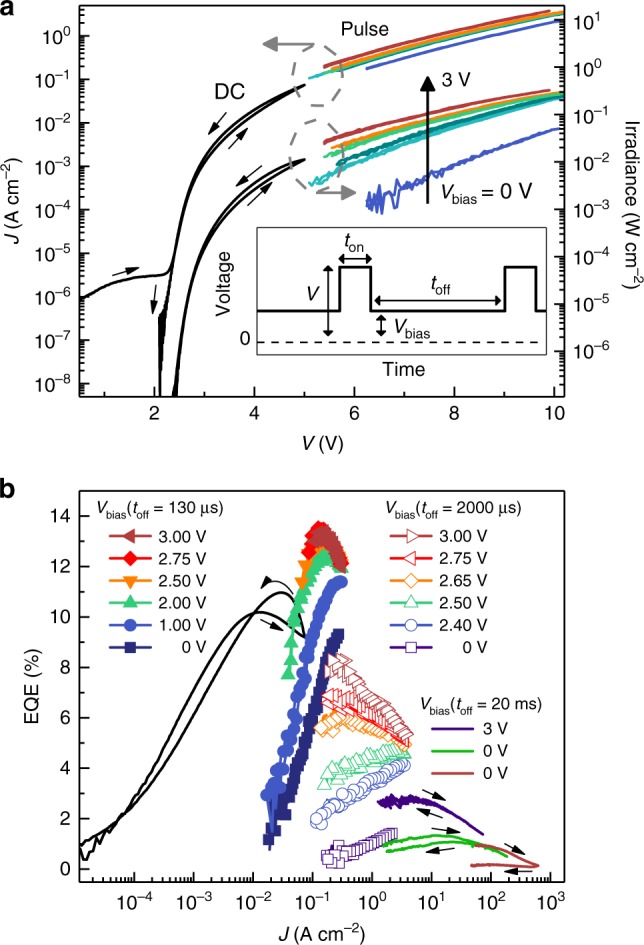
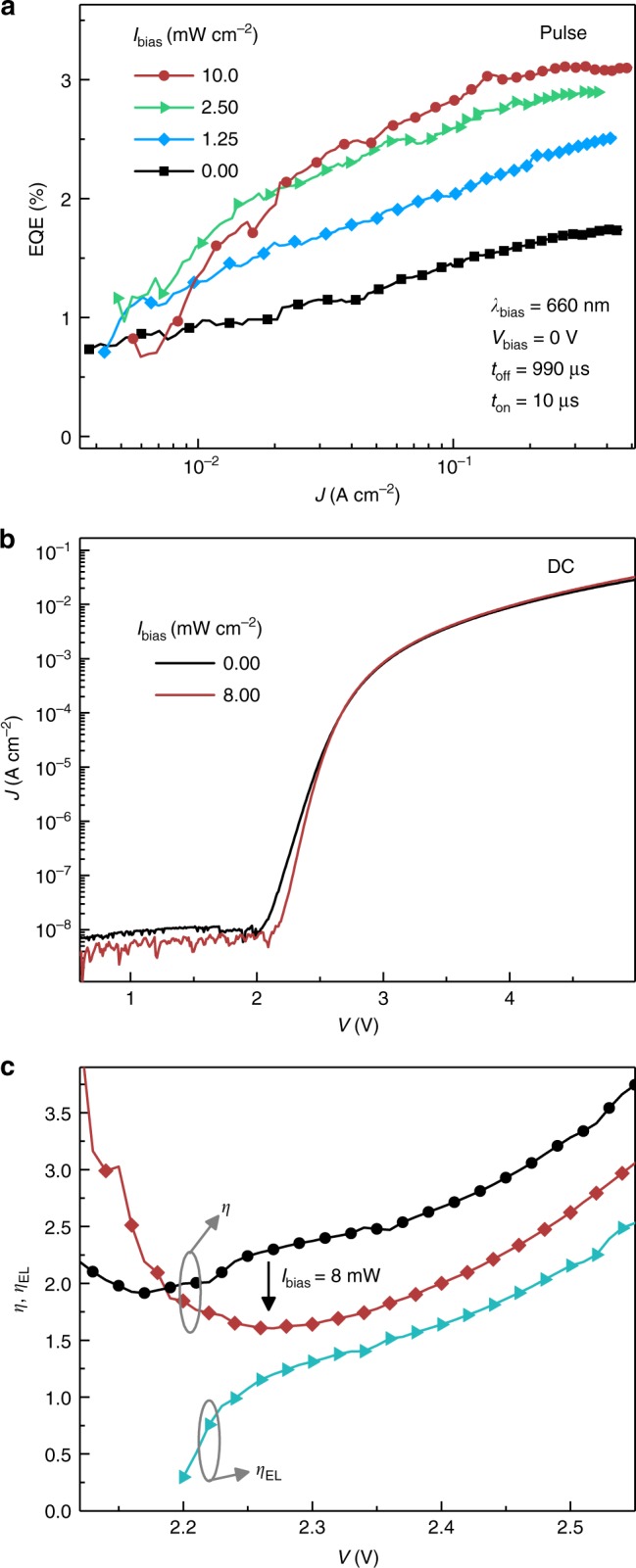
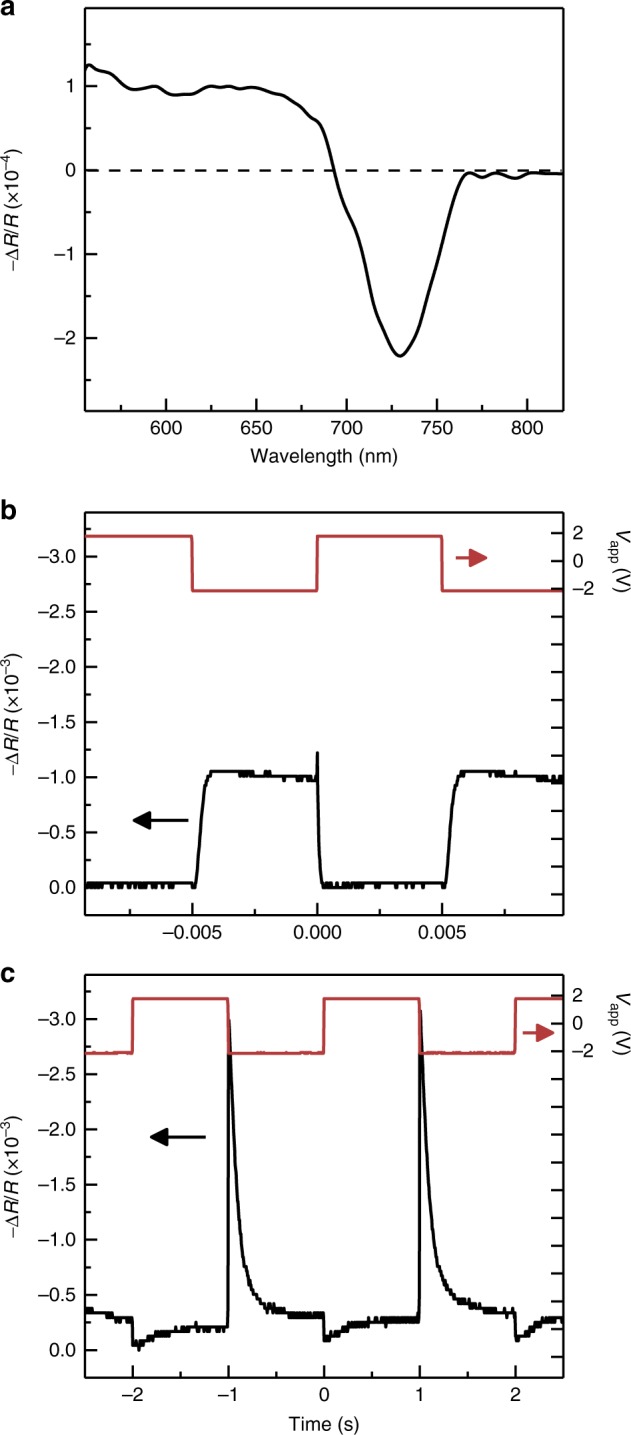
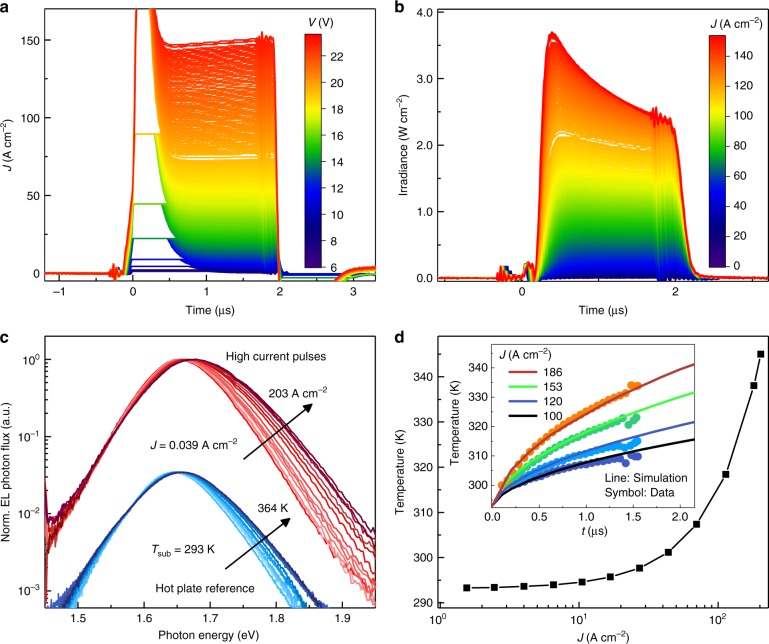
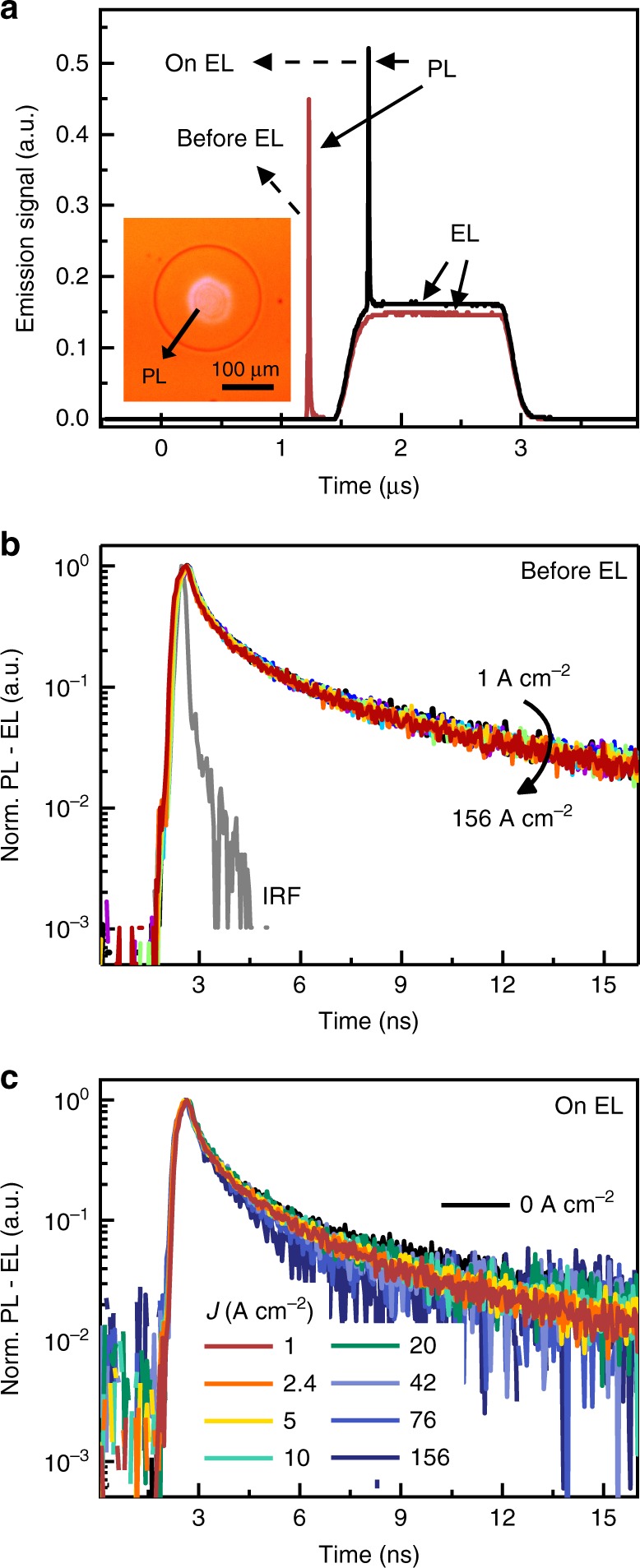
Hybrid perovskite semiconductors represent a promising platform for color-tunable light emitting diodes (LEDs) and lasers; however, the behavior of these materials under the intense electrical excitation required for electrically-pumped lasing remains unexplored. Here, we investigate methylammonium lead iodide-based perovskite LEDs under short pulsed drive at current densities up to 620 A cm. At low current density (J < 10 A cm), we find that the external quantum efficiency (EQE) depends strongly on the time-averaged history of the pulse train and show that this curiosity is associated with slow ion movement that changes the internal field distribution and trap density in the device. The impact of ions is less pronounced in the high current density regime (J > 10 A cm), where EQE roll-off is dominated by a combination of Joule heating and charge imbalance yet shows no evidence of Auger loss, suggesting that operation at kA cm current densities relevant for a laser diode should be within reach.
钙钛矿半导体代表了一种有前途的可调谐发光二极管(LED)和激光平台;然而,对于电泵浦激光所需的强电激发下这些材料的行为仍未被探索。在这里,我们研究了在高达 620A/cm 的电流密度下进行短脉冲驱动的基于甲脒碘化铅的钙钛矿 LED。在低电流密度(J<10A/cm)下,我们发现外量子效率(EQE)强烈依赖于脉冲序列的时间平均历史,并且表明这种奇特现象与缓慢的离子运动有关,该运动改变了器件内部的场分布和陷阱密度。在高电流密度(J>10A/cm)下,离子的影响不那么明显,其中 EQE 滚降主要由焦耳加热和电荷不平衡的组合引起,但没有证据表明存在俄歇损耗,这表明在与激光二极管相关的 kA/cm 电流密度下工作应该是可行的。