Isojunno Saana, Aoki Kagari, Curé Charlotte, Kvadsheim Petter Helgevold, Miller Patrick James O'Malley
Sea Mammal Research Unit, Scottish Oceans Institute, School of Biology, University of St Andrews, St Andrews, United Kingdom.
Atmosphere and Ocean Research Institute, The University of Tokyo, Chiba, Japan.
Front Physiol. 2018 Oct 25;9:1462. doi: 10.3389/fphys.2018.01462. eCollection 2018.
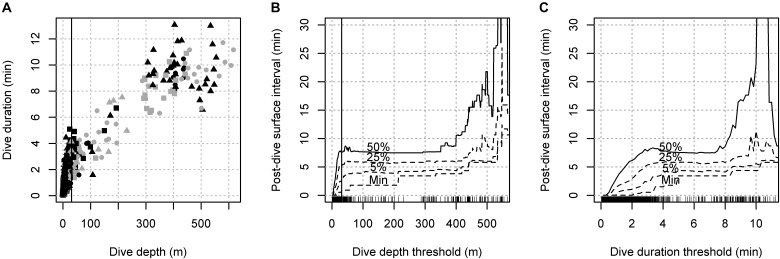
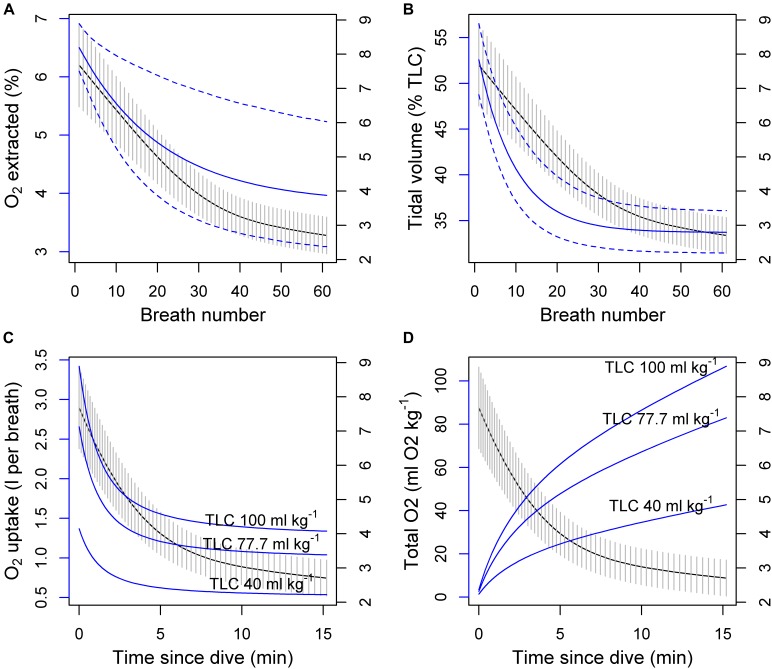
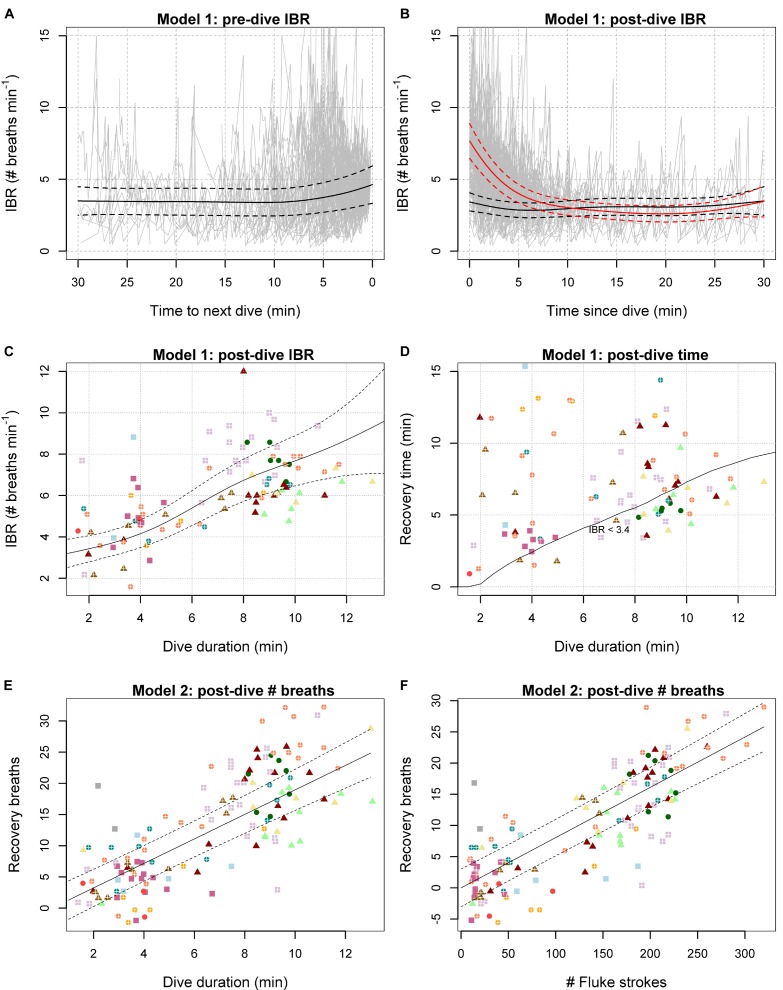
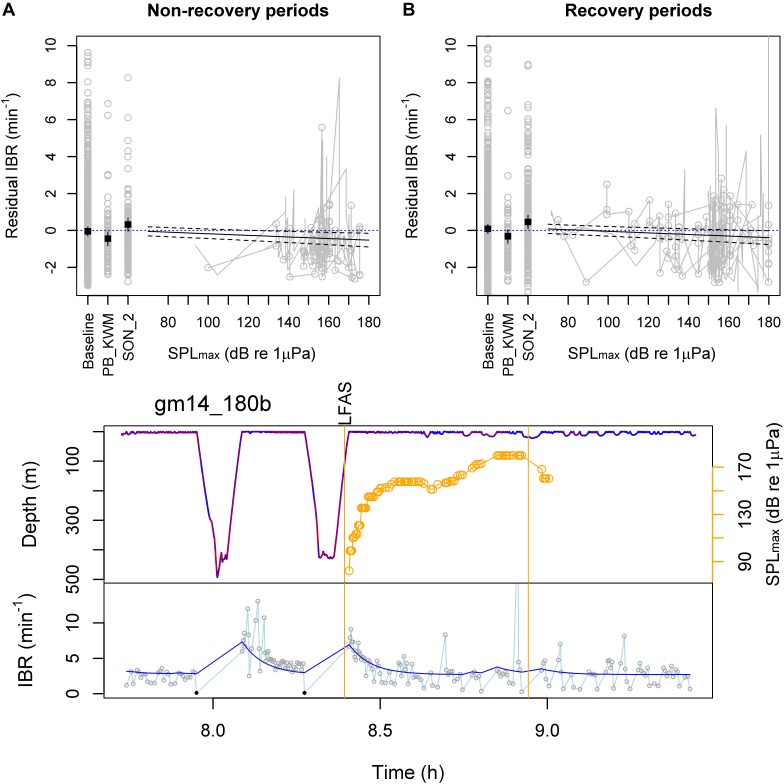
Air-breathing marine predators that target sub-surface prey have to balance the energetic benefit of foraging against the time, energetic and physiological costs of diving. Here we use on-animal data loggers to assess whether such trade-offs can be revealed by the breathing rates (BR) and timing of breaths in long-finned pilot whales (). We used the period immediately following foraging dives in particular, for which respiratory behavior can be expected to be optimized for gas exchange. Breath times and fluke strokes were detected using onboard sensors (pressure, 3-axis acceleration) attached to animals using suction cups. The number and timing of breaths were quantified in non-linear mixed models that incorporated serial correlation and individual as a random effect. We found that pilot whales increased their BR in the 5-10 min period prior to, and immediately following, dives that exceeded 31 m depth. While pre-dive BRs did not vary with dive duration, the initial post-dive BR was linearly correlated with duration of >2 min dives, with BR then declining exponentially. Apparent net diving costs were 1.7 (SE 0.2) breaths per min of diving (post-dive number of breaths, above pre-dive breathing rate unrelated to dive recovery). Every fluke stroke was estimated to cost 0.086 breaths, which amounted to 80-90% average contribution of locomotion to the net diving costs. After accounting for fluke stroke rate, individuals in the small body size class took a greater number of breaths per diving minute. Individuals reduced their breathing rate (from the rate expected by diving behavior) by 13-16% during playbacks of killer whale sounds and their first exposure to 1-2 kHz naval sonar, indicating similar responses to interspecific competitor/predator and anthropogenic sounds. Although we cannot rule out individuals increasing their per-breath O uptake to match metabolic demand, our results suggest that behavioral responses to experimental sound exposures were not associated with increased metabolic rates in a stress response, but metabolic rates instead appear to decrease. Our results support the hypothesis that maximal performance leads to predictable (optimized) breathing patterns, which combined with further physiological measurements could improve proxies of field metabolic rates and per-stroke energy costs from animal-borne behavior data.
以水下猎物为目标的海洋空气呼吸捕食者必须在觅食的能量收益与潜水的时间、能量和生理成本之间取得平衡。在这里,我们使用动物身上的数据记录器来评估这种权衡是否可以通过长鳍领航鲸的呼吸频率(BR)和呼吸时间来揭示。我们特别使用了觅食潜水后的时间段,预计在此期间呼吸行为会针对气体交换进行优化。使用吸盘附着在动物身上的船上传感器(压力、三轴加速度)检测呼吸时间和尾鳍摆动。在纳入序列相关性并将个体作为随机效应的非线性混合模型中对呼吸的次数和时间进行量化。我们发现,领航鲸在深度超过31米的潜水之前和之后的5-10分钟内会提高其呼吸频率。虽然潜水前的呼吸频率不会随潜水持续时间而变化,但潜水后的初始呼吸频率与持续时间超过2分钟的潜水呈线性相关,随后呼吸频率呈指数下降。明显的净潜水成本为每分钟潜水1.7(标准误0.2)次呼吸(潜水后的呼吸次数,高于与潜水恢复无关的潜水前呼吸频率)。估计每次尾鳍摆动的成本为0.086次呼吸,这相当于运动对净潜水成本的平均贡献的80-90%。在考虑尾鳍摆动频率后,小体型类别的个体每分钟潜水的呼吸次数更多。在播放虎鲸声音以及它们首次接触1-2千赫兹海军声纳期间,个体将呼吸频率(与潜水行为预期的频率相比)降低了13-16%,这表明它们对种间竞争者/捕食者和人为声音有类似的反应。虽然我们不能排除个体增加每次呼吸的氧气摄取量以匹配代谢需求的可能性,但我们的结果表明,对实验性声音暴露的行为反应与应激反应中代谢率的增加无关,相反,代谢率似乎会降低。我们的结果支持这样一种假设,即最佳性能会导致可预测的(优化的)呼吸模式,再结合进一步的生理测量,可从动物行为数据中改进野外代谢率和每次摆动能量成本的代理指标。