Division of Occupational and Environmental Medicine, Department of Laboratory Medicine, Lund University, Lund, Sweden.
J Anal Toxicol. 2019 May 1;43(4):277-283. doi: 10.1093/jat/bky091.
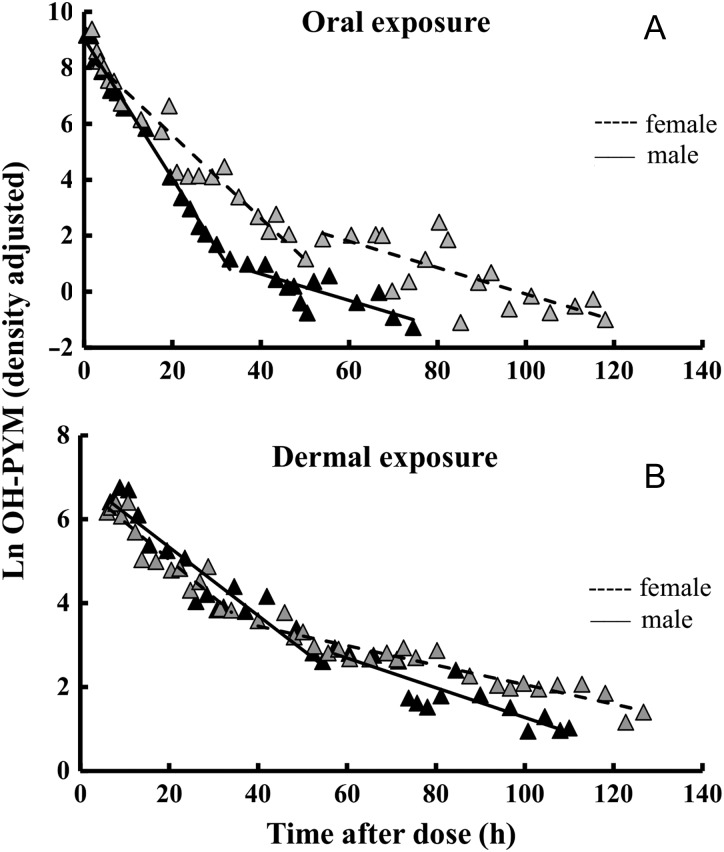
Pyrimethanil (PYM) is a fungicide used pre- and post-harvest on many crops. It has a low acute toxicity but is of toxicological concern because of its antiandrogenic properties. The aim of the current work was to investigate some metabolism and estimate elimination kinetics of PYM in humans after experimental oral and dermal exposure. A liquid chromatography triple quadrupole mass spectrometry (LC-MS-MS) method was developed and validated for the analysis of PYM and its metabolite 4-hydroxypyrimethanil (OH-PYM) in human urine. The method was applied to analyze urine obtained from two volunteers experimentally exposed to PYM. The elimination of OH-PYM seemed to follow first-order kinetics and a two-phase excretion. After the oral exposure, the elimination half-life of OH-PYM in the rapid phase was 5 and 3 h for the female and male volunteer, respectively. In the slower phase, it was 15 h in both volunteers. After the dermal exposure, the half-life in the rapid phase was 8 h in both volunteers. In the slower phase, it was 30 and 20 h, respectively. About 80% of the oral dose was recovered as urinary OH-PYM in both volunteers. The dermal dose recovered as urinary OH-PYM was 9.4% and 19%, in the female and male volunteer, respectively. OH-PYM was mainly found as a conjugate of sulfonate and glucuronic acid. No free PYM was found. The analytical method showed good within-run, between-run and between-batch precision with a coefficient of variation between 6% and 12%. A limit of detection of 0.1 ng/mL and a limit of quantification of 0.4 ng/mL were achieved for both the analytes. The method was applied to biomonitor PYM exposure in populations in Sweden. OH-PYM was detected in nearly 50% and 96% of samples from the environmentally and occupationally exposed populations, respectively.
苯并咪唑 44 号(PYM)是一种在许多农作物上用于预收获和收获后的杀菌剂。它的急性毒性较低,但由于其抗雄激素特性,具有毒理学关注。目前的工作旨在研究人体在实验性口服和皮肤暴露后对 PYM 的一些代谢和估计消除动力学。开发并验证了一种用于分析人尿中 PYM 和其代谢物 4-羟基嘧啶(OH-PYM)的液相色谱三重四极杆质谱(LC-MS-MS)方法。该方法应用于分析两名志愿者在实验中暴露于 PYM 后获得的尿液。OH-PYM 的消除似乎遵循一级动力学和两相排泄。口服暴露后,女性和男性志愿者的 OH-PYM 快速相消除半衰期分别为 5 和 3 小时。在较慢的阶段,分别为 15 小时。皮肤暴露后,两名志愿者的快速相半衰期分别为 8 小时。在较慢的阶段,分别为 30 和 20 小时。两名志愿者的口服剂量中约有 80%以尿液中 OH-PYM 的形式回收。女性和男性志愿者中,皮肤剂量回收的 OH-PYM 分别为 9.4%和 19%。OH-PYM 主要作为硫酸盐和葡萄糖醛酸的缀合物存在。未发现游离的 PYM。分析方法显示出良好的重复性、批间和批内精密度,变异系数在 6%至 12%之间。两种分析物的检测限均为 0.1ng/mL,定量限均为 0.4ng/mL。该方法用于监测瑞典人群中 PYM 的暴露情况。在环境和职业暴露人群中,分别有近 50%和 96%的样本检测到 OH-PYM。