Nutrition Epidemiology Group, School of Food Science and Nutrition, University of Leeds, Leeds LS2 9JT, UK.
Department of Clinical Nutrition, Faculty of Applied Medical Sciences, Umm Al-Qura University, Makkah 21421, Saudi Arabia.
Nutrients. 2018 Nov 20;10(11):1803. doi: 10.3390/nu10111803.
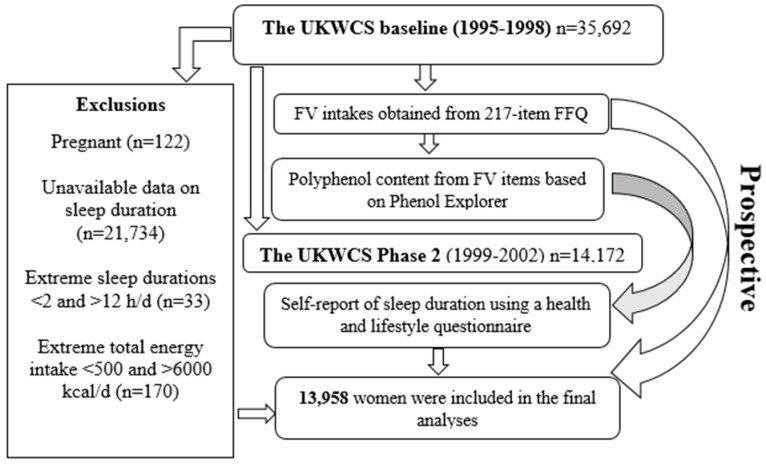
This study aims to investigate the prospective associations between fruit and vegetable (FV) intakes and their polyphenol content with subsequent sleep duration in UK women. In this study, 13,958 women with ~4 years of follow-up in the UK Women's Cohort Study were included in the analyses. FV intakes were assessed at baseline using a food frequency questionnaire (FFQ), and average hours of sleep per day were self-reported in follow-up. Polyphenol intake was calculated by matching FV items from the FFQ with the Phenol-Explorer database. Linear regression models, adjusting for confounders, were used for the analyses. Consuming an additional portion of apples, kiwi, oranges, pineapple, and 100% pure juice were associated with shorter sleep. Similarly, an additional portion of cabbage, celery, aubergine, olives, and peppers were inversely associated with sleep duration. An additional gram of total polyphenols was associated with shorter sleep by 18 min (99% CI -31 to -4, < 0.001). FV consumption and total polyphenol content were inversely associated with sleep duration; however, effect sizes were small, and polyphenol classes from FV intakes were not associated with sleep duration. Future intervention studies considering the time of FV consumption in relation to sleep are needed to clarify the underlying mechanisms.
本研究旨在调查英国女性中水果和蔬菜(FV)摄入量及其多酚含量与随后睡眠时间之间的前瞻性关联。在这项研究中,共有 13958 名女性参与了英国女性队列研究,随访时间约为 4 年。在基线时使用食物频率问卷(FFQ)评估 FV 摄入量,在随访中自我报告平均每天的睡眠时间。通过将 FFQ 中的 FV 项目与 Phenol-Explorer 数据库相匹配来计算多酚摄入量。使用线性回归模型,在调整混杂因素后进行分析。多吃一个苹果、猕猴桃、橙子、菠萝和 100%纯果汁的份,会导致睡眠时间缩短。同样,多吃一份卷心菜、芹菜、茄子、橄榄和辣椒,与睡眠时间延长有关。总多酚摄入量每增加 1 克,与睡眠时间缩短 18 分钟相关(99%置信区间-31 至-4,<0.001)。FV 摄入和总多酚含量与睡眠时间呈负相关;然而,效应大小较小,并且来自 FV 摄入量的多酚类与睡眠时间无关。未来需要考虑 FV 摄入与睡眠相关的时间的干预研究,以阐明潜在机制。