School of Public Health, College of Health Sciences, Makerere University, P.O.Box 7072, Kampala, Uganda.
Clinical Trials Unit, College of Health Sciences, Makerere University, Kampala, Uganda.
BMC Infect Dis. 2018 Nov 21;18(1):591. doi: 10.1186/s12879-018-3475-0.
High retention (follow-up) rates improve the validity and statistical power of outcomes in longitudinal studies and the effectiveness of programs with prolonged administration of interventions. We assessed participant retention in a potential HIV vaccine trials population of fishing communities along Lake Victoria, Uganda.
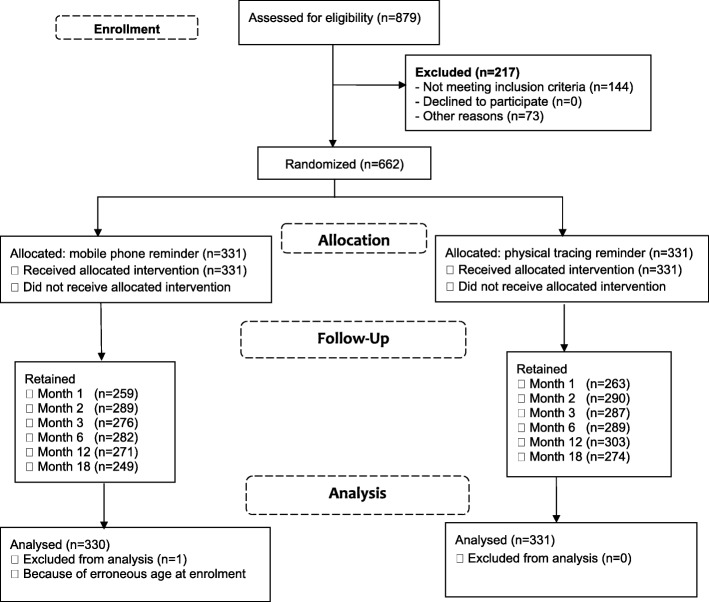
In a community-based individual randomized trial, 662 participants aged 15-49 years were randomized to either mobile phone or physical contact tracing reminders and followed up at months 1, 2, 3, 6, 12 and 18 post-enrolment. The visit schedules aimed at mimicking a vaccine efficacy trial representing an early interval (months 1-6) where most vaccinations would be administered and a later period of post-vaccination follow-up. The primary outcome was retention measured as the proportion of post-baseline follow up visits completed by a participant. Retention was estimated in early and later follow-up intervals, and overall for all the six follow-up visits. Adjusted differences in retention between the study arms were determined by multivariable logistic regression using Stata® 14. One participant was later dropped from the analysis because of age ineligibility discovered after enrolment.
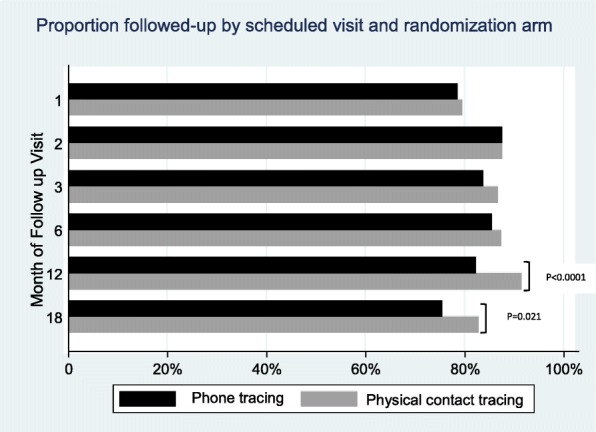
Of the expected total follow up visits of 3966 among 661 participants, 84.1% (3334) were attained; 82.1% (1626/1980) in the phone arm and 86% (1708/1986) in the physical tracing arm (p = 0.001). No statistically significant differences in retention were observed between the study arms in the first 6 months but thereafter, retention was significantly higher for physical contact reminders than mobile phones; 91.5% versus 82.1% (p < 0.0001) at month 12 and 82.8% versus 75.4%, (p = 0.021) at month 18. Controlling for sex, age, education, occupation, community location, length of stay and marital status, the odds of good retention (completing 5 out of 6 follow-up visits) were 1.56 (95% CI;1.08-2.26, p = 0.018) for physical contact tracing compared to mobile phone tracing. Other statistically significant predictors of good retention were residing on islands and having stayed in the fishing communities for 5 or more years.
Among fishing communities of Lake Victoria, Uganda, 84% of follow-up visits can be attained and participant retention is higher using physical contact reminders than mobile phones.
PACTR201311000696101 ( http://www.pactr.org/ ). retrospectively registered on 05 November, 2013.
高保留率(随访)可提高纵向研究结果的有效性和统计效力,并提高干预措施长期实施的项目效果。我们评估了乌干达维多利亚湖沿湖渔业社区中潜在 HIV 疫苗试验人群的参与者保留率。
在一项社区为基础的个体随机试验中,将 662 名年龄在 15-49 岁的参与者随机分配到手机或物理接触追踪提醒组,并在入组后第 1、2、3、6、12 和 18 个月进行随访。随访时间表旨在模拟疫苗效力试验,该试验代表了疫苗接种的早期阶段(第 1-6 个月),以及接种后的后期随访阶段。主要结局是保留率,定义为完成基线后随访的参与者比例。在早期和后期随访间隔以及所有六次随访中分别评估保留率。使用 Stata®14 通过多变量逻辑回归确定研究臂之间保留率的差异。由于在入组后发现年龄不符合条件,一名参与者后来被排除在分析之外。
在 661 名参与者预计的 3966 次总随访中,84.1%(3334 次)得以完成;手机组为 82.1%(1626/1980),物理追踪组为 86%(1708/1986)(p=0.001)。在头 6 个月,两组之间的保留率无统计学差异,但此后,物理接触提醒的保留率显著高于手机组;第 12 个月时分别为 91.5%和 82.1%(p<0.0001),第 18 个月时分别为 82.8%和 75.4%(p=0.021)。控制性别、年龄、教育、职业、社区位置、停留时间和婚姻状况后,与手机追踪相比,物理接触追踪的良好保留(完成 6 次随访中的 5 次)的优势比为 1.56(95%CI:1.08-2.26,p=0.018)。良好保留的其他统计学显著预测因素包括居住在岛屿上和在渔业社区停留 5 年或以上。
在乌干达维多利亚湖的渔业社区中,84%的随访可以完成,与手机追踪相比,使用物理接触提醒可提高参与者的保留率。
PACTOR201311000696101(http://www.pactr.org/)。于 2013 年 11 月 5 日回顾性注册。