Hagberg Katrina Wilcox, Robijn Annelies L, Jick Susan
Boston Collaborative Drug Surveillance Program, Boston University School of Public Health, Lexington, MA 02421, USA,
Clin Epidemiol. 2018 Nov 1;10:1599-1612. doi: 10.2147/CLEP.S180618. eCollection 2018.
Results of some studies suggest that prenatal antidepressant exposure increases the risk of autism spectrum disorder (ASD) in offspring, while other studies suggest that depression independently increases the risk of having a child with ASD. Thus, confounding by indication is a concern.
The aim of this study was to estimate the risk of ASD in offspring of women who were exposed to antidepressants and/or had depression during pregnancy compared to unexposed women.
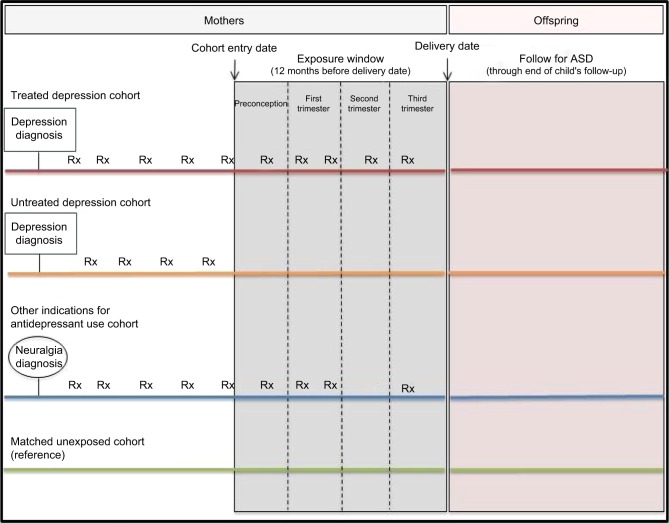
We conducted a cohort study with nested sibling case-control analysis. Using the UK Clinical Practice Research Datalink (CPRD), we identified mother- baby pairs where the mother had ≥12 months of history before the delivery date and the child had ≥3 years of follow-up. Exposures during pregnancy were classified as 1) depression treated with antidepressants, 2) untreated depression, 3) other indications for antidepressant use, and 4) 4:1 match of unexposed women with no history of depression or antidepressant use. We calculated the prevalence of ASD and relative risk (RR) with 95% CI. In the sibling analysis, we compared exposure among ASD cases to that of non-ASD siblings born to the same mother. We calculated ORs and 95% CIs for women with treated and untreated depression, compared to unexposed.
We identified 2,154 offspring with ASD among 194,494 mother-baby pairs. Compared to unexposed, the RR of ASD was 1.72 (95% CI 1.54-1.93) for treated depression and 1.50 (95% CI 1.28-1.75) for untreated depression, while the RR was not elevated in women who received antidepressants for other indications (RR =0.73, 95% CI 0.41-1.29). Additional analyses to assess the effects of severity of depression suggest that the risk of ASD in offspring increases with increasing severity, not with the antidepressant treatment. The results of the sibling analysis were similar to the main analysis.
Women with depression during pregnancy have an increased risk of having a child with ASD, regardless of antidepressant use.
一些研究结果表明,孕期接触抗抑郁药会增加后代患自闭症谱系障碍(ASD)的风险,而其他研究表明,抑郁症本身会增加生育患ASD孩子的风险。因此,指征性混杂是一个值得关注的问题。
本研究的目的是评估孕期接触抗抑郁药和/或患有抑郁症的女性后代患ASD的风险,并与未接触的女性进行比较。
我们进行了一项队列研究,并进行嵌套同胞病例对照分析。利用英国临床实践研究数据链(CPRD),我们确定了母婴对,其中母亲在分娩日期前有≥12个月的病史,孩子有≥3年的随访。孕期暴露分为:1)用抗抑郁药治疗的抑郁症,2)未治疗的抑郁症,3)使用抗抑郁药的其他指征,4)4:1匹配的无抑郁症或抗抑郁药使用史的未暴露女性。我们计算了ASD的患病率和95%置信区间的相对风险(RR)。在同胞分析中,我们比较了ASD病例与同一母亲出生的非ASD同胞的暴露情况。我们计算了治疗和未治疗抑郁症女性与未暴露女性相比的比值比(OR)和95%置信区间。
在194,494对母婴对中,我们确定了2,154名患有ASD的后代。与未暴露相比,治疗抑郁症的ASD的RR为1.72(95%CI 1.54-1.93),未治疗抑郁症的RR为1.50(95%CI 1.28-1.75),而因其他指征接受抗抑郁药治疗的女性RR未升高(RR =0.73,95%CI 0.41-1.29)。评估抑郁症严重程度影响的进一步分析表明,后代患ASD的风险随严重程度增加而增加,而非抗抑郁药治疗。同胞分析结果与主要分析结果相似。
孕期患有抑郁症的女性生育患ASD孩子的风险增加,无论是否使用抗抑郁药。