Mafeld Sebastian, Wong Jen Jou, Kibriya Nabil, Stenberg Ben, Manas Derek, Bassett Paul, Aslam Tahira, Evans Jonathan, Littler Peter
Department of Interventional Radiology, Freeman Hospital, Newcastle upon Tyne, NE7 7DN, UK.
Department of Interventional Radiology, Royal Liverpool University Hospital, Prescot St, Liverpool, L7 8XP, UK.
Cardiovasc Intervent Radiol. 2019 Apr;42(4):577-583. doi: 10.1007/s00270-018-2120-z. Epub 2018 Nov 21.
Irreversible electroporation (IRE) is a non-thermal ablative option in patients unsuitable for standard thermal ablation, due to its potential to preserve collagenous structures (vessels and ducts) and a reduced susceptibility to heat sink effects. In this series from two large tertiary referral hepatobiliary centres, we aim to assess the safety/outcomes of hepatic IRE.
Bi-institutional retrospective, longitudinal follow-up series of IRE for primary hepatic malignancy; [hepatocellular carcinoma (n = 20), cholangiocarcinoma (n = 3)] and secondary metastatic disease; colorectal (n = 28), neuroendocrine (n = 1), pancreatic (n = 1), breast (n = 1), gastrointestinal stromal tumour (GIST, n = 1) and malignant thymoma (n = 1). Outcome measures included procedural safety/effectiveness, time to progression and time to death.
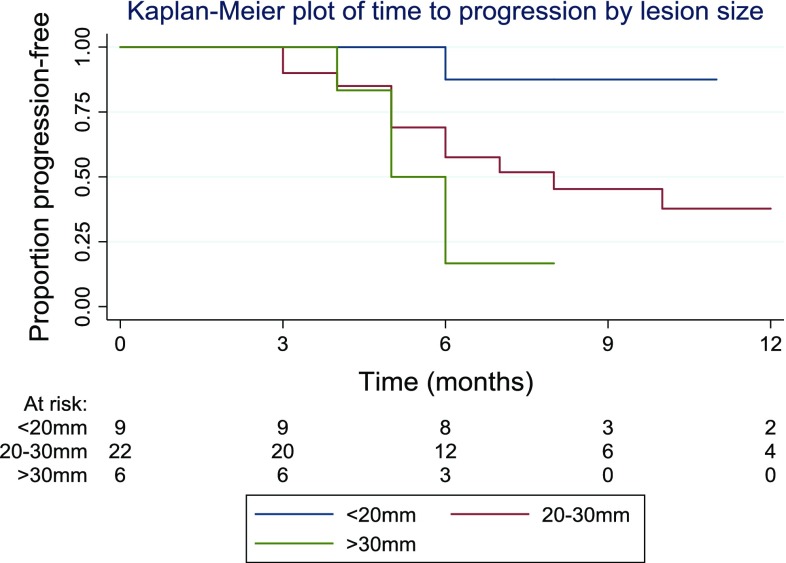
Between 2013 and 2017, 52 patients underwent percutaneous IRE of 59 liver tumours in 53 sessions. All tumours were deemed unsuitable for thermal ablation. Cases were performed using ultrasound (US) or computed tomography (CT) guidance. A complete ablation was achieved in n = 44, (75%) of cases with an overall complication rate of 17% (n = 9). Of the complete ablation group, median time to progression was 8 months. At 12 months, 44% were progression-free (95% CI 30-66%). The data suggest that larger lesion size (> 2 cm) is associated with shorter time to progression and there is highly significant difference with faster time to progression in mCRC compared with HCC. Median survival time was 38 months.
This bi-institutional review is the largest UK series of IRE and suggests this ablative technology can be a useful tool, but appears to mainly induce local tumour control rather than cure with HCC having better outcomes than mCRC.
不可逆电穿孔(IRE)是一种非热消融方法,适用于不适宜进行标准热消融的患者,因为它有可能保留胶原结构(血管和导管),且对热沉效应的敏感性较低。在这个来自两个大型三级转诊肝胆中心的系列研究中,我们旨在评估肝脏IRE的安全性/疗效。
对原发性肝恶性肿瘤(肝细胞癌,n = 20;胆管癌,n = 3)以及继发性转移性疾病(结直肠癌,n = 28;神经内分泌癌,n = 1;胰腺癌,n = 1;乳腺癌,n = 1;胃肠道间质瘤,n = 1;恶性胸腺瘤,n = 1)进行IRE的双机构回顾性纵向随访研究。观察指标包括手术安全性/有效性、疾病进展时间和死亡时间。
2013年至2017年期间,52例患者在53个疗程中接受了59个肝脏肿瘤的经皮IRE治疗。所有肿瘤均被认为不适宜进行热消融。手术采用超声(US)或计算机断层扫描(CT)引导。44例(75%)患者实现了完全消融,总体并发症发生率为17%(n = 9)。在完全消融组中,疾病进展的中位时间为8个月。12个月时,44%的患者无疾病进展(95%置信区间30 - 66%)。数据表明,较大的病变尺寸(> 2 cm)与较短的疾病进展时间相关,与肝细胞癌相比,转移性结直肠癌的疾病进展时间更快,差异具有高度显著性。中位生存时间为38个月。
这项双机构综述是英国最大规模的IRE系列研究,表明这种消融技术可能是一种有用的工具,但似乎主要是诱导局部肿瘤控制而非治愈,肝细胞癌的疗效优于转移性结直肠癌。