Odlum Michelle, Yoon Sunmoo, Broadwell Peter, Brewer Russell, Kuang Da
Columbia University Medical Center, New York, NY, United States.
Charles E Young Research Library, University of California Los Angeles, Los Angeles, CA, United States.
JMIR Public Health Surveill. 2018 Nov 22;4(4):e10262. doi: 10.2196/10262.
HIV/AIDS is a tremendous public health crisis, with a call for its eradication by 2030. A human rights response through civil society engagement is critical to support and sustain HIV eradication efforts. However, ongoing civil engagement is a challenge.
This study aimed to demonstrate the use of Twitter data to assess public sentiment in support of civil society engagement.
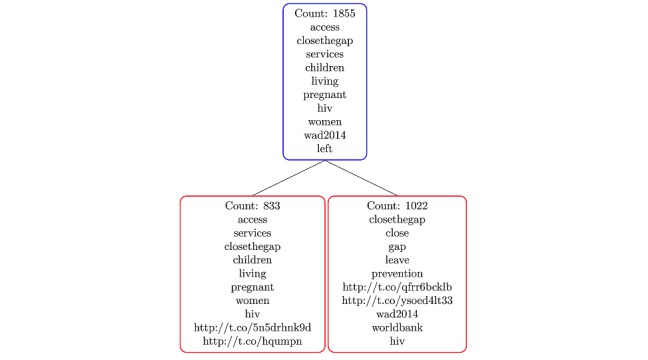
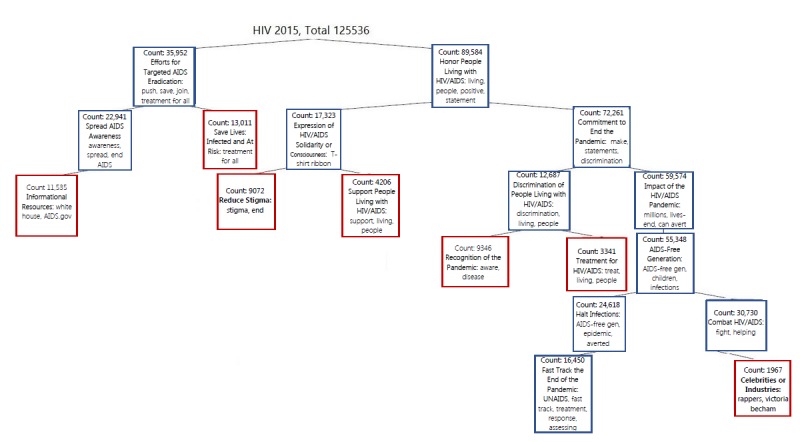
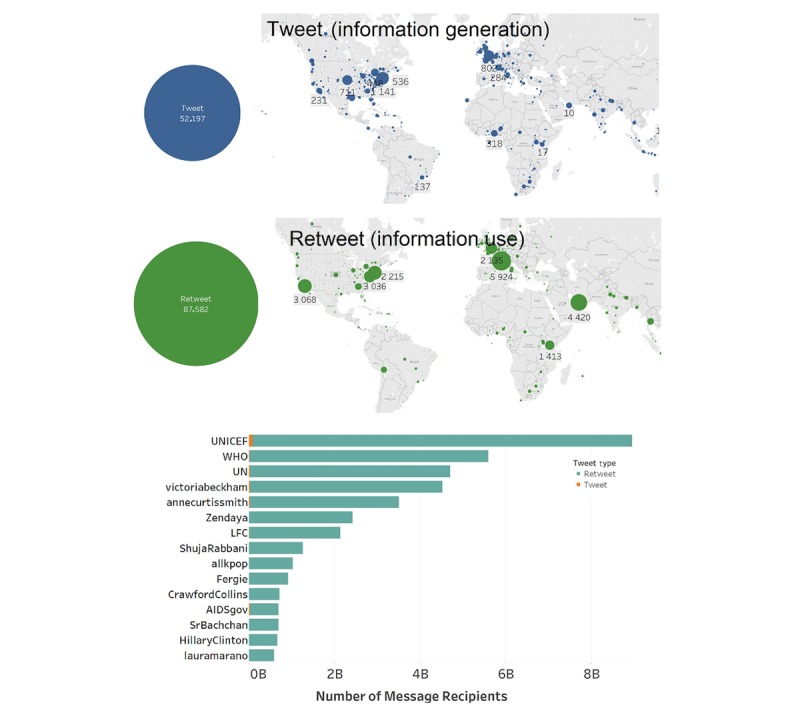
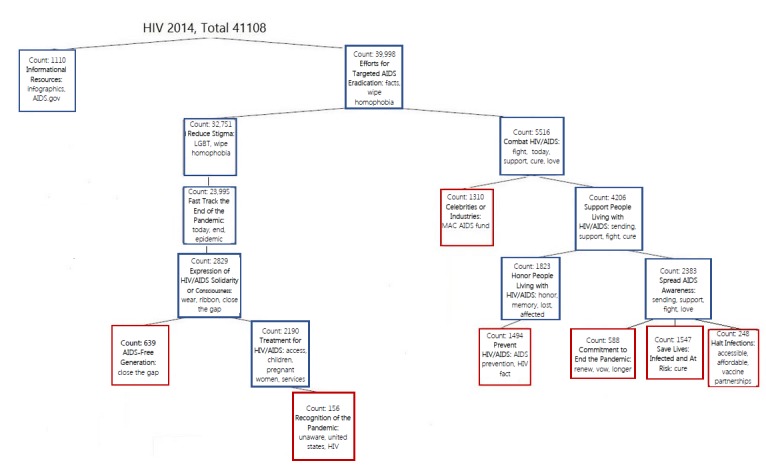
Tweets were collected during World AIDS Days 2014 and 2015. A total of 39,940 unique tweets (>10 billion users) in 2014 and 78,215 unique tweets (>33 billion users) in 2015 were analyzed. Response frequencies were aggregated using natural language processing. Hierarchical rank-2 nonnegative matrix factorization algorithm generated a hierarchy of tweets into binary trees. Tweet hierarchy clusters were thematically organized by the Joint United Nations Programme on HIV/AIDS core action principles and categorized under HIV/AIDS Prevention, Treatment or Care, or Support.
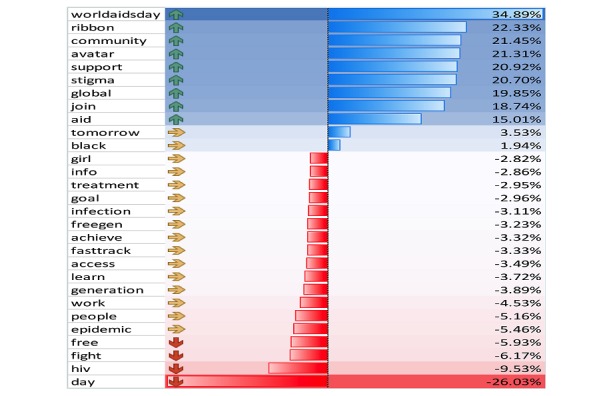
Topics tweeted 35 times or more were visualized. Results show a decrease in 2015 in the frequency of tweets associated with the fight to end HIV/AIDS, the recognition of women, and to achieve an AIDS-free generation. Moreover, an increase in tweets was associated with an integrative approach to the HIV/AIDS response. Hierarchical thematic differences in 2015 included no prevention discussion and the recognition of the pandemic's impact and discrimination. In addition, a decrease was observed in motivation to fast track the pandemic's end and combat HIV/AIDS.
The human rights-based response to HIV/AIDS eradication is critical. Findings demonstrate the usefulness of Twitter as a low-cost method to assess public sentiment for enhanced knowledge, increased hope, and revitalized expectations for HIV/AIDS eradication.
艾滋病毒/艾滋病是一场巨大的公共卫生危机,呼吁到2030年根除该疾病。通过公民社会参与采取人权应对措施对于支持和维持艾滋病毒根除工作至关重要。然而,持续的公民参与是一项挑战。
本研究旨在证明利用推特数据评估支持公民社会参与的公众情绪。
在2014年和2015年世界艾滋病日期间收集推文。对2014年共39940条独特推文(超过100亿用户)和2015年78215条独特推文(超过330亿用户)进行了分析。使用自然语言处理汇总回复频率。二级非负矩阵分解算法将推文层次结构生成为二叉树。推文层次聚类按照联合国艾滋病毒/艾滋病联合规划署的核心行动原则进行主题组织,并归类为艾滋病毒/艾滋病预防、治疗或护理或支持。
对发布35次或更多次的主题推文进行了可视化处理。结果显示,2015年与终结艾滋病毒/艾滋病斗争、对妇女的认可以及实现无艾滋病一代相关的推文频率有所下降。此外,与艾滋病毒/艾滋病应对综合方法相关的推文有所增加。2015年的层次主题差异包括没有预防讨论以及对该流行病影响和歧视的认可。此外,观察到在快速终结该流行病和抗击艾滋病毒/艾滋病的动力方面有所下降。
基于人权的艾滋病毒/艾滋病根除应对措施至关重要。研究结果证明了推特作为一种低成本方法在评估公众情绪以增强对艾滋病毒/艾滋病根除的认识、增加希望和重振期望方面的有用性。