Song Bo Mi, Kim Hyeon Chang, Shim Jee Seon, Kang Dae Ryong
Cardiovascular and Metabolic Disease Etiology Research Center, Yonsei University College of Medicine, Seoul, Korea.
Department of Preventive Medicine, Yonsei University College of Medicine, Seoul, Korea.
Korean Circ J. 2019 Mar;49(3):267-277. doi: 10.4070/kcj.2018.0147. Epub 2018 Oct 23.
This study aimed to investigate the right-left arm difference in detection of hypertension in the general Korean population.
This study analyzed data from the Cardiovascular and Metabolic Disease Etiology Research Center cohort. Study population was 2,103 people who were aged 30 to 64 years old, without history of major cardiovascular diseases, and did not use antihypertensive medication. Brachial blood pressures (BPs) were measured for both arms using an automated oscillometric device equipped with 2 cuffs for simultaneous double-arm measurements. Systolic and diastolic blood pressures (SBP and DBP) were measured 3 times, and the average value was used in the analysis. Overall hypertension was defined as elevated blood pressure (SBP/DBP ≥140/90 mmHg) at the arm with higher value, while right-arm or left-arm hypertension was defined as elevated BP at each arm. Sensitivity was calculated as the number of each-arm hypertension divided by the number of overall hypertension.
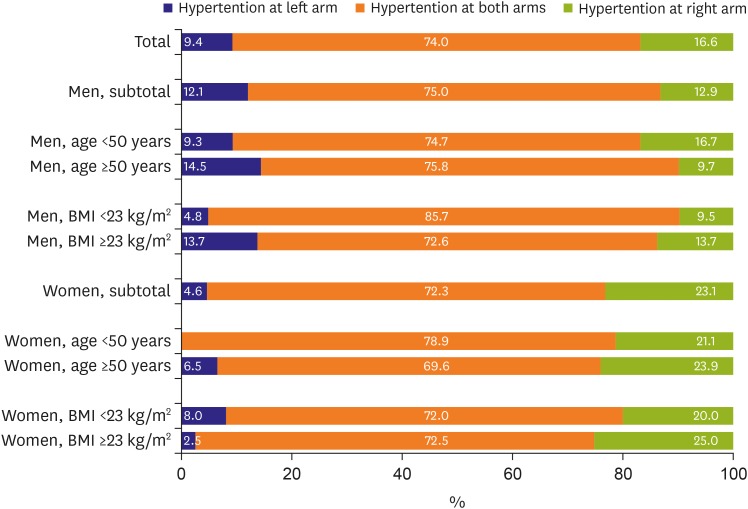
Overall 8.6% of the population had hypertension at either arm, while 7.8% had right-arm hypertension, 7.2% had left-arm hypertension, and 6.4% had both arms hypertension. The sensitivity for the detection of hypertension was 90.6% when BP was measured only at right arm, and 83.4% when measured only at left arm. Corresponding sensitivity were 87.9% and 87.1% in men, and 95.4% and 76.9% in women.
Single-arm measurements, compared to double-arm measurements, may underestimate the prevalence of hypertension. However, if double-arm measurements are unavailable, right arm is preferred for measurement of BP, especially in women.
本研究旨在调查韩国普通人群中左右臂高血压检测的差异。
本研究分析了心血管与代谢疾病病因研究中心队列的数据。研究对象为2103名年龄在30至64岁之间、无重大心血管疾病史且未使用抗高血压药物的人群。使用配备两个袖带的自动示波装置同时测量双臂的肱动脉血压(BP)。收缩压和舒张压(SBP和DBP)测量3次,并将平均值用于分析。总体高血压定义为较高值手臂的血压升高(SBP/DBP≥140/90 mmHg),而右臂或左臂高血压定义为各手臂的血压升高。敏感性计算为各手臂高血压人数除以总体高血压人数。
总体而言,8.6%的人群至少有一侧手臂患有高血压,其中7.8%患有右臂高血压,7.2%患有左臂高血压,6.4%双侧手臂均患有高血压。仅测量右臂血压时高血压检测的敏感性为90.6%,仅测量左臂血压时为83.4%。男性相应的敏感性分别为87.9%和87.1%,女性为95.4%和76.9%。
与双臂测量相比,单臂测量可能会低估高血压的患病率。然而,如果无法进行双臂测量,测量血压时首选右臂,尤其是在女性中。