Department of Movement and Sports Sciences, Ghent University, 9000 Ghent, Belgium.
PRCPAN (Priority Research Centre for Physical Activity and Nutrition), School of Education, University of Newcastle, Callaghan NSW 2308, Australia.
Int J Environ Res Public Health. 2018 Nov 21;15(11):2599. doi: 10.3390/ijerph15112599.
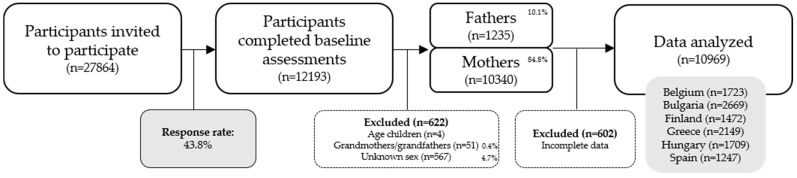
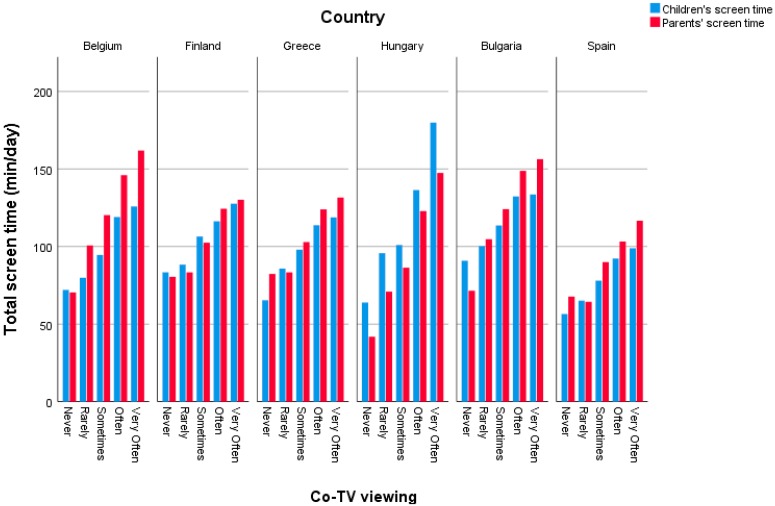
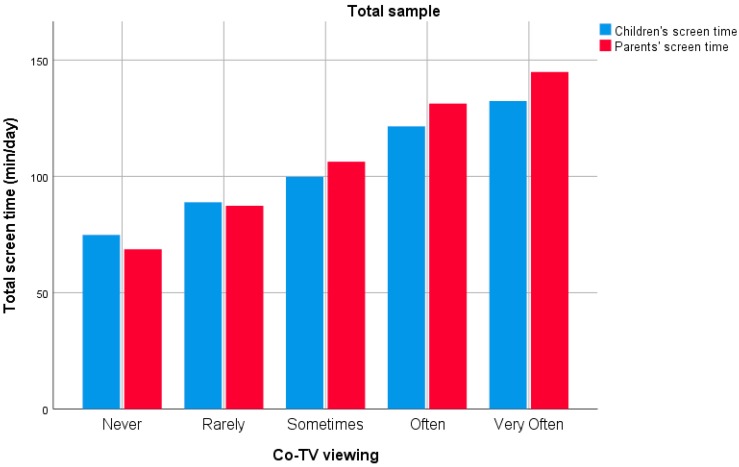
In many European children, high levels of screen time can be found, which is associated with several adverse health outcomes. Therefore, there is a need for identifying effective intervention strategies that reduce screen time in children. A factor that may contribute to excessive screen time in children may be "co-TV viewing" (i.e., the time that parents and children spend on watching TV together), as parents often recognize the importance of limiting children's (individual) screen time, but often encourage TV viewing as a family because of its perceived benefits (e.g., educational purposes). The primary aim of this study was to investigate the (sex-specific) association between co-TV viewing and both children's and parents' screen time, and these associations were investigated across and within six European countries. In total, 10,969 parents (Mean = 40.7 ± 5.3 years, Mean = 24.4 ± 4.6) of primary school children (Mean = 8.2 ± 1.0 years, 49.0% boys, Mean = 17.3 ± 2.8) completed a questionnaire assessing co-TV viewing and screen time. Multilevel regression analyses were conducted. Across countries, positive associations were found between co-TV viewing and both children's (β = 11.85, SE = 3.69, < 0.001) and parents' screen time (β = 14.47, SE = 4.43, = 0.001). Similar associations were found in most (but not all) countries. The results suggest that targeting co-TV viewing might be a promising intervention strategy because of its potential to limit screen time of both children and parents.
在许多欧洲儿童中,都可以发现高水平的屏幕时间,这与多种不良健康结果有关。因此,需要确定有效的干预策略,以减少儿童的屏幕时间。导致儿童过度观看屏幕的一个因素可能是“共同看电视”(即父母和孩子一起看电视的时间),因为父母通常认识到限制孩子(个人)屏幕时间的重要性,但往往会鼓励作为家庭一起看电视,因为他们认为这样做有好处(例如,教育目的)。本研究的主要目的是调查共同看电视与儿童和父母的屏幕时间之间的(性别特异性)关联,并在六个欧洲国家内和跨国家调查这些关联。共有 10969 名小学生的父母(平均年龄 = 40.7 ± 5.3 岁,平均年龄 = 24.4 ± 4.6 岁)完成了一份评估共同看电视和屏幕时间的问卷。进行了多层次回归分析。在各国之间,共同看电视与儿童(β = 11.85,SE = 3.69,< 0.001)和父母的屏幕时间(β = 14.47,SE = 4.43,< 0.001)之间均存在正相关。在大多数(但不是全部)国家都发现了类似的关联。结果表明,针对共同看电视可能是一种有前途的干预策略,因为它有可能限制儿童和父母的屏幕时间。