Pojda-Wilczek Dorota, Maruszczyk Wojciech, Sirek Sebastian
Ophthalmology Clinic and Department of Ophthalmology, University Clinical Centre, School of Medicine in Katowice, Medical University of Silesia in Katowice, Ceglana 35, 40-514, Katowice, Poland.
Doc Ophthalmol. 2019 Feb;138(1):35-42. doi: 10.1007/s10633-018-9663-9. Epub 2018 Nov 23.
To compare flash visual evoked potentials (FVEP) elicited using a Ganzfeld bowl (G), Mini Ganzfeld (MG) and Flash Goggles (GG) with eyes open and closed.
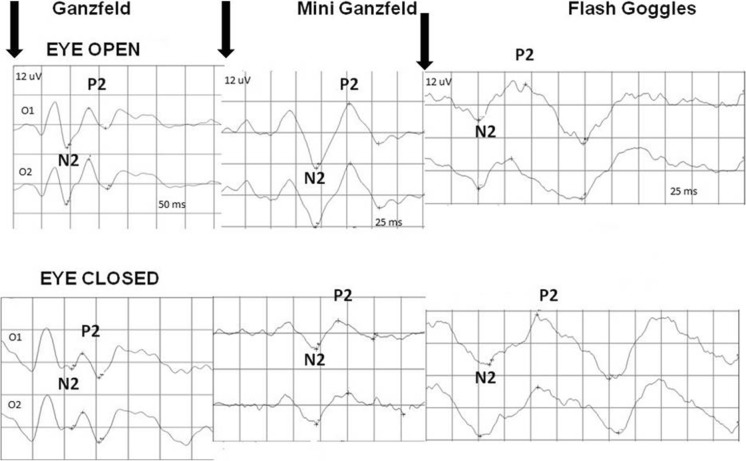
The study group comprised 17 volunteers with mean age of 30 years; all of them were examined with the Roland Consult electrophysiological diagnostic system. Active electrodes were placed at O and O. With the G and MG stimulators, the flash generated by white-light-emitting diodes (LEDs) presented standard flash of 3 cd s m. The GG used red LED flash of 3 cd s m. Stimulus frequency of 1.0 Hz, low-pass filter of 1.0 Hz and high-pass filters of 100 Hz (G); 50 Hz (MG); 30 Hz (GG) were used. P2 amplitude and latency were compared by the means of the Wilcoxon matched-pairs signed-rank test.
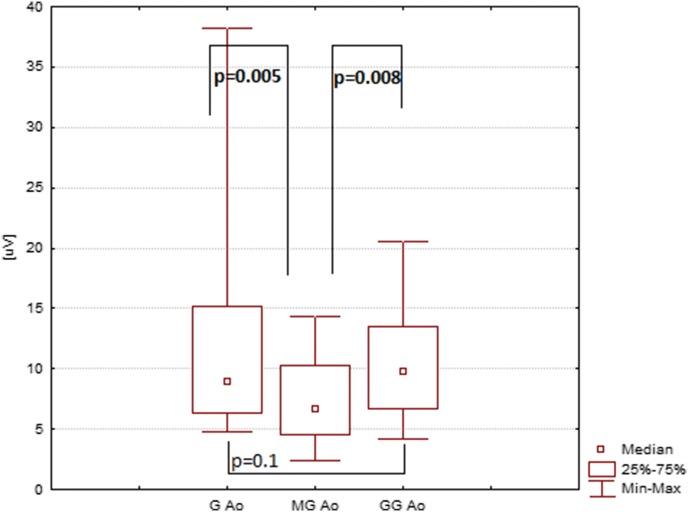
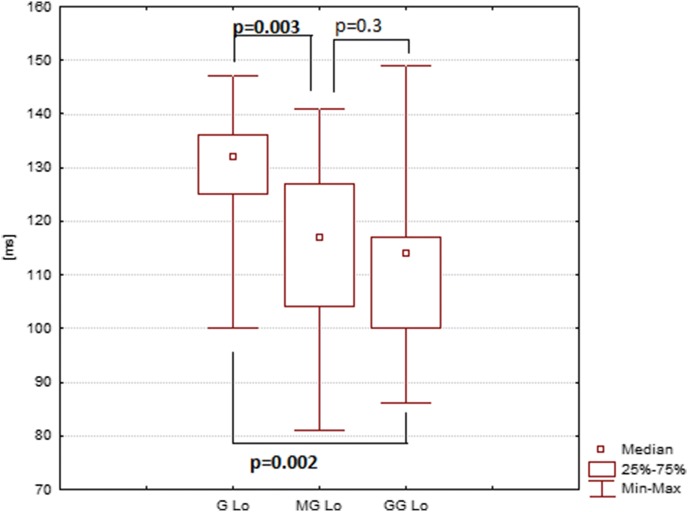
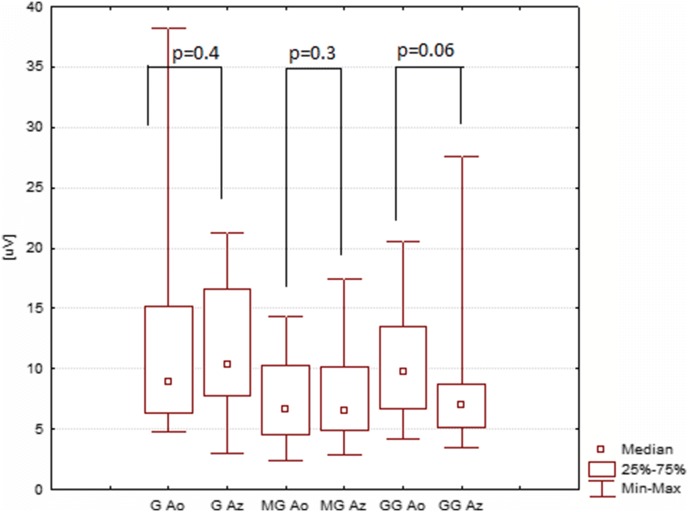
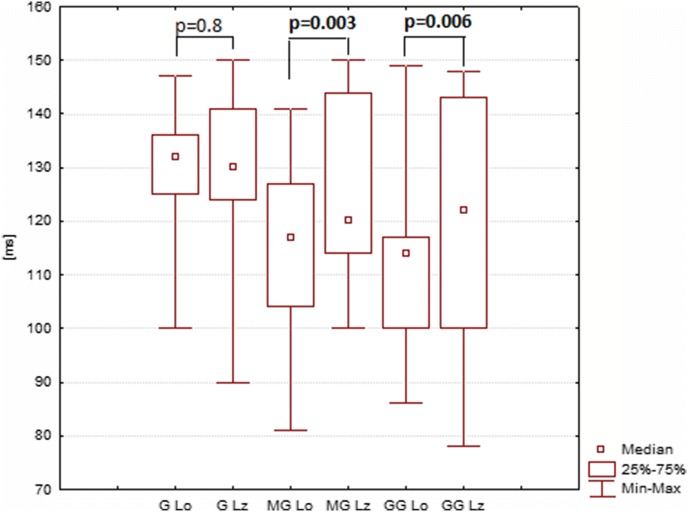
After right eye stimulation (from O; n = 17), the mean amplitudes of P2, elicited with the G, MG and GG, were 13, 7 and 10 µV, respectively. The respective latencies were 129, 114 and 110 ms. Hence, the difference between the results obtained with these stimulators was statistically significant (p < 0.05). The mean P2 amplitudes, acquired by the means of the G, MG and GG, were 13 µV, 7 µV and 10 µV for open eyes, and 11 µV, 8 µV and 8 µV for closed eyes. The respective latencies were 129, 114 and 110 ms for eyes open, and 127, 125 and 121 ms for eyes closed. These results of the MG (latency only) and GG (latency and amplitude) stimulation differed significantly (p < 0.05).
The amplitudes and latencies of the FVEP P2 elicited with different stimulators are not suitable for comparison. Closing the eye during the examination had a significant effect on the components of FVEP waveform elicited with the Flash Goggle and on the latency of P2 elicited with the MG.
比较使用全视野球(G)、迷你全视野(MG)和闪光护目镜(GG)在睁眼和闭眼状态下诱发的闪光视觉诱发电位(FVEP)。
研究组由17名平均年龄30岁的志愿者组成;他们均使用罗兰咨询公司的电生理诊断系统进行检查。活性电极置于O点和O点。使用G和MG刺激器时,由白色发光二极管(LED)产生的闪光呈现3cd·s·m的标准闪光。GG使用3cd·s·m的红色LED闪光。刺激频率为1.0Hz,低通滤波器为1.0Hz,高通滤波器分别为100Hz(G)、50Hz(MG)、30Hz(GG)。采用Wilcoxon配对符号秩检验比较P2波幅和潜伏期。
右眼刺激(从O点;n = 17)后,使用G、MG和GG诱发的P2波平均波幅分别为13、7和10μV。各自的潜伏期分别为129、114和110ms。因此,这些刺激器获得的结果之间的差异具有统计学意义(p < 0.05)。使用G、MG和GG获得的睁眼时P2波平均波幅分别为13μV、7μV和10μV,闭眼时分别为11μV、8μV和8μV。睁眼时各自的潜伏期分别为129、114和110ms,闭眼时分别为127、125和121ms。MG(仅潜伏期)和GG(潜伏期和波幅)刺激的这些结果存在显著差异(p < 0.05)。
不同刺激器诱发的FVEP P2波的波幅和潜伏期不适合进行比较。检查期间闭眼对闪光护目镜诱发的FVEP波形成分以及MG诱发的P2潜伏期有显著影响。