Natural Sciences and Psychology, Liverpool John Moores University, Byrom Street, Liverpool, L3 3AF, England, UK.
Centre for Cognitive Ageing and Cognitive Epidemiology, University of Edinburgh, Edinburgh, UK.
Qual Life Res. 2019 Mar;28(3):737-749. doi: 10.1007/s11136-018-2056-4. Epub 2018 Nov 23.
Quality of life (QoL) decreases in very old age, and is strongly related to health outcomes and mortality. Understanding the predictors of QoL and change in QoL amongst the oldest old may suggest potential targets for intervention. This study investigated change in QoL from age 79 to 90 years in a group of older adults in Scotland, and identified potential predictors of that change.
Participants were members of the Lothian Birth Cohort 1921 who attended clinic visits at age 79 (n = 554) and 90 (n = 129). Measures at both time points included QoL (WHOQOL-BREF: four domains and two single items), anxiety and depression, objective health, functional ability, self-rated health, loneliness, and personality.
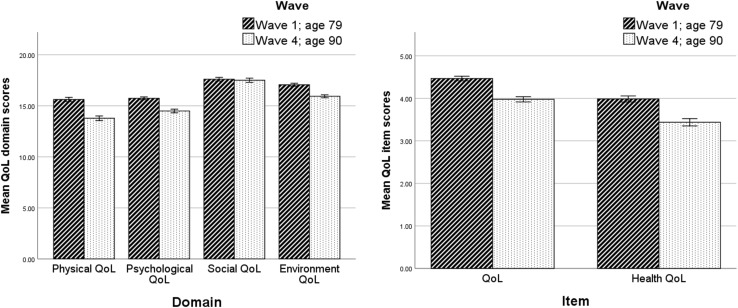
Mean QoL declined from age 79 to 90. Participants returning at 90 had scored significantly higher at 79 on most QoL measures, and exhibited better objective health and functional ability, and lower anxiety and depression than non-returners. Hierarchical multiple regression models accounted for 20.3-56.3% of the variance in QoL at age 90. Baseline QoL was the strongest predictor of domain scores (20.3-35.6% variance explained), suggesting that individual differences in QoL judgements remain largely stable. Additional predictors varied by the QoL domain and included self-rated health, loneliness, and functional and mood decline between age 79 and 90 years.
This study has identified potential targets for interventions to improve QoL in the oldest old. Further research should address causal pathways between QoL and functional and mood decline, perceived health and loneliness.
生活质量(QoL)在非常高龄时会下降,并且与健康结果和死亡率密切相关。了解最年长人群的 QoL 预测因素及其变化,可能为干预提供潜在目标。本研究调查了苏格兰一组老年人从 79 岁到 90 岁的 QoL 变化,并确定了这种变化的潜在预测因素。
参与者是洛锡安出生队列 1921 年的成员,他们在 79 岁(n=554)和 90 岁(n=129)时参加了临床就诊。两个时间点的测量包括 QoL(WHOQOL-BREF:四个领域和两个单项)、焦虑和抑郁、客观健康、功能能力、自我评估健康、孤独感和人格。
从 79 岁到 90 岁,平均 QoL 下降。在 90 岁时返回的参与者在大多数 QoL 测量中得分显著更高,并且表现出更好的客观健康和功能能力,以及较低的焦虑和抑郁水平,而非返回者则不然。层次多重回归模型解释了 90 岁时 QoL 的 20.3-56.3%的方差。基线 QoL 是预测领域得分的最强预测因子(20.3-35.6%的方差解释),表明 QoL 判断的个体差异在很大程度上仍然保持稳定。其他预测因子因 QoL 领域而异,包括自我评估健康、孤独感以及 79 岁至 90 岁之间的功能和情绪下降。
本研究确定了改善最年长人群 QoL 的潜在干预目标。进一步的研究应该解决 QoL 与功能和情绪下降、感知健康和孤独感之间的因果关系。