Yi Ming, Qin Shuang, Zhao Weiheng, Yu Shengnan, Chu Qian, Wu Kongming
Department of Oncology, Tongji Hospital of Tongji Medical College, Huazhong University of Science and Technology, Wuhan, 430030 China.
Exp Hematol Oncol. 2018 Nov 16;7:28. doi: 10.1186/s40164-018-0120-y. eCollection 2018.
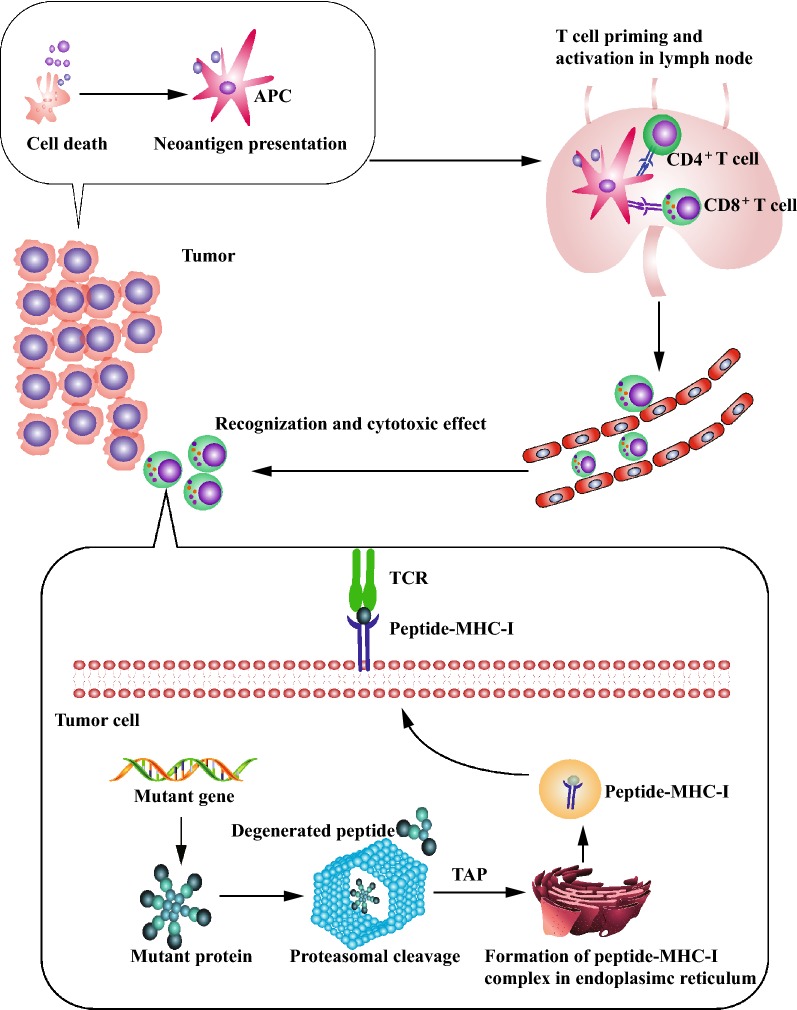
Immune checkpoint inhibitor induces tumor rejection by activated host immune system. The anti-tumor immune response consists of capture, presentation, recognition of neoantigen, as well as subsequent killing of tumor cell. Due to the interdependence among this series of stepwise events, neoantigen profoundly influences the efficacy of anti-immune checkpoint therapy. Moreover, the neoantigen-specific T cell reactivity is the cornerstone of multiple immunotherapies. In fact, several strategies targeting neoantigen have been attempted for synergetic effect with immune checkpoint inhibitor. Increasing neoantigen presentation to immune system by oncolytic virus, radiotherapy, or cancer vaccine is feasible to enhance neoantigen-specific T cell reactivity in theory. However, some obstacles have not been overcome in practice such as dynamic variation of neoantigen landscape, identification of potential neoantigen, maintenance of high T cell titer post vaccination. In addition, adoptive T cell transfer is another approach to enhance neoantigen-specific T cell reactivity, especially for patients with severe immunosuppression. In this review, we highlighted the advancements of neoantigen and innovative explorations of utilization of neoantigen repertoire in immune checkpoint blockade therapy.
免疫检查点抑制剂通过激活宿主免疫系统诱导肿瘤排斥。抗肿瘤免疫反应包括新抗原的捕获、呈递、识别以及随后对肿瘤细胞的杀伤。由于这一系列逐步事件之间的相互依存关系,新抗原深刻影响抗免疫检查点治疗的疗效。此外,新抗原特异性T细胞反应性是多种免疫疗法的基石。事实上,已经尝试了几种针对新抗原的策略以与免疫检查点抑制剂产生协同效应。从理论上讲,通过溶瘤病毒、放射疗法或癌症疫苗增加新抗原向免疫系统的呈递对于增强新抗原特异性T细胞反应性是可行的。然而,在实践中一些障碍尚未克服,如新抗原格局的动态变化、潜在新抗原的鉴定、疫苗接种后高T细胞效价的维持。此外,过继性T细胞转移是增强新抗原特异性T细胞反应性的另一种方法,特别是对于严重免疫抑制的患者。在本综述中,我们重点介绍了新抗原的进展以及在免疫检查点阻断治疗中利用新抗原库的创新探索。