Department of Anatomy and Cell Biology, Brody School of Medicine, East Carolina University, Greenville, NC 27834.
Mol Biol Cell. 2018 Nov 26;29(24):2913-2921. doi: 10.1091/mbc.E18-04-0222.
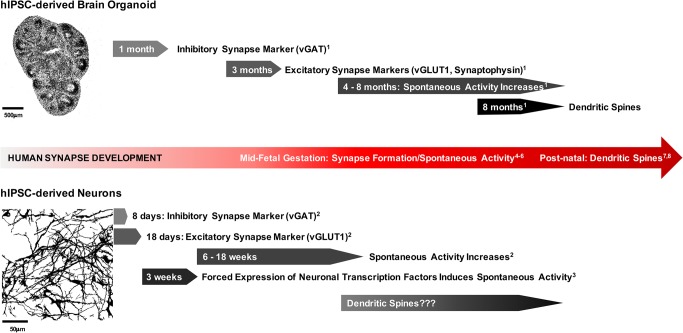
Many brain disorders exhibit altered synapse formation in development or synapse loss with age. To understand the complexities of human synapse development and degeneration, scientists now engineer neurons and brain organoids from human-induced pluripotent stem cells (hIPSC). These hIPSC-derived brain models develop both excitatory and inhibitory synapses and functional synaptic activity. In this review, we address the ability of hIPSC-derived brain models to recapitulate synapse development and insights gained into the molecular mechanisms underlying synaptic alterations in neuronal disorders. We also discuss the potential for more accurate human brain models to advance our understanding of synapse development, degeneration, and therapeutic responses.
许多脑部疾病在发育过程中表现出突触形成异常或随着年龄增长而突触丧失。为了理解人类突触发育和退化的复杂性,科学家们现在利用人类诱导多能干细胞(hiPSC)来设计神经元和脑类器官。这些由 hiPSC 衍生的大脑模型会发育出兴奋性和抑制性突触,以及功能性突触活性。在这篇综述中,我们探讨了 hiPSC 衍生的大脑模型再现突触发育的能力,以及在神经元疾病中突触改变的分子机制方面所获得的认识。我们还讨论了更准确的人类大脑模型在推进我们对突触发育、退化和治疗反应的理解方面的潜力。