Gerotech Inc., Ulsan, Republic of Korea.
Dental Research Institute, Pusan National University Dental Hospital, Yangsan, Republic of Korea.
PLoS One. 2018 Nov 26;13(11):e0200900. doi: 10.1371/journal.pone.0200900. eCollection 2018.
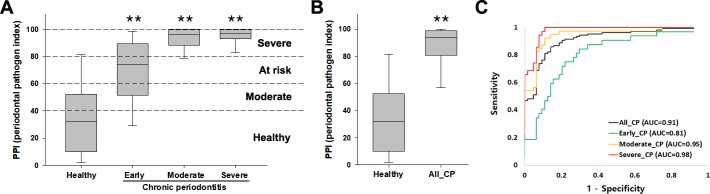
Periodontitis is an infectious disease that is associated with microorganisms that colonize the tooth surface. Clinically, periodontal condition stability reflects dynamic equilibrium between bacterial challenge and host response. Therefore, periodontal pathogen assessment can assist in the early detection of periodontitis. Here we developed a grading system called the periodontal pathogen index (PPI) by analyzing the copy numbers of multiple pathogens both in healthy and chronic periodontitis patients. We collected 170 mouthwash samples (64 periodontally healthy controls and 106 chronic periodontitis patients) and analyzed the salivary 16S rRNA levels of nine pathogens using multiplex, quantitative real-time polymerase chain reaction. Except for Aggregatibacter actinomycetemcomitans, copy numbers of all pathogens were significantly higher in chronic periodontitis patients. We classified the samples based on optimal cut-off values with maximum sensitivity and specificity from receiver operating characteristic curve analyses (AUC = 0.91, 95% CI: 0.87-0.96) into four categories of PPI: Healthy (1-40), Moderate (41-60), At Risk (61-80), and Severe (81-100). PPI scores were significantly higher in all chronic periodontitis patients than in the controls (odds ratio: 31.7, 95% CI: 13.41-61.61) and were associated with age, scaling as well as clinical characteristics including clinical attachment level and plaque index. Our PPI grading system can be clinically useful for the early assessment of pathogenic bacterial burden and follow-up monitoring after periodontitis treatment.
牙周炎是一种与定植于牙面的微生物有关的传染病。临床上,牙周状况的稳定反映了细菌挑战与宿主反应之间的动态平衡。因此,牙周病原体评估有助于牙周炎的早期发现。在这里,我们通过分析健康和慢性牙周炎患者的多种病原体的拷贝数,开发了一种称为牙周病原体指数(PPI)的分级系统。我们收集了 170 个漱口样本(64 个牙周健康对照和 106 个慢性牙周炎患者),并使用多重、定量实时聚合酶链反应分析了 9 种病原体的唾液 16S rRNA 水平。除了伴放线放线杆菌外,慢性牙周炎患者的所有病原体拷贝数均显著升高。我们根据最佳截断值对样本进行分类,最佳截断值来自接收器操作特征曲线分析的最大敏感性和特异性(AUC = 0.91,95%置信区间:0.87-0.96),将 PPI 分为四个类别:健康(1-40)、中度(41-60)、有风险(61-80)和严重(81-100)。与对照组相比,所有慢性牙周炎患者的 PPI 评分均显著升高(比值比:31.7,95%置信区间:13.41-61.61),与年龄、刮治以及包括临床附着水平和菌斑指数在内的临床特征有关。我们的 PPI 分级系统可用于临床评估致病性细菌负荷,并在牙周炎治疗后进行随访监测。