Department of Public Health and General Practice, Faculty of Medicine, Norwegian University of Science and Technology, Trondheim, Norway.
Department of Epidemiology and Biostatistics, School of Public Health, Imperial College, London, United Kingdom.
Am J Clin Nutr. 2018 Nov 1;108(5):1069-1091. doi: 10.1093/ajcn/nqy097.
High dietary intake or blood concentrations (as biomarkers of dietary intake) of vitamin C, carotenoids, and vitamin E have been associated with reduced risk of cardiovascular disease, cancer, and mortality, but these associations have not been systematically assessed.
We conducted a systematic review and meta-analysis of prospective studies of dietary intake and blood concentrations of vitamin C, carotenoids, and vitamin E in relation to these outcomes.
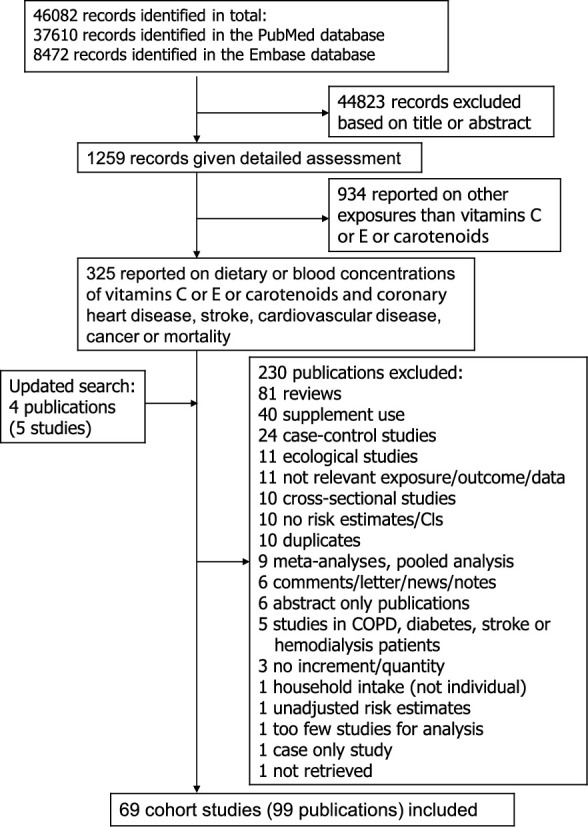
We searched PubMed and Embase up to 14 February 2018. Summary RRs and 95% CIs were calculated with the use of random-effects models.
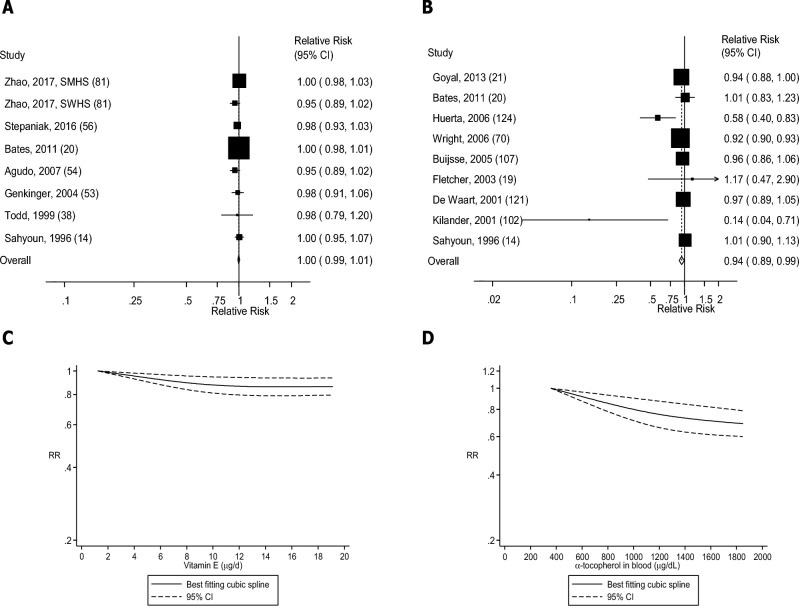
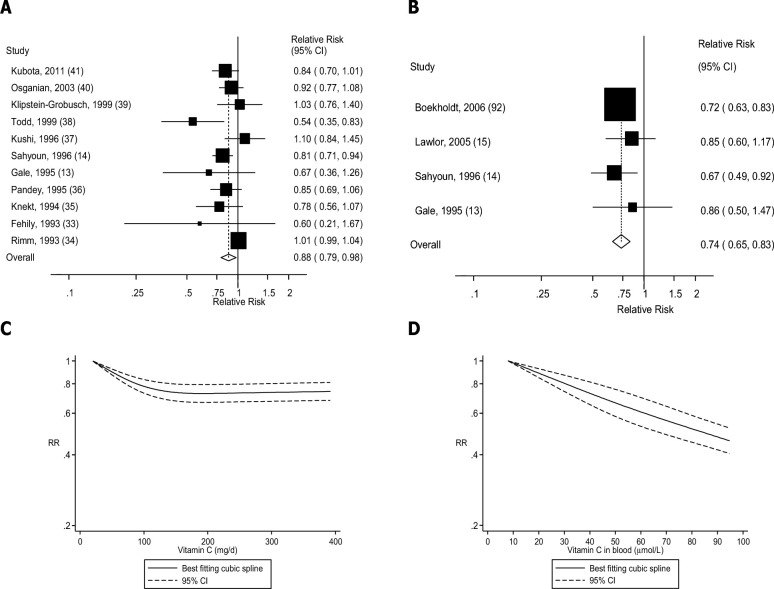
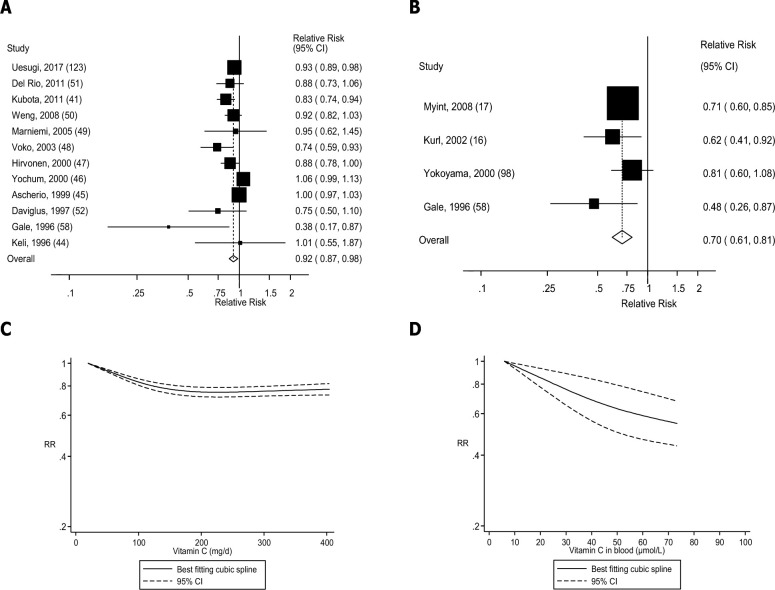
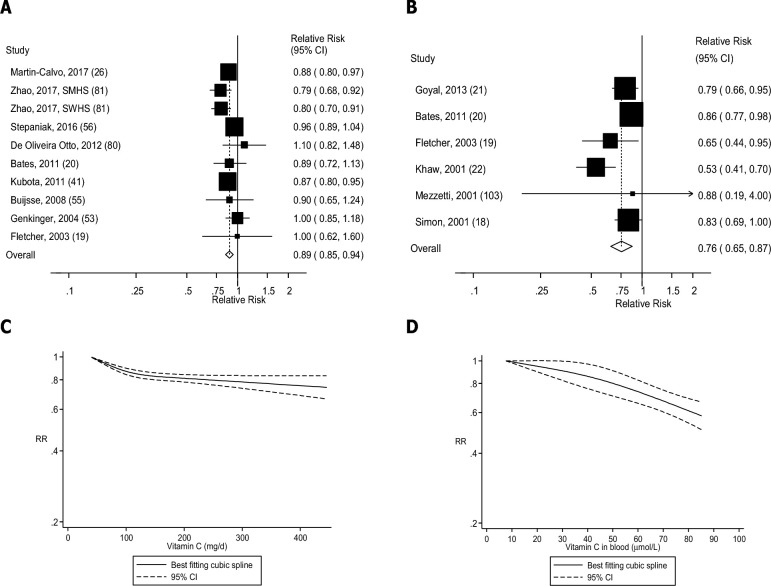
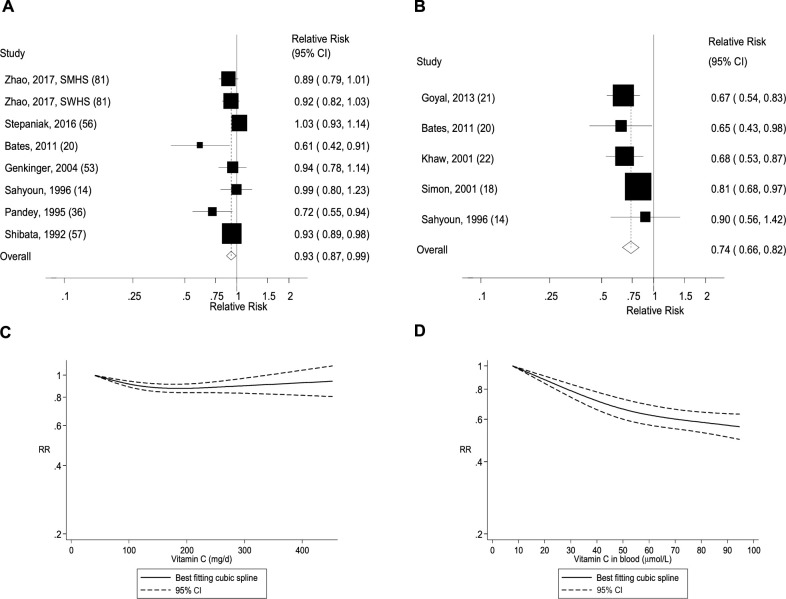
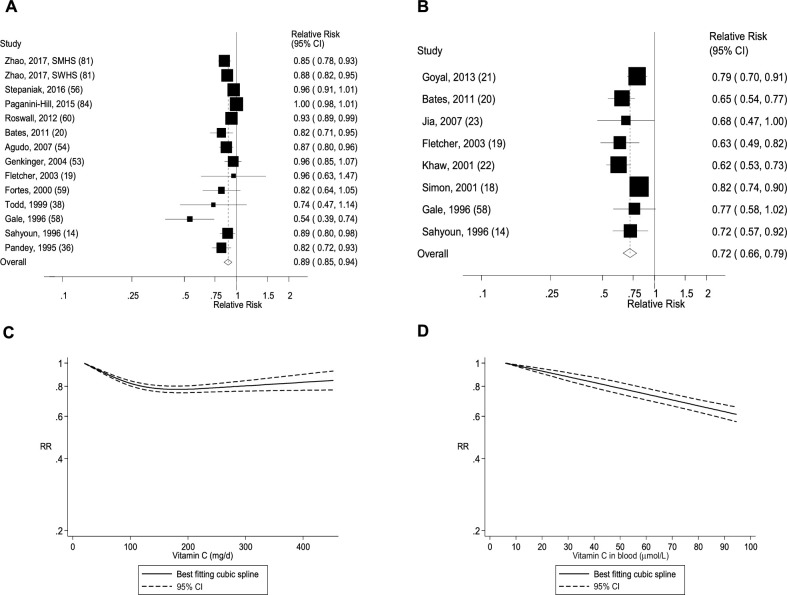
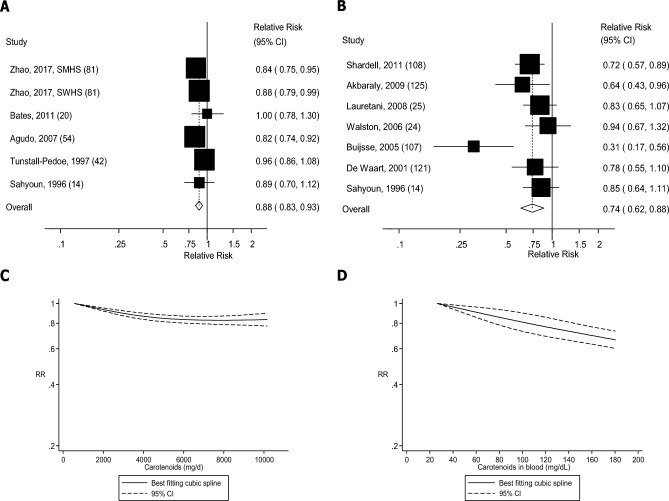
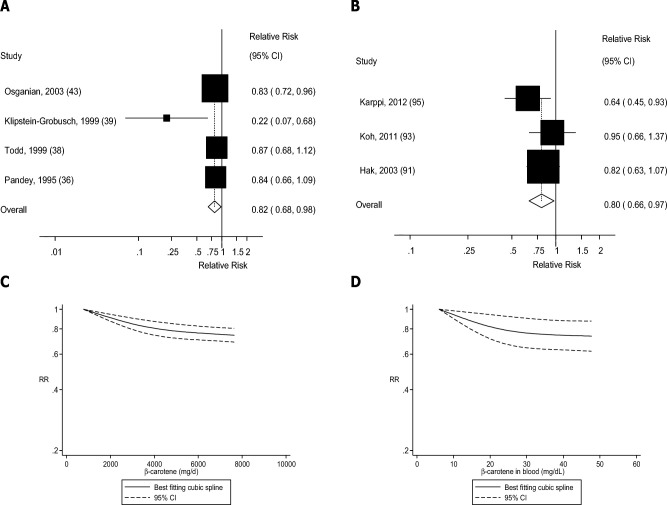
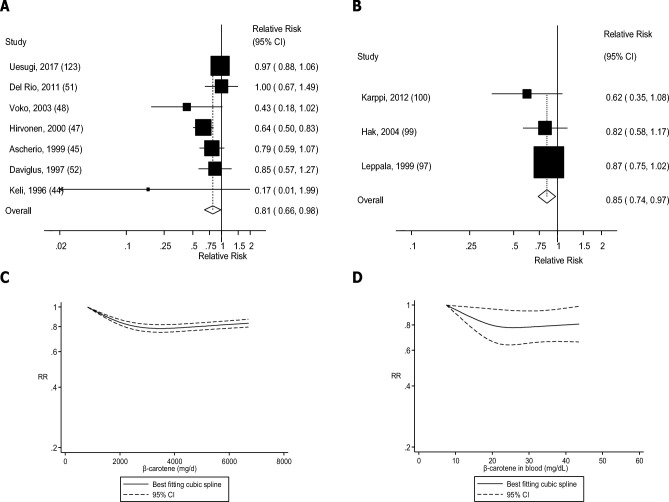
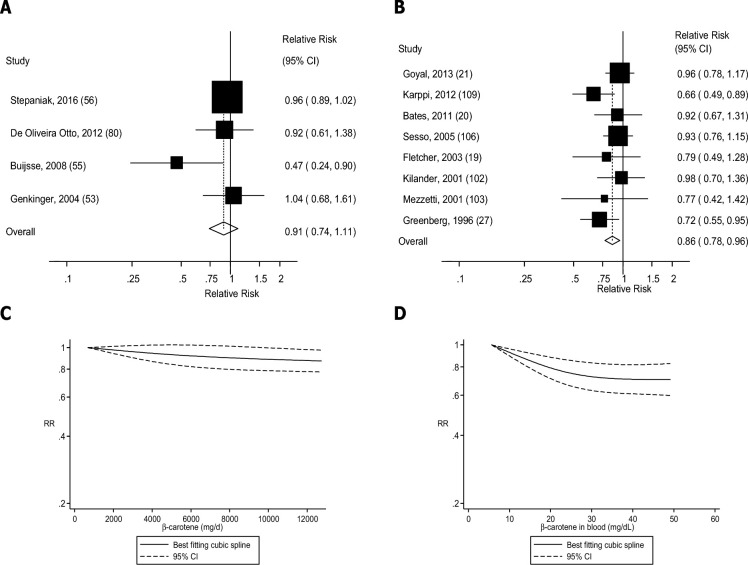
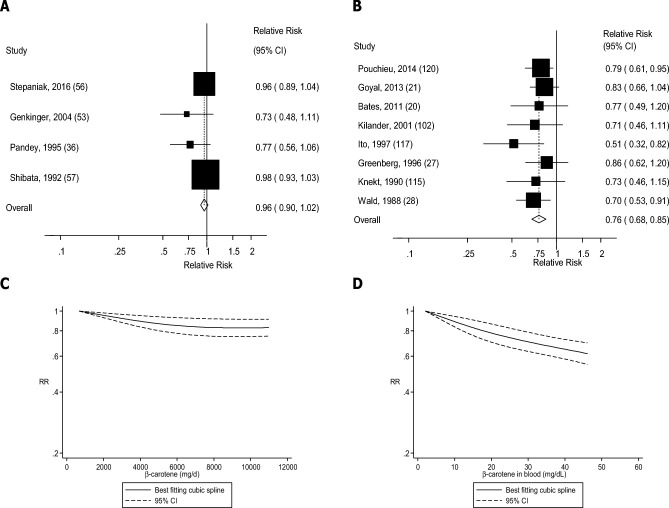
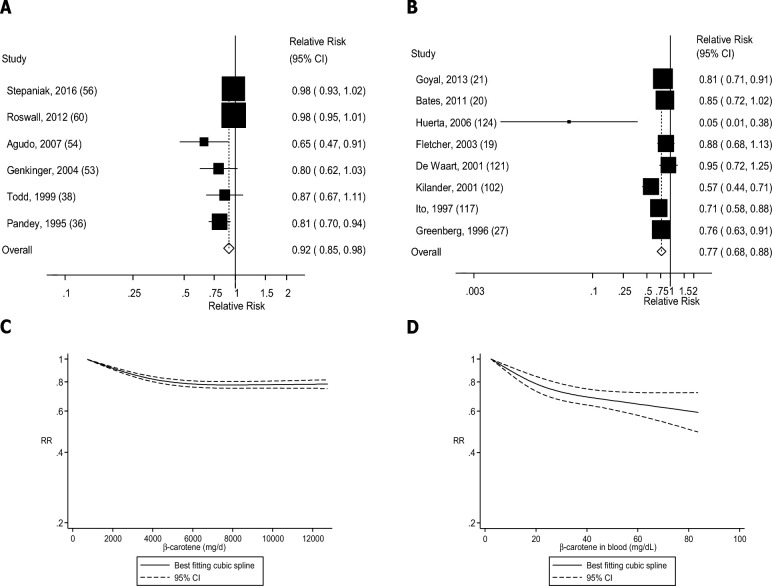
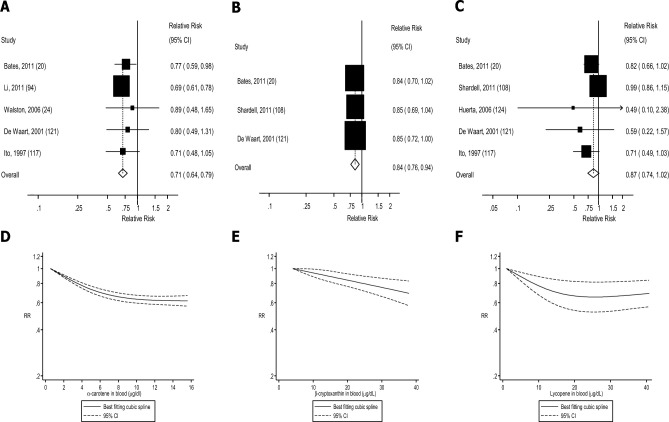
Sixty-nine prospective studies (99 publications) were included. The summary RR per 100-mg/d increment of dietary vitamin C intake was 0.88 (95% CI: 0.79, 0.98, I2 = 65%, n = 11) for coronary heart disease, 0.92 (95% CI: 0.87, 0.98, I2 = 68%, n = 12) for stroke, 0.89 (95% CI: 0.85, 0.94, I2 = 27%, n = 10) for cardiovascular disease, 0.93 (95% CI: 0.87, 0.99, I2 = 46%, n = 8) for total cancer, and 0.89 (95% CI: 0.85, 0.94, I2 = 80%, n = 14) for all-cause mortality. Corresponding RRs per 50-μmol/L increase in blood concentrations of vitamin C were 0.74 (95% CI: 0.65, 0.83, I2 = 0%, n = 4), 0.70 (95% CI: 0.61, 0.81, I2 = 0%, n = 4), 0.76 (95% CI: 0.65, 0.87, I2 = 56%, n = 6), 0.74 (95% CI: 0.66, 0.82, I2 = 0%, n = 5), and 0.72 (95% CI: 0.66, 0.79, I2 = 0%, n = 8). Dietary intake and/or blood concentrations of carotenoids (total, β-carotene, α-carotene, β-cryptoxanthin, lycopene) and α-tocopherol, but not dietary vitamin E, were similarly inversely associated with coronary heart disease, stroke, cardiovascular disease, cancer, and/or all-cause mortality.
Higher dietary intake and/or blood concentrations of vitamin C, carotenoids, and α-tocopherol (as markers of fruit and vegetable intake) were associated with reduced risk of cardiovascular disease, total cancer, and all-cause mortality. These results support recommendations to increase fruit and vegetable intake, but not antioxidant supplement use, for chronic disease prevention.
高膳食摄入量或血液浓度(作为膳食摄入量的生物标志物)的维生素 C、类胡萝卜素和维生素 E 与降低心血管疾病、癌症和死亡率的风险有关,但这些关联尚未得到系统评估。
我们对前瞻性研究进行了系统回顾和荟萃分析,评估了维生素 C、类胡萝卜素和维生素 E 的膳食摄入量和血液浓度与这些结局的关系。
我们检索了 PubMed 和 Embase 数据库,截至 2018 年 2 月 14 日。使用随机效应模型计算汇总相对风险(RR)和 95%置信区间(CI)。
纳入了 69 项前瞻性研究(99 篇文献)。每增加 100mg/d 的膳食维生素 C 摄入量,冠心病的汇总 RR 为 0.88(95%CI:0.79,0.98,I2=65%,n=11),中风为 0.92(95%CI:0.87,0.98,I2=68%,n=12),心血管疾病为 0.89(95%CI:0.85,0.94,I2=27%,n=10),总癌症为 0.93(95%CI:0.87,0.99,I2=46%,n=8),全因死亡率为 0.89(95%CI:0.85,0.94,I2=80%,n=14)。血液中维生素 C 浓度每增加 50-μmol/L,相应的 RR 为 0.74(95%CI:0.65,0.83,I2=0%,n=4)、0.70(95%CI:0.61,0.81,I2=0%,n=4)、0.76(95%CI:0.65,0.87,I2=56%,n=6)、0.74(95%CI:0.66,0.82,I2=0%,n=5)和 0.72(95%CI:0.66,0.79,I2=0%,n=8)。类胡萝卜素(总类、β-胡萝卜素、α-胡萝卜素、β-隐黄质、番茄红素)和α-生育酚(维生素 E 的一种形式)的膳食摄入量和/或血液浓度与冠心病、中风、心血管疾病、癌症和/或全因死亡率呈负相关,但维生素 E 不是。
较高的膳食摄入量和/或血液浓度的维生素 C、类胡萝卜素和α-生育酚(作为水果和蔬菜摄入量的标志物)与降低心血管疾病、总癌症和全因死亡率的风险有关。这些结果支持增加水果和蔬菜摄入量、而非抗氧化剂补充剂的使用来预防慢性病的建议。