Department of Preventive Medicine and Public Health, University of Navarra, 31008 Pamplona, Navarra, Spain.
IdiSNA, Navarra Institute for Health Research, 31008 Pamplona, Navarra, Spain.
Nutrients. 2017 Aug 29;9(9):954. doi: 10.3390/nu9090954.
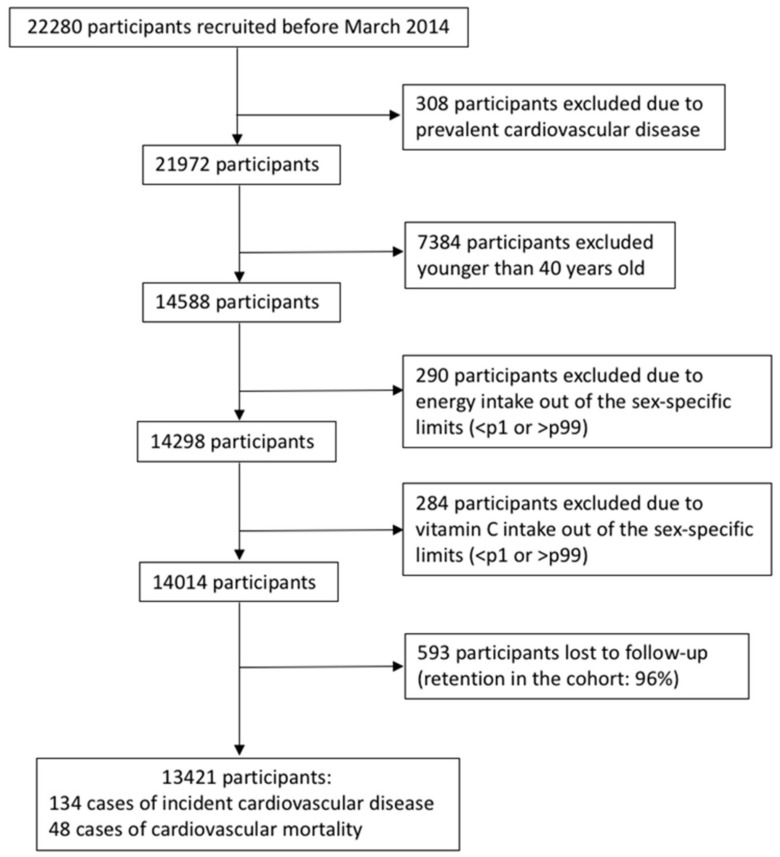
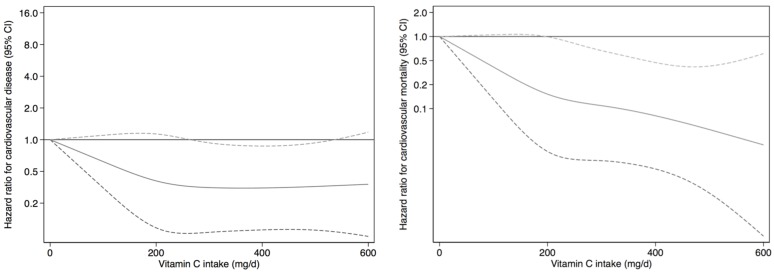
Observational studies have found a protective effect of vitamin C on cardiovascular health. However, results are inconsistent, and residual confounding by fiber might be present. The aim of this study was to assess the association of vitamin C with the incidence of cardiovascular disease (CVD) and cardiovascular mortality (CVM) while accounting for fiber intake and adherence to the Mediterranean dietary pattern. We followed up 13,421 participants in the Seguimiento Universidad de Navarra (University of Navarra follow-up) (SUN) cohort for a mean time of 11 years. Information was collected at baseline and every two years through mailed questionnaires. Diet was assessed with a validated semi-quantitative food frequency questionnaire. Incident CVD was defined as incident fatal or non-fatal myocardial infarction, fatal or non-fatal stroke, or death due to any cardiovascular cause. CVM was defined as death due to cardiovascular causes. Events were confirmed by physicians in the study team after revision of medical records. Cox proportional hazard models were fitted to assess the associations of (a) energy-adjusted and (b) fiber-adjusted vitamin C intake with CVD and CVM. We found energy-adjusted vitamin C was inversely associated with CVD and CVM after adjusting for several confounding factors, including fiber from foods other than fruits and vegetables, and adherence to the Mediterranean dietary pattern. On the other hand, when vitamin C was adjusted for total fiber intake using the residuals method, we found a significant inverse association with CVM (HR (95% confidence interval (CI)) for the third tertile compared to the first tertile, 0.30 (0.12-0.72), but not with CVD in the fully adjusted model.
观察性研究发现维生素 C 对心血管健康具有保护作用。然而,结果并不一致,并且可能存在纤维的残留混杂。本研究旨在评估维生素 C 与心血管疾病(CVD)和心血管死亡率(CVM)的发生率之间的关联,同时考虑纤维摄入量和对地中海饮食模式的依从性。我们对 13421 名参加纳瓦拉大学随访研究(SUN)队列的参与者进行了平均 11 年的随访。基线和每两年通过邮寄问卷收集信息。饮食使用经过验证的半定量食物频率问卷进行评估。新发 CVD 定义为致命或非致命性心肌梗死、致命或非致命性中风或任何心血管原因导致的死亡。CVM 定义为心血管原因导致的死亡。研究团队的医生在查阅病历后确认了事件。使用 Cox 比例风险模型评估(a)能量调整和(b)纤维调整后的维生素 C 摄入量与 CVD 和 CVM 的相关性。我们发现,在调整了其他几种混杂因素后,包括来自水果和蔬菜以外食物的纤维和对地中海饮食模式的依从性,能量调整后的维生素 C 与 CVD 和 CVM 呈负相关。另一方面,当使用残差法将维生素 C 调整为总纤维摄入量时,我们发现与 CVM 呈显著负相关(与第一三分位相比,第三三分位的 HR(95%置信区间(CI))为 0.30(0.12-0.72),但在完全调整模型中与 CVD 无关。